Nautilus (NAUT): Early Customers Validate Product; Commercial Upside Hinges on Scale and Contracting
Nautilus Biotechnology operates a capital‑intensive platform business that sells instruments and consumables while capturing recurring value through software subscriptions and service plans. Today the company monetizes primarily through an Early Access Program that combines field-run service offerings and validated assays (notably a Tau proteoforms assay), with the commercial model designed to transition into instrument sales, reagent consumables, and SaaS analytics as adoption scales. For investors, the critical questions are timing of instrument rollouts, conversion of early‑access engagements into repeat consumable and software revenue, and customer concentration during this pilot phase. Learn more at https://nullexposure.com/.
Why the customer list matters now: commercial validation in the field
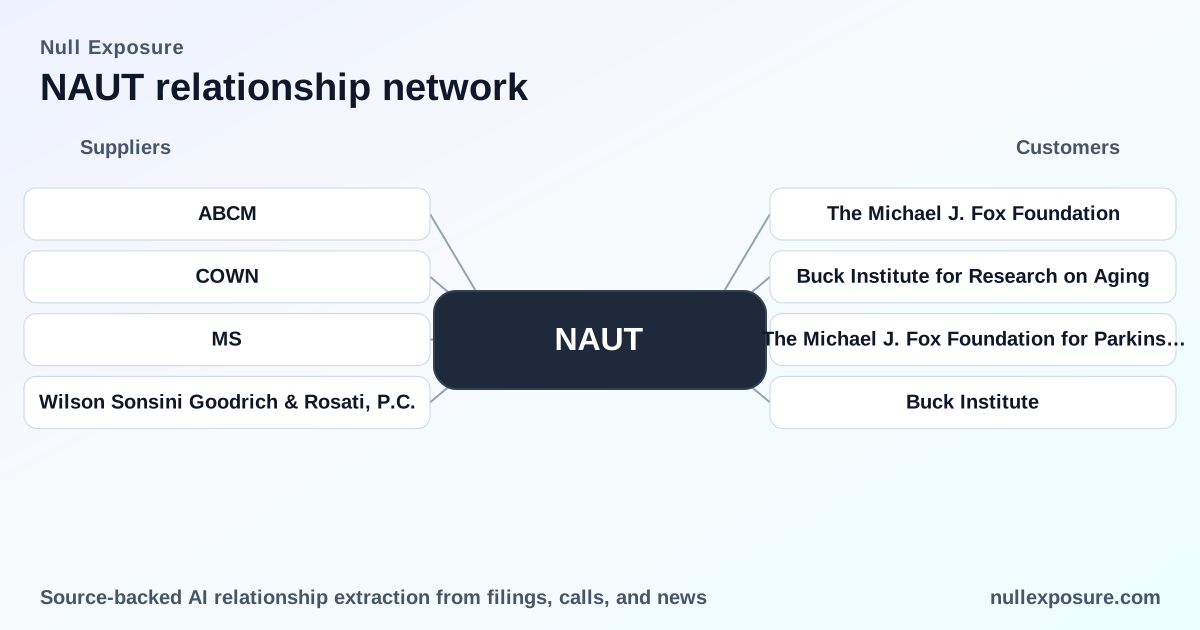
Nautilus’ public customer disclosures in early 2026 show targeted adoption by respected academic and research organizations and grant-funded collaborations that lend scientific credibility to the Voyager platform and assay portfolio. These early wins validate technical performance in neurodegeneration and oncology use cases and set the stage for a typical life‑science hardware playbook: instrument placement → consumable consumption → software/subscription capture.
- Commercial posture: Nautilus is running a service-led Early Access Program as it ramps instrument deployments and prepares to sell systems and consumables at scale.
- Customer profile: Early counterparties are academic, non‑profit, and large research institutions rather than broad commercial biotech customers today.
- Revenue outlook: Management emphasizes that early program receipts are not expected to be material in the near term while market expansion and direct commercialization proceed.
Who is on the roster today (what each relationship shows)
Baylor College of Medicine
Baylor is named as the first customer of Nautilus’ Iterative Mapping Early Access Program, participating in an NIH‑funded cancer study that leverages Nautilus’ validated Tau proteoform assay under the Early Access framework. This represents a strategic reference customer for clinical‑research and translational programs. Source: Nautilus press releases and Q1 2026 reporting (GlobeNewswire and company Q1 release, March–April 2026).
Buck Institute for Research on Aging (listed also as Buck Institute)
The Buck Institute is operating one of the company’s earliest externally deployed instruments, using the Tau Proteoforms assay to map hundreds of distinct tau proteoform groups across brain regions, which provides independent, field‑level validation of assay reproducibility and biological insight generation. Source: Nautilus press materials and multi‑outlet coverage (GlobeNewswire / Biospace / Markets Insider, Jan–Mar 2026).
The Michael J. Fox Foundation (listed also as The Michael J. Fox Foundation for Parkinson’s Research)
Nautilus disclosed grant funding from the Michael J. Fox Foundation to support development of an alpha‑synuclein proteoform assay, with approximately $1.2–$1.6 million of support and work scheduled across 2026–2027; the engagement couples external research funding with Nautilus’ platform development. Source: Management remarks and related press coverage (earnings call transcript and Yahoo Finance coverage, March 2026).
How the disclosed constraints define the business model and near‑term risk
Nautilus’ public disclosures provide measurable signals about operating design and risk profile. Present these as company‑level characteristics rather than relationship attributes unless explicitly tied to a counterparty in a disclosure.
- Contracting posture: subscription + consumables + service — Management outlines a three‑part value capture: sale of instruments and reagent consumables, a SaaS analytics and insights subscription, and a service warranty/support plan. This indicates a hybrid hardware‑plus‑recurring revenue model that targets higher lifetime value per installation.
- Customer mix: large enterprise and non‑profit heavy in early phases — Guidance positions early customers across academia, large pharma, and non‑profit research organizations; customer concentration toward sophisticated research institutions is a deliberate, lower‑volume commercialization strategy.
- Geographic expansion intent: North America first, then APAC and EMEA — Nautilus plans to commercialize directly in the U.S. initially and to expand internationally, which implies staged market entry and execution risk in distribution and regulatory support.
- Role during pilot: Nautilus as service provider — Early Access is delivered as a Nautilus‑run service using prototype systems; the company retains operational control in the pilot phase, delaying full instrument handoff and consumable monetization until after validation.
- Relationship maturity: pilot / early access — Disclosures describe a limited release and pre‑sales phase; commercial revenue remains immature, so short‑term financials will continue to reflect development‑stage dynamics.
- Materiality: early engagements are immaterial today — Management explicitly notes these activities are not expected to generate material revenue in the foreseeable future, which frames near‑term valuation drivers as optionality on future scale.
- Product segmentation: hardware + software — Nautilus’ go‑to‑market is anchored in instrument sales and consumables, with software subscriptions positioned as the long‑term margin and data‑monetization layer.
Investment implications and how to monitor progress
Nautilus’ early customers deliver scientific validation and reference use cases in neurodegeneration and oncology, but the company is still in the transition from proof‑of‑concept to repeatable commercial engine. For investors and operators evaluating NAUT:
- Monitor the cadence of instrument sales outside Nautilus‑run services and the first true recurring consumable orders tied to customer installations.
- Track contract types and lengths when instruments shift to customer sites; multi‑year service or SaaS commitments materially de‑risk revenue visibility.
- Watch international commercialization steps into APAC and EMEA as indicators of scalable distribution capability.
- Use customer announcements from large, NIH‑funded studies (for example, Baylor) and foundation grants (such as Michael J. Fox Foundation support) as signals that assay demand is research‑led and durable.
For deeper briefings on customer signaling and commercial traction, visit https://nullexposure.com/ for ongoing updates.
Bottom line
Nautilus has achieved meaningful early validation with high‑quality research partners, which supports the technical claims of the Voyager platform and associated assays. Commercial upside depends on converting service pilots into installed systems and recurring consumable and subscription revenue, and investors should prioritize evidence of that conversion when assessing NAUT’s path to sustainable revenue.