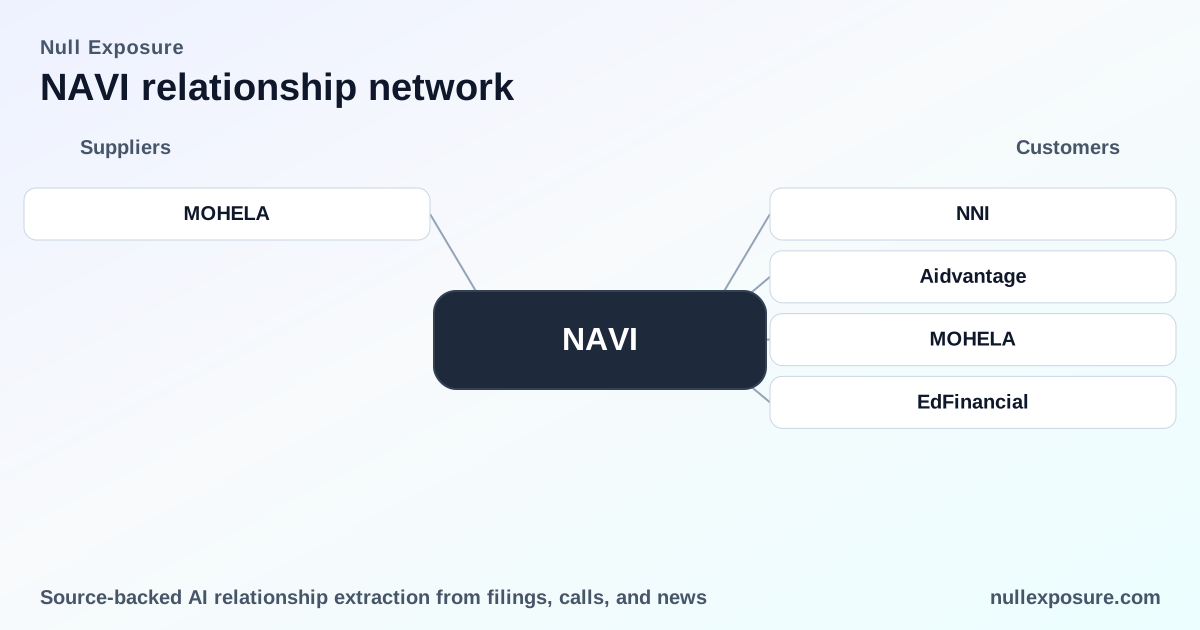
Navient (NAVI): Customer relationships that define the servicing exit and recurring fee profile
Investor thesis — Navient operates as a technology-enabled education finance company that earns recurring, usage-linked fees from loan servicing and private education lending and has transitioned away from government business processing following asset sales in 2024–2025. The company monetizes through servicing fees, asset recovery and private loan origination, with revenue heavily concentrated in U.S. education loans and a contract mix that is predominantly long-term but billed on a usage basis.
Explore the relationship map and signal-backed summaries at https://nullexposure.com/ for a faster view of how counterparties influence NAVI’s risk profile.
How Navient makes money and why customers matter
Navient’s primary economic engine is servicing and related business processing for education loan portfolios and originations of private education loans through brands such as Earnest. The company receives variable, usage-based revenue as it executes servicing, collections and related transactions, yet those engagements are typically under longer-term contractual horizons because loans amortize over many years. Navient’s counterparty base splits between government clients (historical) and retail/individual borrowers, and a meaningful portion of revenue flows from asset recovery and collection activity tied to borrower behavior and regulatory outcomes.
Constraints that shape the operating model (company-level signals)
- Contracting posture: Navient generates most revenue under long-term contractual arrangements (contracts that span more than a year), while recognizing revenue on a usage basis tied to monthly billings and per-transaction performance. This creates durable franchise economics but with variable near-term cashflow.
- Counterparty concentration: The company historically served both government entities and individual borrowers, with a notable legacy relationship with federal student loan programs. That mix creates regulatory sensitivity on one hand and retail credit exposure on the other.
- Geography & market: Operations are U.S.-centric — domestic education finance is the addressable market.
- Role & segment: Navient functions both as a seller (private loan originations) and as a service provider (loan servicing, collections, business processing). The services segment is core to the revenue base.
- Relationship maturity: The company has terminated its government and healthcare business processing lines via divestitures in 2024–2025, while a large share of education loan relationships remain active and in repayment.
- Commercial criticality: Servicing contracts are high-friction to transfer and therefore commercially important, but regulatory or enforcement actions can alter counterparty composition rapidly.
These characteristics drive a business that is stable at the contract level but volatile at the revenue recognition level, and that remains sensitive to regulatory adjudication and asset transfers.
Customer relationship snapshots investors should know
SLM Student Loan Trust 2006-5
Navient acts as administrator for trust structures tied to securitized student loans; a May 3, 2026 Investing.com note reported that SLM Student Loan Trust 2006-5, administered by Navient Solutions, LLC, prepared a preliminary remarketing memorandum for reset-rate notes, underscoring Navient’s continued operational role in trust administration. (Investing.com, May 3, 2026 — https://www.investing.com/news/company-news/navient-corp-stock-hits-52week-low-at-1052-93CH-4470850)
Department of Education
Navient historically serviced more than 6 million federal student loan accounts under contract with the Department of Education, a fact cited in settlement discussions and news coverage; that legacy relationship is instrumental in shaping regulatory exposure and settlement obligations. (Yahoo Finance / UK, May 3, 2026 — https://uk.finance.yahoo.com/news/navient-student-loan-settlement-payments-004220886.html)
SLM (Sallie Mae spin-out)
Navient originated as the servicing arm spun from Sallie Mae (SLM) and continues to be referenced in market commentary as the education loan servicer that manages federal and private student loans and provides business processing solutions, highlighting the firm’s historical positioning and operating DNA. (TradingView, May 3, 2026 — https://www.tradingview.com/news/stockstory:d0c9517e4094b:0-q4-earnings-highlights-sallie-mae-nasdaq-slm-vs-the-rest-of-the-consumer-finance-stocks/)
Nelnet (NNI)
Following Navient’s exit from federal loan servicing, some accounts were transferred to servicers including Nelnet, illustrating the post-exit distribution of federal servicing portfolios and the competitive universe of successor servicers. (Economic Times, March 10, 2026 — https://m.economictimes.com/news/international/us/navient-settlement-checks-are-going-out-see-which-student-loan-borrowers-qualify/articleshow/128848471.cms)
NNI (ticker reference for Nelnet)
Market coverage treating Nelnet by its ticker NNI reaffirms the same transition: accounts moved to Nelnet (NNI) among other servicers after Navient’s federal servicing exit. This confirms investor focus on successor servicers and their role in absorbing transferred relationships. (Economic Times, March 10, 2026 — https://m.economictimes.com/news/international/us/navient-settlement-checks-are-going-out-see-which-student-loan-borrowers-qualify/articleshow/128848471.cms)
MOHELA
MOHELA is listed among the successor servicers that received accounts after Navient’s federal servicing exit, underscoring the fragmentation of the federal servicing book and the operational complexity of borrower transfers. (Economic Times, March 10, 2026 — https://m.economictimes.com/news/international/us/navient-settlement-checks-are-going-out-see-which-student-loan-borrowers-qualify/articleshow/128848471.cms)
Aidvantage
Aidvantage is another servicer that absorbed accounts post-exit, reinforcing the industry pattern where multiple servicers share the successor burden and the associated integration and migration risks. (Economic Times, March 10, 2026 — https://m.economictimes.com/news/international/us/navient-settlement-checks-are-going-out-see-which-student-loan-borrowers-qualify/articleshow/128848471.cms)
EdFinancial
EdFinancial also received accounts transferred from Navient, highlighting the dispersal of customer relationships across smaller and mid-sized servicers in the U.S. market. (Economic Times, March 10, 2026 — https://m.economictimes.com/news/international/us/navient-settlement-checks-are-going-out-see-which-student-loan-borrowers-qualify/articleshow/128848471.cms)
If you want an interactive relationship map and deeper signal-backed summaries, visit https://nullexposure.com/.
What this means for investors and operators
- Revenue durability with variable cashflow: Long-term contracts underpin a durable book, but usage-based billing makes near-term revenue sensitive to borrower activity and regulatory outcomes.
- Regulatory concentration risk: Historical ties to the Department of Education and the visibility of settlement-related transfers make regulatory enforcement and reputational factors a persistent valuation risk.
- Operational transition risk: The sale of government and healthcare processing units in 2024–2025 reduces legacy exposure but concentrates the company on servicing and private lending, altering counterparty concentration and margin dynamics.
- Counterparty fragmentation opportunity and threat: Transfers to Nelnet, MOHELA, Aidvantage and EdFinancial show both the market’s absorptive capacity and the operational friction that can generate one-off costs or opportunities for third-party vendors.
Bottom line
Navient is a service-led, U.S.-centric education finance company with revenue that is contractually long-term yet operationally usage-driven. Customer relationships—whether trust administration, federal servicing legacy ties, or transfers to successor servicers—are the primary vectors for earnings volatility and regulatory risk. Investors should weigh durable contractual footing against the ongoing sensitivity to borrower behavior and policy outcomes.
For a concise, signal-driven map of Navient’s counterparty landscape, see https://nullexposure.com/.