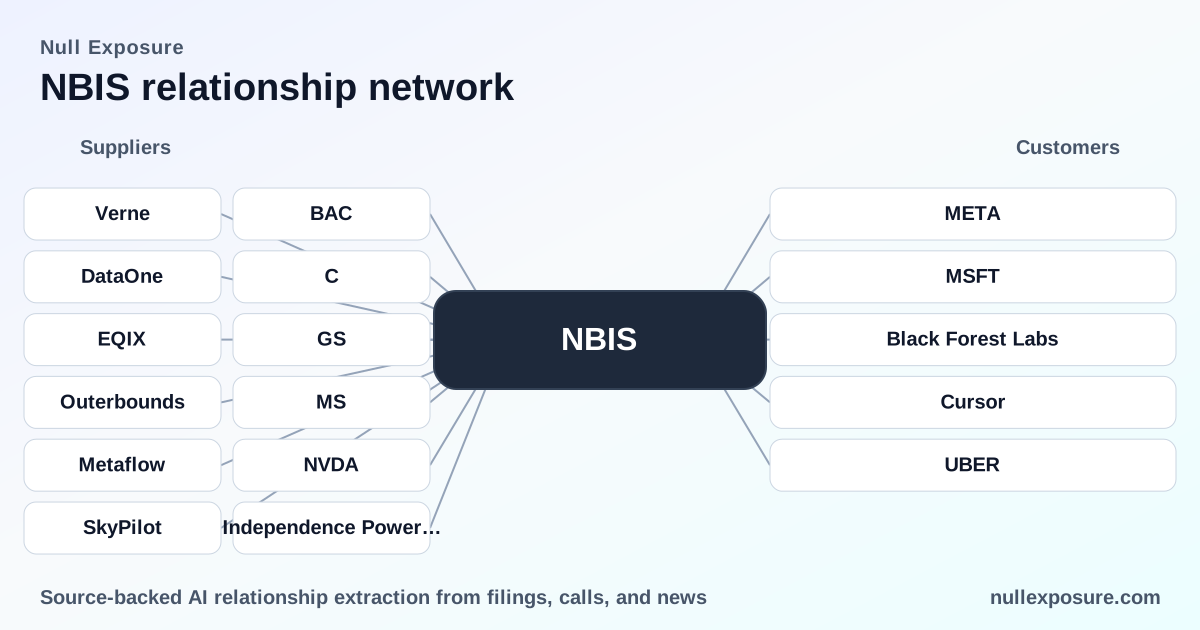
Nebius Group (NBIS): The customer map behind the AI-infrastructure growth story
Nebius monetizes by selling dedicated AI compute and cloud capacity and related software tools to large enterprise customers and selected startups, converting multi-year capacity contracts and upfront customer financing into capital to fund rapid infrastructure buildout. The company’s revenue model is driven by a small number of very large, multi‑year contracts that supply dedicated GPU-heavy capacity, plus ancillary software and tooling that deepen customer lock‑in. For an investor, the core thesis is simple: Nebius is scaling as a wholesale AI‑infrastructure provider whose valuation and cash flow profile now hinge on delivery against a handful of highly material customer commitments. Learn more at Null Exposure.
Why customer relationships matter more than headline metrics
Nebius’ reported financials show rapid revenue growth alongside negative operating cash flow and heavy capex; customer contracts that prepay or commit capacity materially change capital requirements and underwriting. The operating model is not a broad retail cloud franchise—Nebius sells large, bespoke capacity packages and adjacent software to very large buyers and prioritized early adopters. That concentration compresses upside if executions succeed and amplifies downside if delivery or contract timing slips.
What the deal list looks like — every relationship in the record
Below I cover each customer relationship referenced in the collected reporting. Each entry is a plain-English, 1–2 sentence summary with a compact source callout.
-
Microsoft (MSFT) — Nebius signed a multi‑year agreement to deliver dedicated AI infrastructure capacity to Microsoft, reported as a five‑year deal initially valued at about $17.4 billion with options to expand the commitment toward $19.4 billion; reporting describes dedicated capacity from a new Vineland, NJ data center starting in 2025. According to Reuters coverage aggregated in December 2025 and multiple March 2026 updates, this contract is the central driver of Nebius’ growth narrative and investor interest (Reuters / ts2.tech, Sept–Dec 2025; SahmCapital, Feb–Mar 2026).
-
Meta Platforms (META) — Nebius disclosed a five‑year agreement to supply AI infrastructure to Meta, reported at roughly $3 billion initially and later discussed in some outlets as potentially expanding to a much larger framework (up to $27 billion in some summaries of long‑term optionality). Reuters and subsequent market writeups have placed this Meta contract alongside the Microsoft deal as another cornerstone customer commitment (Reuters / ts2.tech, Nov 2025; SahmCapital, Mar 2026).
-
Black Forest Labs — Identified as one of Nebius’ smaller, early customers competing with Big Tech demand, Black Forest Labs is cited by market coverage as a startup waiting for allocated compute capacity from Nebius amid high demand. Reporting positions Black Forest Labs as illustrative of Nebius’ two‑tiered customer base (SahmCapital, Nov 2025).
-
Cursor — Cursor is named alongside other startups in coverage describing high demand from smaller customers that are being rationed against large enterprise commitments; Nebius’ capacity constraints have forced prioritization decisions. This underscores Nebius’ product scarcity and the prioritization of large strategic deals (SahmCapital, Nov 2025).
-
RoboForce — RoboForce appears in reports as an early user of Nebius’ platform, benefiting from faster development cycles when using Nebius’ compute and tooling for robotics and perception workloads. This is presented as validation that Nebius’ stack serves not only hyperscalers but also specialized enterprise users (SahmCapital, Mar 17, 2026).
-
Voxel51 — Voxel51 is listed with RoboForce as an early adopter that reports productivity improvements on Nebius’ platform, reinforcing the company’s value proposition beyond raw capacity to include tooling and data workflow benefits (SahmCapital, Mar 17, 2026).
-
TD SYNNEX (SNX) — Coverage notes TD SYNNEX expanding its AI Infrastructure-as-a-Service portfolio with dedicated NVIDIA HGX clusters on Nebius’ AI Cloud, positioning TD SYNNEX as a channel or partner that routes enterprise demand to Nebius capacity. This relationship signals distribution reach into enterprise procurement channels (SahmCapital / April 2026 summary).
-
Uber (UBER) — Nebius’ autonomous vehicle unit Avride went live with robotaxi rides on Uber in Dallas, a customer‑facing deployment that demonstrates commercial usage of Nebius’ autonomous‑vehicle stack and related infrastructure services. This is an early revenue and product‑validation example outside pure cloud contracts (ts2.tech coverage, Dec 2025).
Operating model constraints and what they imply for investors
There are no itemized constraint excerpts in the collected relationship data; at the company level the public narrative nevertheless signals several structural characteristics you must price into any valuation:
-
Contracting posture — Nebius accepts large multi‑year, dedicated‑capacity deals with significant upfront economics, which both funds capex and creates concentrated revenue streams. This posture shortens capital payback if clients prepay, but raises execution risk if capacity delivery lags.
-
Concentration risk — The business is materially concentrated: Microsoft and Meta constitute the core revenue and delivery commitments in the public narrative, creating single‑counterparty exposure that amplifies earnings volatility and operational dependency.
-
Criticality and service type — Contracts are for dedicated AI compute and infrastructure rather than commodity cloud instances; that makes Nebius a critical supplier for specific high‑value model runs and production workloads, increasing stickiness if service levels meet expectations.
-
Maturity and scaling profile — Nebius is in a heavy‑capex scaling phase: reporting highlights convertible raises and large equity offerings alongside customer financing, indicating a company moving from prototype to hyperscale execution while still absorbing operating losses and buildout risk.
These are company‑level signals derived from the deal mix and reporting; no collected constraint text tied a named relationship to specific contract clauses.
Risk‑reward and the path to durable economics
Upside: If Nebius executes on capacity delivery, the Microsoft and Meta contracts transform the company into a high‑margin, high‑utilization infrastructure supplier with embedded recurring revenue and potential for upward scope expansion via software add‑ons. Downside: Execution shortfalls, delayed data‑center approvals, or changes in hyperscaler procurement priorities would rapidly compress the valuation given concentration and current negative operating margins—market coverage already flags capex nerves and investor sensitivity to timing.
Bottom line and next step
Nebius’ customer map is both the company’s growth engine and its single biggest risk vector. For investors and operators evaluating NBIS relationships, the key diligence items are delivery milestones, contract payment profiles, and the company’s ability to scale channel partnerships (e.g., TD SYNNEX) while servicing both hyperscalers and high‑value enterprise adopters.
For a structured deep‑dive on counterparties and contract timelines, see more company‑level intelligence at Null Exposure.