Neurocrine Biosciences (NBIX): customer relationships that move the P&L
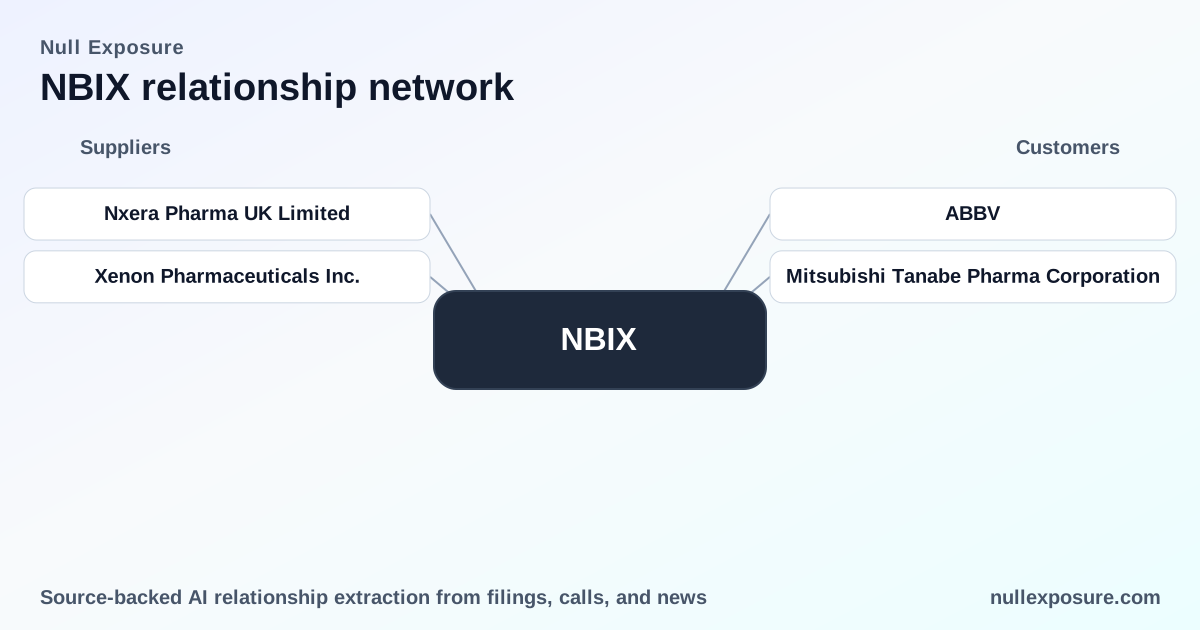
Neurocrine Biosciences monetizes through a hybrid commercial model: it develops and sells proprietary therapeutics in the U.S. market while also collecting royalties from global partners that commercialize Neurocrine-originated molecules outside its direct sales footprint. The company’s revenue base is dominated by mature franchise sales (INGREZZA) and expanding launch revenues (CRENESSITY), complemented by royalty streams from strategic partners such as AbbVie and Mitsubishi Tanabe that directly contribute to reported top-line and margin stability.
How Neurocrine’s customers and partners drive revenue
Neurocrine’s operating model combines direct-to-market commercial selling with partner licensing. The company acts as a seller for U.S.-sold products and relies on specialty pharmacy and wholesale distributor networks to move product across the supply chain. At the same time, strategic licensing agreements generate royalty income on partner sales internationally and on non-licensed indications.
- Contracting posture: Neurocrine sells INGREZZA exclusively in the U.S. through a limited specialty network and launched CRENESSITY in the U.S. in December 2024, demonstrating a direct-commercial posture domestically while outsourcing or licensing international commercialization. Company filings confirm this U.S.-focused distribution approach.
- Concentration and criticality: INGREZZA remains the revenue engine—net product sales were reported at $2.51 billion for 2025—so customer and payer concentration has a material impact on Neurocrine’s results. The company itself warns that the majority of current revenue is derived from federal healthcare programs, which introduces critical payor risk.
- Maturity profile: Product maturity is mixed: INGREZZA is a mature, high-revenue franchise, while CRENESSITY is in a ramping phase after a December 2024 launch with $301.2 million in 2025 sales in its first full year.
- Channel roles: Filings list customers as specialty pharmacies, wholesale distributors, and specialty distributors, indicating reliance on third-party intermediaries for U.S. dispensing and channel execution.
For a concise customer mapping and further coverage, visit the Null Exposure homepage: https://nullexposure.com/
Partners and counterparties identified in public reporting
Neurocrine’s public reporting and market commentary call out a small set of financially meaningful partner relationships. Below I cover every partner observed in the sourced results and summarize their commercial role in plain English.
AbbVie (ABBV)
AbbVie pays royalties to Neurocrine on U.S. sales of elagolix-based products for endometriosis and uterine fibroids; those royalty payments contribute to Neurocrine’s top line. According to a Zacks preview carried by TradingView on March 10, 2026, AbbVie is specifically cited as a royalty-paying partner on elagolix-based products in the U.S. (https://www.tradingview.com/news/zacks:8ffe42aec094b:0-neurocrine-biosciences-to-report-q4-earnings-what-s-in-the-cards/). Key takeaway: AbbVie provides a recurring royalty stream that supplements product sales revenue.
Mitsubishi Tanabe Pharma Corporation
Mitsubishi Tanabe Pharma generates international sales of valbenazine (marketed as Dysval/Remleas outside the U.S.), and Neurocrine collects royalties on those international sales. This relationship is cited in market commentary on March 10, 2026 (Finviz and TradingView summaries reference Mitsubishi Tanabe’s role in international commercialization of valbenazine; see https://finviz.com/news/301570/neurocrine-biosciences-to-report-q4-earnings-whats-in-the-cards and https://www.tradingview.com/news/zacks:8ffe42aec094b:0-neurocrine-biosciences-to-report-q4-earnings-what-s-in-the-cards/). Key takeaway: Mitsubishi Tanabe extends Neurocrine’s international reach while converting foreign commercialization into royalty revenue.
What these relationships mean for investors
These partnerships diversify Neurocrine’s revenue profile beyond direct U.S. sales, but the structure introduces several analytically relevant dynamics:
- Revenue diversification with limited operational exposure. Royalties from AbbVie and Mitsubishi Tanabe provide cash flow without requiring Neurocrine to underwrite global commercialization costs, improving capital efficiency and margins on those revenue streams.
- Payer and channel concentration remains the dominant risk. Company disclosures identify federal healthcare programs (Medicare/Medicaid) as a major revenue source and point to specialty distributors and pharmacies as primary customers. That concentration elevates pricing and reimbursement risk across Neurocrine’s core franchises.
- Product lifecycle asymmetry. INGREZZA drives steady, material cash flow as a mature franchise, while CRENESSITY is in a growth/ramping phase; this lowers short-term volatility from launch dynamics but maintains longer-term exposure to adoption curves, formulary decisions, and payor coverage.
- Geographic strategy: Neurocrine’s sales footprint is primarily North America for its direct commercial business; international scale is largely achieved through licensing partners such as Mitsubishi Tanabe, which reduces fixed-cost exposure but creates dependence on partner execution for global upside.
Operational constraints and contract posture (company-level signals)
Company filings and public excerpts provide several operational signals investors should treat at the corporate level:
- Government entities are frequently involved outside the U.S. as clinical investigators, prescribers, and purchasers, which introduces public-sector counterparty dynamics for clinical development and international sales.
- Neurocrine sells key products exclusively in the U.S. through a limited specialty network, reinforcing a tight domestic distribution footprint and reliance on specialty channels.
- The company explicitly flags that federal cost-containment measures could materially impair revenue generation and commercialization, establishing the government/payor channel as a critical vulnerability.
- Relationship roles in filings—seller, distributor, and service provider—confirm that Neurocrine leverages third-party distribution and specialty pharmacy partners rather than vertically integrating global commercialization.
For a deeper look at Neurocrine’s customer maps and partner analytics, see Null Exposure: https://nullexposure.com/
Bottom line for operators and investors
Neurocrine combines a high-margin, U.S.-centric commercial engine with royalty streams from global partners to create a hybrid revenue model that balances direct sales risk and partner execution risk. AbbVie and Mitsubishi Tanabe are straightforward revenue enhancers: royalties that support margins without incremental commercial expense. The company’s key risks are not partner execution but rather payor concentration, federal reimbursement policy, and the reliance on specialty distribution channels. For investors valuing predictability and margin quality, Neurocrine’s partner royalties are constructive; for those focused on reimbursement politics and channel concentration, the company’s exposure to federal programs requires careful monitoring.