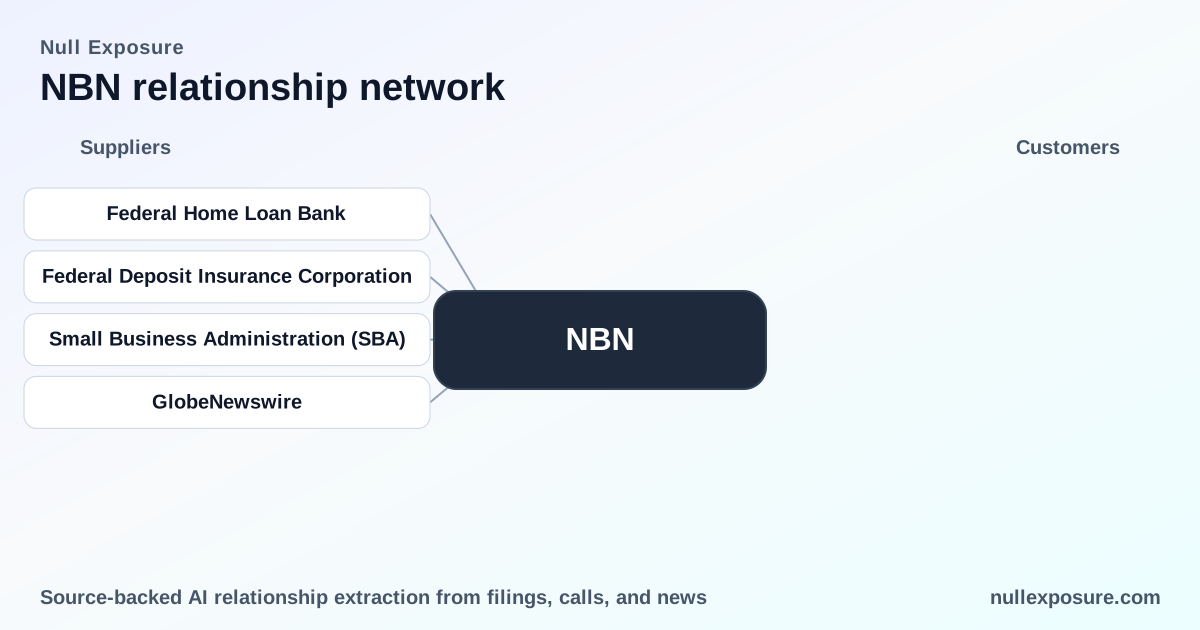
Northeast Bancorp (NBN): Customer relationships that drive lending income
Northeast Bancorp operates as a regional bank out of Portland, Maine, monetizing through interest-bearing loan portfolios, deposit spreads, and fee income from commercial and consumer banking lines. The customer relationships disclosed in public reporting show direct lending and warehouse-facility activity with structured-finance counterparties, confirming that a portion of Northeast’s revenue is generated by financing vehicles and collateralized loan structures rather than only retail deposits. For deeper diligence on counterparties and underwriting posture visit https://nullexposure.com/.
Why these customer links matter to investors
Northeast’s balance sheet economics revolve around net interest margin and credit performance. Loan agreements and creditor advances to finance trusts and warehouse vehicles are higher-yield, relationship-driven exposures that contribute to NII and noninterest fee income, but they also concentrate credit and operational risk in specialty counterparties. The two customer relationships captured in public reporting point to the bank’s active role in supporting structured finance transactions—a predictable source of revenue when underwriting and collateral management remain disciplined.
What the reporting shows about contracting posture and maturity
No explicit contractual terms (covenants, exclusivity, maturities) were captured in the material reviewed, which is a company-level signal: contract visibility is limited in public excerpts, so investors should assume standard commercial loan documentation unless direct agreements are available in filings. From the types of counterparties listed, the contracting posture is consistent with short- to medium-term, balance-sheet-backed lending and warehouse facility structures where advances are repaid as securitizations close or as assets refinance. This positions Northeast as a transactional counterparty rather than a long-term strategic owner of CLO equity positions.
Relationship: Lument Finance Trust (LFT)
Northeast Bank provided a committed loan facility that allows Lument Finance Trust up to $50 million in advances to finance portions of its investment portfolio, reflecting a direct credit relationship with an externally managed finance trust. According to an earnings-call transcript published on InsiderMonkey in May 2026, Lument disclosed the new loan agreement with Northeast Bank for that $50 million advance facility (FY2026 reporting).
Implication: This facility produces interest income and fee opportunities for Northeast, and it ties bank performance to the credit profile and asset-turnover of a publicly managed finance trust.
Relationship: Lcmt Npl Warehouse, LLC
MarketScreener’s reporting referenced a December 16 filing in which Lcmt Npl Warehouse, LLC entered into a loan agreement with Northeast Bank in connection with a commercial real-estate CLO (LMNT CRE 2025-FL3), indicating warehouse financing tied to CRE collateral that feeds into a securitization. MarketScreener reported the transaction details in its FY2026 coverage.
Implication: Warehouse lending to CRE-originating entities is a classic regional-bank product that generates spread but concentrates exposure to real-estate cycle dynamics and the securitization market’s appetite for CRE paper.
Constraints and what they imply for the business model
The dataset did not include explicit constraint excerpts such as detailed covenants, exclusivity clauses, or collateral descriptions. As a company-level signal, the absence of captured constraints limits visibility into counterparty protections and termination risk, so underwriters and investors should prioritize obtaining full loan documents or supplemental disclosures when assessing exposure size and recovery mechanics.
From the business-model perspective this limited constraint visibility suggests:
- Contracting posture: Relationship lending and warehouse facilities typical of regional banks, likely governed by standard commercial loan agreements.
- Concentration: Publicly disclosed relationships are with structured-finance and warehouse entities rather than retail customers, indicating pockets of concentration in the bank’s commercial lending book.
- Criticality: These facilities are revenue-relevant—they drive NII while also tying performance to counterparties’ ability to securitize or monetize assets.
- Maturity: The instruments are likely short-to-mid tenor, aligned with funding and securitization cycles, but explicit maturities are not disclosed in the excerpts.
Risk profile investors should monitor
The customer links highlight four practical risk vectors for Northeast Bancorp investors:
- Credit risk from finance trusts and warehouse vehicles, which can amplify stress during securitization or CRE market dislocation.
- Collateral and recovery uncertainty if loan documents and perfection steps are not transparent.
- Concentration risk if structured-finance lending comprises a material share of the commercial loan book.
- Market-cycle sensitivity tied to securitization appetite and CRE valuations.
To evaluate these risks, investors should review loan-level disclosures, provision coverage, and the bank’s segmentation of commercial versus retail credit exposure in quarterly filings.
Bottom line: what this means for an investor
Northeast Bank’s public relationship disclosures show targeted lending into structured-finance channels—specifically a $50 million advance facility to a finance trust and warehouse lending to an NPL/CLO vehicle—which supports margin expansion but increases exposure to securitization and CRE cycles. For investors, the revenue upside from these facilities is clear, but the absence of detailed contractual constraints in available reporting means underwriting quality and collateral protections remain the central questions for valuation and risk modeling.
For ongoing monitoring of Northeast’s counterparty profile and to access relational analytics, consult https://nullexposure.com/ for source-linked summaries and follow-up diligence.