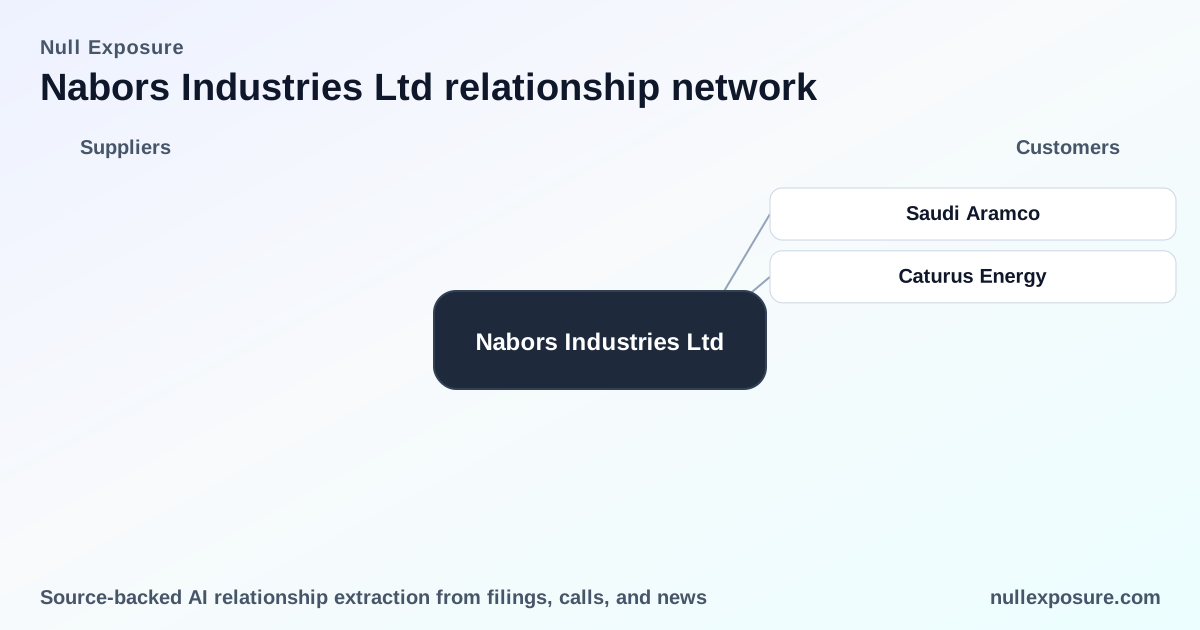
Nabors Industries (NBR): Customer relationships that drive visibility — and concentration risk
Nabors Industries operates and monetizes a global drilling services and rig-equipment business by contracting rigs, specialized drilling services and engineered rig components to oil and gas operators worldwide. Revenue converts through a mix of long-term drilling contracts, equipment sales and service agreements — with a material share of consolidated revenues concentrated in a few large customers and national oil companies. Learn more about how we surface counterparty intelligence at https://nullexposure.com/.
Why the customer map matters for investors
Nabors’ commercial model blends fleet contracting with technology-led services. That creates three investable characteristics: contracting posture that favors long-term and prioritized allocations, customer concentration that materially influences earnings visibility, and geographic exposure to Middle East, Latin America and North American basins. Company disclosures note operations in over 20 countries and that one customer accounted for roughly 30% of consolidated operating revenues in 2025, while the three largest drilling customers contributed about 41% of revenue that year, underpinning both earnings leverage and counterparty concentration. These are company-level signals drawn from Nabors’ filings and investor communications.
- Contracting posture: Nabors sells both time-and-materials drilling services and multi-year contracts; its Rig Technologies unit also sells manufactured components. Company filings describe rigs and rig-related equipment operated under contracts with state-owned energy companies (NOCs) and a trade-receivable book that management views as concentrated among financially substantial counterparties.
- Concentration and criticality: A single customer representing roughly 30% of revenue and the top three representing ~41% creates a material dependency profile that investors must model explicitly.
- Geographic exposure and maturity: With a marketed U.S. fleet and major international operations in the Middle East and Latin America, Nabors combines mature North American cash-generating operations with higher-scale international NOC relationships.
If you want a compact, visual view of these commercial relationships, visit https://nullexposure.com/ for our structured intelligence and trackable signals.
Relationship-by-relationship: recent coverage and what it tells investors
PEMEX — settled large receivables in Mexico; working capital positive signal
Nabors reported a sizable portion of its 2024 receivables in Mexico were settled by PEMEX in Q4, and payments for 2025 services have been timely, improving short-term working capital dynamics. This was highlighted in a TradingView/Zacks write-up dated May 3, 2026. (TradingView / Zacks, 2026-05-03)
Saudi Aramco (SANAD JV referenced) — SANAD JV central to international growth
Multiple sources emphasize that Nabors’ international expansion relies heavily on the SANAD joint venture with Saudi Aramco, positioning the company to access prioritized rig work and capital deployment in Saudi markets. This point was explicitly noted in coverage on March 10, 2026. (Bitget News, 2026-03-10)
Catus — operating unit active in South Texas
Nabors continues to operate at least one unit for Catus in South Texas, confirming active land-rig deployment and revenue generation in core U.S. basins. This detail was disclosed in an earnings-call transcript summarizing Q1 2026 remarks. (Investing.com transcript, 2026-05-03)
Caturus Energy — PACE‑X Ultra rig on location in Texas
A PACE‑X Ultra rig (Rig X33) from Nabors was documented on location in Live Oak County, Texas, working for Caturus Energy, reinforcing Nabors’ product-to-customer execution on high-spec land rigs. The equipment placement appeared in an industry technology and innovation piece on March 10, 2026. (EPMag, 2026-03-10)
Saudi Aramco (earnings-call context) — operator priorities influence allocation
During a Q1 2026 earnings call, commentary about Aramco’s internal prioritization—favoring operators focused on oil and gas drilling over workover work—indicates customer-side allocation dynamics that affect Nabors’ contract mix and bidding outcomes for high-priority programs. This nuance was captured in the Q1 2026 transcript. (Investing.com transcript, 2026-05-03)
Aramco (investor commentary) — closer ties and long-term contracts underpin visibility
Investor write-ups in April–May 2026 highlighted closer ties with Aramco, international rig reactivations and longer-term contracts as the principal supports for Nabors’ earnings visibility, implying durable revenue streams if SANAD and related contracts scale as discussed. (SimplyWall.St, 2026-05-03)
Aramco (additional market commentary) — analysts flag Aramco relationship as a core support
Independent market commentary repeated the same theme: Aramco relationships and long-term international contracts are central to expectations for sustained international revenue growth and earnings stability. This perspective appeared in commentary from Sahm Capital in mid-April 2026. (Sahm Capital, 2026-04-17)
What the evidence collectively implies for investors
- Revenue visibility is driven by a small set of large customers and NOC partnerships. Company-level disclosures confirm material concentration: one customer ~30% of revenue and three customers ~41% of revenue in recent years, which amplifies upside when counterparties accelerate work and heightens downside if awards slow.
- Working capital and receivables are active levers. The PEMEX receivable settlement in Q4 2024 improved liquidity and validates operational cash collection on large NOC contracts.
- SANAD and Aramco access are strategic growth multipliers. Multiple independent reports cite the SANAD JV as central to international reactivation plans; that implies Nabors’ overseas fleet reactivations and long-term contracts will be a critical driver of mid‑cycle earnings.
- Geographic diversification is real but skewed. Nabors is global — active in North America, Latin America and the Middle East — which reduces single-market risk but concentrates exposure to NOCs and major national programs in EMEA and LATAM.
Investment considerations and key risks
- Upside: Reactivations, SANAD scale with Aramco, and predictable contract renewals translate into high incremental margins and strong EBITDA leverage given the company’s capital-light rental/service economics for certain assets.
- Downside: Concentration risk (one customer ≈30%) and dependence on large NOC payments create path-sensitive outcomes for cash flow and valuation multiples; contract re-awards and working-capital timing are primary value swing factors.
- Operational maturity: Nabors combines mature U.S. land operations with international growth platforms and an equipment-manufacturing arm, signaling a hybrid business model that can both sell rig components and operate fleets.
Final takeaway
Nabors’ customer relationships are the core valuation engine: concentrated, strategically tied to major NOCs (notably through SANAD/Aramco), and capable of delivering step-changes in cash flow when reactivations and large contract settlements occur. Investors must model both the upside of large, prioritized awards and the asymmetric downside that stems from customer concentration and NOC payment dynamics.
For a concise dashboard of counterparties and real-time relationship signals, see our coverage at https://nullexposure.com/.