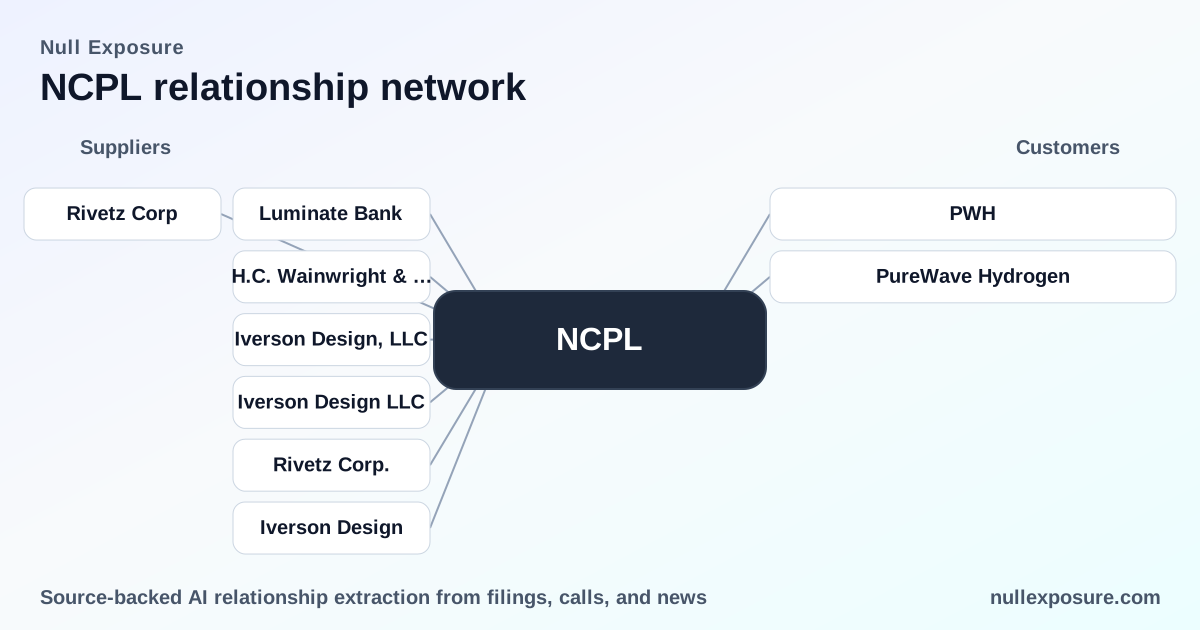
Netcapital Inc (NCPL): Customer Relationships and What They Mean for Investors
Netcapital Inc operates a regulated online funding portal and a boutique advisory arm that helps private companies raise capital from accredited and non‑accredited investors. The company monetizes through upfront listing fees, usage‑based success fees on capital raised (4.9% on cash proceeds plus a standardized $5,000 listing charge), and a 1% equity success fee introduced in recent years, while its advisory arm provides marketing and strategic services for cash fees. These revenue levers position Netcapital as a fee‑for‑service fintech intermediary that is now pursuing tokenization as a new revenue channel. For more background on platform dynamics and research on issuer relationships, visit https://nullexposure.com/.
Executive takeaway: a fee business with concentrated customers and a push into tokenization
Netcapital’s economics are transactional and usage‑driven, which makes revenue scalable but sensitive to deal flow and the size of individual raises. Revenue concentration is material (one customer accounted for ~20% of revenue in FY2025), contract tenors are short, and spend per issuer historically sits in the low‑to‑mid five‑digit range — all of which frame both upside (high margin on each successful placement) and downside (volatility if deal flow slows). The firm’s move into real‑asset tokenization signals a strategic attempt to broaden fees beyond traditional funding‑portal slices.
How Netcapital is structured and how that shapes customer economics
Netcapital’s customer relationships carry several company‑level characteristics that shape revenue predictability and risk:
- Usage-based contracting: Issuers pay listing and success fees tied to capital raised (e.g., $5,000 listing fee, 4.9% portal fee on cash proceeds, and a 1% equity fee introduced in fiscal 2024–2025). This creates direct revenue alignment with platform activity and volume.
- Short contract duration: Contracts are typically one year or less, so the company relies on continual new issuers and repeat business rather than long‑term retainers.
- Customer type and spend: The platform serves both individual investors and private issuers; issuer spend per engagement historically sits sub‑$100k on the equity fee examples provided, implying many engagements are modest in absolute dollars even when fees are percentage‑based.
- Material concentration: The company reported one customer representing ~20% of revenue for FY2025 and a second at ~11%, which is a notable concentration risk for a small public company.
- Service mix: Netcapital blends its funding portal with consulting/marketing services (Netcapital Advisors), so its revenue mix is a hybrid of platform fees and bespoke services.
These characteristics imply a highly variable top line that is closely correlated to new issuer throughput and the average size of raises, while tokenization initiatives are intended to introduce higher‑value, potentially recurring revenue streams.
Client relationships: who Netcapital is working with (direct evidence)
Below I cover each customer relationship reported in the public record and the supporting source.
EnergyX — growth capital raised on Netcapital’s funding portal
EnergyX raised $4.5 million in growth capital through Netcapital’s funding portal, demonstrating Netcapital’s continued role as a capital‑raising channel for early‑stage growth companies. This transaction was reported by Fintech Futures on May 3, 2026. (Fintech Futures, May 3, 2026 — https://www.fintechfutures.com/press-releases/netcapital-success-story-energyx-receives-450-million-private-equity-commitment-in-support-of-future-ipo-plans)
PureWave Hydrogen (PWH) — Netcapital’s first tokenized asset client
PureWave Hydrogen is documented as Netcapital’s inaugural tokenization client: Netcapital structured a securities‑based tokenization of hydrogen‑drilling assets on the Mid‑Continent Kansas shelf, marking the company’s public launch into real‑asset tokenization and a potential new fee stream. Multiple press outlets covered the engagement, including Crowdfund Insider (January 2026) and IndexBox / The Globe and Mail reporting in March 2026. (Crowdfund Insider, Jan 2026 — https://www.crowdfundinsider.com/2026/01/257342-netcapital-announces-first-tokenized-offering-as-markets-shift-to-digital-securities/; The Globe and Mail / IndexBox, Mar 10, 2026 — https://www.theglobeandmail.com/investing/markets/stocks/NCPLW/pressreleases/36996550/netcapital-to-tokenize-hydrogen-drilling-assets/ and https://www.indexbox.io/blog/netcapital-partners-with-purewave-hydrogen-for-first-asset-tokenization-deal/)
(Note: the public record shows multiple press placements and syndication of this announcement across outlets in early 2026 that consistently describe PureWave as the first tokenization engagement.)
Why these relationships matter to investors
EnergyX illustrates Netcapital’s core funding portal business in action: when deal flow includes larger raises (multiple millions), Netcapital’s percentage and listing fees translate into meaningful revenue per engagement. By contrast, the company’s historical examples of 1% equity fees ranging from low hundreds to tens of thousands of dollars show the broad dispersion of issuer economics.
PureWave Hydrogen is strategically significant: tokenization is explicitly positioned as an expansion into real‑world asset services. If Netcapital converts tokenization from pilot to repeatable product, it can capture higher‑value structuring and advisory fees and benefit from potential ongoing servicing revenues tied to tokenized assets.
Both relationships underscore two simultaneous realities: the company’s base business is transactional and episodic, while tokenization offers a pathway to more differentiated, higher‑margin engagements.
Investment implications: risks, optionality, and what to watch
- Concentration risk is real. A handful of clients drove a material proportion of FY2025 revenue; any loss or non‑recurrence of those engagements would compress reported revenue quickly.
- Revenue is highly correlated with deal flow and ticket size. Usage‑based fees mean Netcapital scales with issuer success, but also that revenue declines when the market for raises softens.
- Short contract terms limit visibility. With typical contracts of a year or less, backlog and renewal rates will be crucial metrics for forecasting.
- Tokenization is a strategic optionality. The PureWave engagement is an important proof point, but execution risk remains around converting one‑off tokenizations into a repeatable, margin‑accretive product line.
- Unit economics tilt toward sub‑$100k fee outcomes for many issuers. That forces the company to pursue volume, higher‑value deals, or value‑added services to improve overall margins.
Investors should monitor issuer throughput, average raise size, frequency of advisory mandates, tokenization pipeline (number of deals, structuring fees), and client concentration trends.
For a deeper dive into Netcapital’s customer dynamics and how we source and interpret issuer evidence, see our research hub at https://nullexposure.com/.
Final read: where value might come from
Netcapital’s current valuation and operating metrics reflect a small, fee‑oriented fintech with meaningful revenue concentration and short‑term contract dynamics. The PureWave tokenization engagement introduces a credible route to diversify and increase average fee per client, while deals such as EnergyX validate the platform’s ability to handle multi‑million dollar raises. Netcapital’s upside depends on scaling transaction volume, closing higher‑value tokenization engagements, and reducing concentration risk; downside is driven by deal‑flow volatility and the short‑term nature of customer contracts.