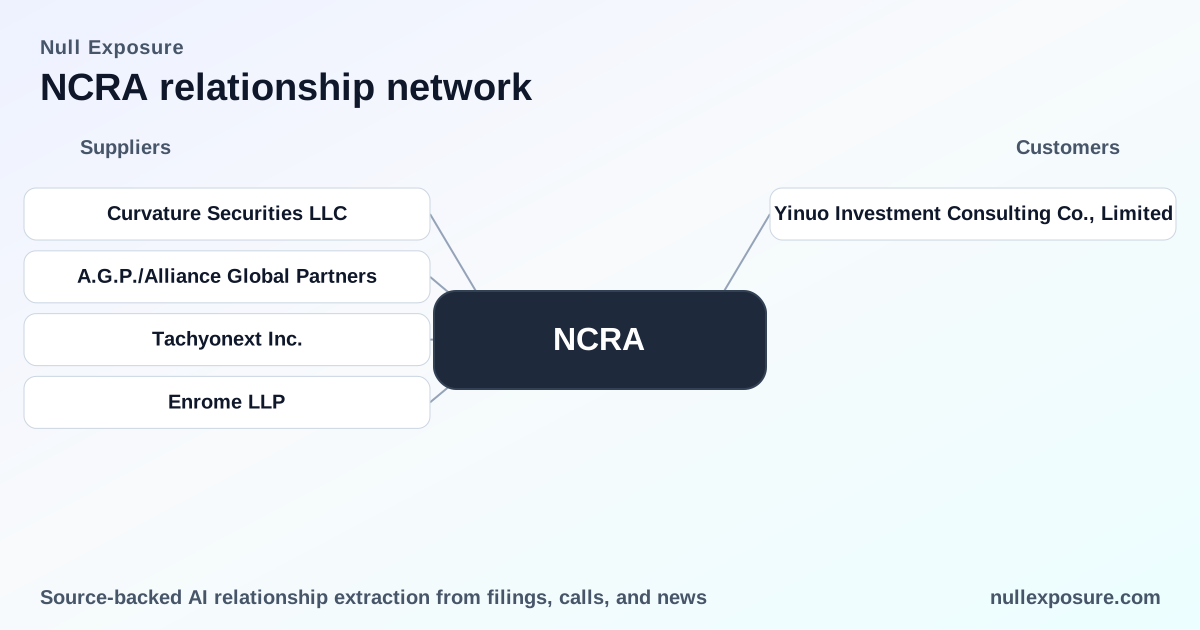
Nocera (NCRA) — Customer Relationships, Concentration Risks, and the Meixin Divestiture
Thesis: Nocera, Inc. designs, manufactures and sells land-based recirculating aquaculture systems (RAS) and related services, and it monetizes through point-of-sale equipment and project contracts, recurring maintenance warranties and exclusive agency licensing fees, plus commissions from live-commerce distribution. Revenue combines one-time equipment sales, multi-year warranty/service streams and licensing arrangements, producing a mixed cash flow profile with substantial customer concentration. For a concise portal to the underlying documents, visit https://nullexposure.com/.
Business model and how Nocera generates cash Nocera’s core product is large-scale RAS equipment and turnkey project services for fish farms; the company also trades fish (primarily eels), operates food processing lines and provides consulting and project-management services. Monetization occurs at three layers: upfront equipment recognition (point-in-time on delivery), ratable revenue from multi-year maintenance warranties and exclusive sales agency licenses, and net commission revenue from acting as a facilitator on third-party e-commerce sales. The company’s financial profile shows modest revenue (approximately $11.0M TTM) and negative operating leverage (negative EBITDA and profit margin), which amplifies the impact of high customer concentration on cash flow and working capital needs.
Why the Meixin sale matters to investors Nocera completed a material corporate action in late 2025, selling a controlling stake in a subsidiary, which changes the company’s exposure to certain project revenues and potentially frees up liquidity. The divestiture is both a strategic de-risking step and a liquidity event. For investors tracking counterparty relationships, the buyer — Yinuo Investment Consulting — becomes a relevant counterparty in Nocera’s transaction history and ownership changes.
Customer relationship breakdown (complete) This section covers every customer relationship callout in the searchable results for NCRA.
- Yinuo Investment Consulting Co., Limited — Nocera sold 80% of its equity interest in Meixin Institutional Food Development Co., Ltd. to Yinuo Investment Consulting for a purchase price of $420,000 under an Equity Transfer Agreement executed December 1, 2025; the transaction is reported in a press release available via The Globe and Mail and corroborated in SEC/filing coverage summarized by Investing.com. According to the Globe and Mail press release (filed in the company’s public notices in early 2026), the sale completed for $420,000; Investing.com’s SEC filing summary reiterated the same sale amount and closing. (Sources: company press release published via The Globe and Mail, first reported March 2026; SEC/filing coverage summarized on Investing.com, May 2026.)
Operating and contracting constraints that drive customer economics The available disclosures offer multiple signals about Nocera’s contracting posture, counterparty mix and geographic reach — all of which affect valuation and operational risk.
- Contracting posture: Nocera combines short-term transactional contracts (goods recognized at transfer of control, with typical advance payments and deferred revenue recognized within 12 months) and longer-term performance obligations (maintenance warranties that predominantly run 18 months, with some as long as 72 months). The company also issues exclusive sales agency licenses and recognizes licensing revenue ratably over the license life. These mixed contract types create both immediate cash inflows from equipment sales and multi-period revenue that requires ongoing service delivery and warranty reserves.
- Concentration and criticality: Customer concentration is very high — five customers represented roughly 81.8% of revenue in 2024, and a prior year set of four customers represented ~80.85% in 2023 — signaling single-counterparty risk and revenue volatility if any major buyer reduces orders. This is a company-level signal drawn from reported accounts receivable and revenue breakdowns.
- Counterparty profile and geography: Nocera serves a mix of individual investors, government-supported or funded companies and international customers, with the company historically focused on APAC markets (Japan, Taiwan, Thailand) and explicit plans to expand into North and South America. Geographic concentration in APAC combined with expansion ambitions into NA and LATAM influence currency, regulatory and operational execution risk.
- Role and end-to-end involvement: The company functions as manufacturer, seller and service provider, handling equipment design/manufacture, on-site installation and ongoing maintenance, while also acting as an agent for e-commerce sales where it recognizes commission revenue on a net basis when it facilitates third-party shipments. This vertical span increases operational complexity but gives multiple monetization touchpoints.
- Segment mix and revenue sensitivity: Nocera’s operations span core RAS product design and project delivery, fish trading (eel distribution), food processing and consulting/service lines. Cyclicality in fish markets, notably the eel fry shortfall cited in 2022–2023, materially compressed revenue in 2024 and underscores how commodity supply shocks translate directly into top-line volatility.
- Relationship stage and maturity: Reported sales decreased from ~$23.9M in 2023 to ~$17.01M in 2024, with TTM revenue around $11.03M and negative operating metrics (negative EBITDA and profit margins). These figures indicate an early-stage commercial cycle with cash flow stress and high insider ownership (insiders controlling ~50.7% of shares), which concentrates control but may limit outside institutional support.
Key takeaways for investors
- High counterparty concentration is the principal customer risk: a handful of buyers drive the majority of revenue, so contract renewals and single-customer disputes carry outsized influence on cash flow.
- Contract mix lengthens revenue recognition: the coexistence of immediate equipment sales with ratable warranty and licensing revenue creates predictability in service revenue but also deferred obligations that consume working capital.
- Divestitures like the Meixin sale are liquidity- and risk-management levers: the December 2025 sale to Yinuo for $420,000 reduces subsidiary exposure and is a material corporate action investors must track alongside operating performance.
- Geographic diversification is a growth vector but execution risk is material: APAC remains the core market; planned expansion into the Americas diversifies addressable markets but requires significant capital and project management capability.
For more comprehensive document-level detail and to trace the referenced filings and press releases directly, visit https://nullexposure.com/. If you want regular monitoring of NCRA customer and counterparty developments, the site provides the primary sources and curated summaries.