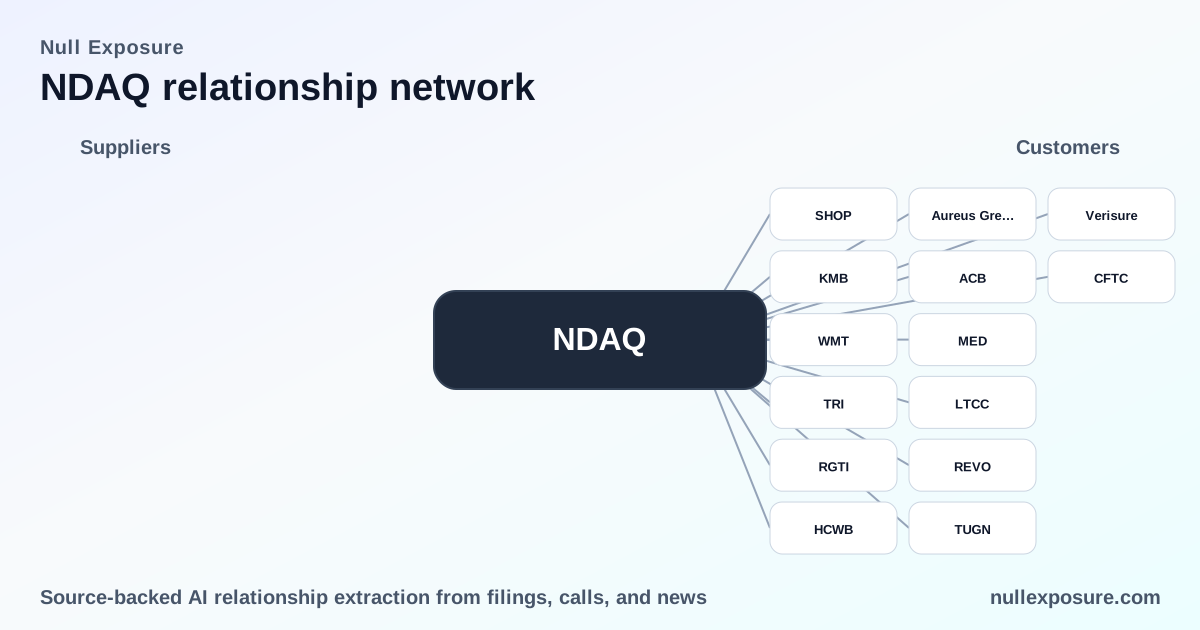
Nasdaq Inc. (NDAQ): How the exchange business monetizes access and why customer relationships matter
Nasdaq operates as a diversified market infrastructure and financial-technology platform: it runs equities and derivatives markets, sells market data and index/licensing products, provides clearing and surveillance services, and licenses software (on‑premise and cloud) to exchanges, banks and regulators. Revenue streams are transaction/spot fees, recurring subscriptions for real‑time and historical data, licensing for indices and trademarks, and multi‑year technology and professional services contracts. For investors, the critical underwriting thesis is that Nasdaq earns a blend of high‑margin, recurring data and licensing revenue plus cyclical trading fees—anchored by mission‑critical infrastructure contracts that create stickiness and scale economics (Nasdaq filings and earnings commentary, FY2025–FY2026).
If you need a systematic view of Nasdaq customer exposure, our platform provides structured relationship intelligence and primary‑source links — see the homepage for the service (https://nullexposure.com/).
What to watch: the operating and commercial constraints that shape risk and resilience
- Contracting posture: Nasdaq sells both spot/transactional services (trade execution and clearing) and multi‑year licenses/subscriptions (data, indices, Calypso platform). That mix means revenue volatility is dampened by recurring contracts while trading volume exposure remains a macro lever. (Nasdaq 10‑K and revenue mix disclosures, FY2025).
- Concentration and counterparty scale: Nasdaq serves very large enterprises (G‑SIBs, exchanges), governments and thousands of institutional customers; receivables and service relationships concentrate around major market participants. Concentration increases commercial leverage but also exposure to a handful of large counterparties. (Nasdaq client disclosures, FY2025–FY2026).
- Criticality and maturity: Several offerings are mission‑critical (exchange operations, surveillance, clearing, Calypso). Loss or disruption of these services would be critical to customers — and consequential to Nasdaq. At the same time, software and SaaS businesses present product‑risk (bugs, vulnerabilities) that Nasdaq manages through long‑term SLAs. (Nasdaq product and risk disclosures, FY2026).
- Global footprint: Nasdaq’s customer base is global (130+ marketplaces, 55+ countries), which diversifies market risk but raises regulatory and operational complexity across jurisdictions. (Nasdaq corporate overview, FY2026).
- Materiality signals: Nasdaq reports both immaterial write‑offs and material risk if trading volumes fall materially; expect trading fees to be sensitive to market structure and macro liquidity. (Nasdaq financial disclosures, FY2026).
Mid‑report note: if you’d like a tailored, downloadable list of Nasdaq counterparties with source links and contract‑type tagging, view our offering at the NullExposure homepage (https://nullexposure.com/).
Representative customer relationships (select) — plain English, primary source
Below are clear one‑ to two‑sentence summaries for a set of named relationships captured in public reports and news — each line notes the source observed in the dataset.
- AARD — Aardvark Therapeutics reports its common stock is listed on the Nasdaq Global Select Market under AARD, indicating Nasdaq is the listing venue for the issuer (S‑3 filing, observed May 2026; source: stocktitan.net/S‑3 for AARD).
- BPACR — Blueport Acquisition Ltd. separates its securities for trading on Nasdaq Capital Market under BPAC/BPACR, showing Nasdaq’s role in SPAC unit separations (press release, May 2026; source: Yahoo Finance).
- NDLS — Noodles & Company announced a 1‑for‑8 reverse split and that its shares continue trading on the Nasdaq Global Select Market under NDLS (company release, Feb 2026; source: QuiverQuant/GlobeNewswire).
- BANX — ArrowMark Financial Corp. is a closed‑end fund listed on Nasdaq Global Select as BANX; Nasdaq acts as the fund’s listing venue (press release, Jan 2026; source: GlobeNewswire).
- EMPG — Empro Group’s ordinary shares were approved for listing on the Nasdaq Capital Market (EMPG) for its IPO (press release, Jul 2025; source: GlobeNewswire).
- RYOJ — Ryoj Baba raised capital and commenced trading on the Nasdaq Capital Market under RYOJ, reflecting Nasdaq’s role for foreign issuers (news report, FY2025; source: Investing.com).
- FOFO — Hang Feng Technology Innovation’s shares began trading on Nasdaq Capital Market (FOFO) following its IPO (press release, Sep 2025; source: GlobeNewswire).
- AFJKU / AFJK — Aimei Health’s units and subsequent separation to AFJK / AFJKR took place on Nasdaq, underscoring the exchange’s SPAC/unit handling (news release, Dec 2023–2024; source: GlobeNewswire).
- VMCAU — Valuence Merger Corp. I’s units listed on Nasdaq Global Market as VMCAU, another SPAC example (IPO press release, Mar 2022; source: GlobeNewswire).
- BJDX — Bluejay Diagnostics separated its units and began trading on the Nasdaq Capital Market under BJDX, illustrating recent small‑cap listings (IPO filing, Nov 2021; source: GlobeNewswire).
- DYOR — Insight Digital Partners II listed its units and split trading on Nasdaq as DYORU/DYOR, a frequent pattern for sponsor‑led vehicles (IPO press release, Oct 2025; source: GlobeNewswire).
- TGL — Treasure Global implemented a reverse split and remained on Nasdaq Capital Market as TGL, later regaining compliance with bid‑price rules (press releases, Dec 2025–Jan 2026; source: GlobeNewswire).
- AEAQW — Activate Energy Acquisition units began trading on the Nasdaq Global Market (AEAQU) after IPO close (press release, Dec 2025; source: GlobeNewswire).
- GSBC — Great Southern Bancorp’s common stock lists on Nasdaq Global Select as GSBC, a regional bank listing example (earnings notice, Mar 2026; source: GlobeNewswire).
- TW (Tradeweb) — Nasdaq completed the sale of its U.S. fixed‑income platform NFI to Tradeweb, a strategic divestiture with Tradeweb (TW) acquiring Nasdaq’s fixed‑income business (industry report, 2021–2025 retrospective; source: Finance Magnates).
- BNC — CEA Industries’ stapled warrants and common stock actions note listings and trading on Nasdaq Capital Market under BNC/BNCWZ, reflecting structured security listings (press releases, Apr–Aug 2025–2026; sources: GlobeNewswire, QuiverQuant).
- CDT — Conduit Pharmaceuticals implemented a reverse split and continued trading on Nasdaq Capital Market as CDT (press release and market notices, Mar 2026; source: Bitget/Investing).
- BOLD — Boundless/Biotech IPOs debuted on Nasdaq Global Select under BOLD, an example of life‑science listings (press release, FY2024; source: BioSpace).
- NHPBP / NHP — National Healthcare Properties filed to list on Nasdaq under NHP, demonstrating REIT activity and Nasdaq listings (IPO/reg filing, Apr 2026; source: WTVBAM).
- BCARW — D‑Boral Arc’s unit separation expected to list BCAR/BCARW on Nasdaq Global Market, showing the standard SPAC unit separation mechanics (press release, Aug 2025; source: IndyStar).
- BODI — Beachbody’s transfer to Nasdaq underscores corporate transfer activity; management explained the move was to leverage Nasdaq trading and data services (company commentary, 2025; sources: SGB Online, AthletechNews).
- APAD — A Paradise Acquisition Corp’s units began trading on the Nasdaq Capital Market as APADU, another SPAC listing (IPO press release, Jul 2025; source: Investing.com).
- SHOP / Shopify / WMT / Kimberly‑Clark / TRI — Nasdaq’s earnings commentary lists major transfers and 'switch' program wins for large corporates (Shopify, Walmart, Kimberly‑Clark, Thomson Reuters), highlighting strategic exchange migrations (NDAQ Q4 2025 earnings call; source: Nasdaq earnings transcript, Mar 2026).
- DRUG — Bright Minds Biosciences’ listing on Nasdaq Capital Market (DRUG) illustrates biotech uplistings (press release, FY2021–2024 filings; source: GlobeNewswire/BioSpace).
- INAC, CCII, BRBI, and dozens more — the dataset records many IPOs, unit separations, ADS ratio changes, reverse splits, and Nasdaq notices for compliance and transfers across a broad set of issuers (public press releases and filings aggregated in 2024–2026; sources: GlobeNewswire, Investing.com, SEC filings).
Note: the public record in the results contains numerous additional issuer listings, SPAC unit separations, reverse‑split notices and compliance letters (examples include PALOU, VAVX, TDOG, MEVO, LXEH, MODD and hundreds of others). Those entries uniformly document Nasdaq as listing venue, trading symbol actions, or regulatory/compliance notices (sources: GlobeNewswire, Investing.com, QuiverQuant, SEC filings, various press feeds across 2024–2026).
Takeaways for investors and operators
- Recurring revenue and licensing are the most defensible margins in Nasdaq’s model — indices, trademark licensing and data subscriptions underpin stable cash flow.
- Operational risk and counterparty concentration matter: mission‑critical contracts with exchanges, G‑SIBs and regulators create high value but also single‑point exposures.
- Product mix gives macro optionality: trading fees move with volumes, while technology and professional services scale with market structure modernization (Calypso adoption, surveillance wins).
- Regulatory and global complexity is persistent: cross‑border listings, ADS conversions, and compliance notices (minimum bid price, MVLS) create ongoing legal and operational workstreams that affect issuers and the exchange.
For a complete, exportable roster of the relationship entries cited here with direct primary‑source links, request the Nasdaq customer print from NullExposure (https://nullexposure.com/) — we can tailor the output to your diligence or portfolio monitoring needs.