Nuveen Dynamic Municipal Opportunities Fund (NDMO): who holds it, what that means for investors
Nuveen Dynamic Municipal Opportunities Fund is a closed-end municipal bond fund that earns management fees by actively managing a tax‑exempt municipal portfolio and monetizes via asset management and the market value of its shares; its performance and distribution profile flow directly from portfolio yield, credit selection and the fund’s premium/discount to net asset value. Institutional holders and ETF wrappers that include NDMO as a weighting influence share liquidity and secondary‑market pricing, so understanding those relationships is essential for investors evaluating demand and downside risk. For a concise institutional gateway to additional coverage, see https://nullexposure.com/.
Quick company thesis for investors
NDMO operates as an actively managed closed‑end fund focused on municipal securities with a mandate to generate current income while managing credit and duration exposures. Revenue is driven by management fees and the fund’s NAV behavior; market capitalization (~$611M) and the concentration of institutional ownership (c.24%) define the fund’s investor base and liquidity profile. The fund’s closed‑end structure makes secondary‑market holders—ETFs, mutual fund portfolios and institutions—key operational counterparts even though they are not vendors in a contractual sense.
What the relationship data shows — every recorded holder and citation
Below I cover every relationship captured in the provided records. Each entry contains a short, plain‑English summary with the reported source.
-
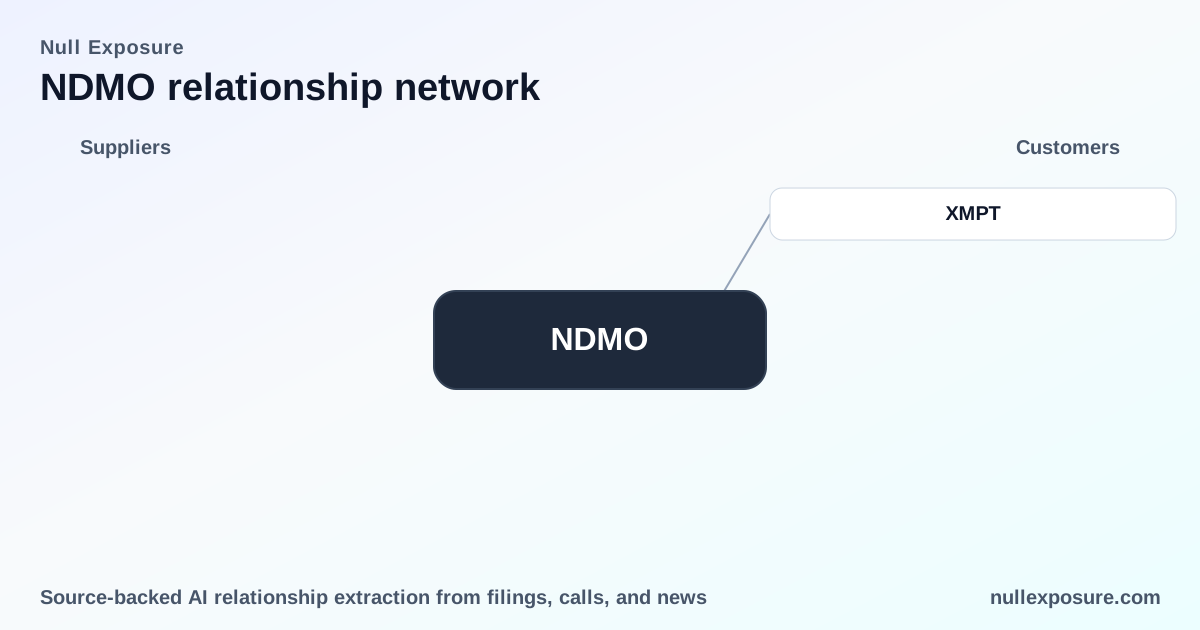
VanEck CEF Muni Income ETF (inferred symbol XMPT): The record shows the VanEck CEF Muni Income ETF holds NDMO with a 1.62% portfolio weight and a reported market value of $3.53 million as of the cited snapshot. This is a direct indicator that NDMO is included in ETF wrappers used to package municipal exposure for investors. Source: TradingView NDMO page (observed 2026-03-10), https://www.tradingview.com/symbols/NYSE-NDMO/.
-
XMPT (same inferred symbol): The same holding is captured a second time under the name XMPT, repeating that XMPT includes NDMO at a 1.62% weight equivalent to $3.53M in the referenced fiscal period. The duplicate entry reinforces the presence of ETF‑level exposure to NDMO in the public holdings universe. Source: TradingView NDMO page (observed 2026-03-10), https://www.tradingview.com/symbols/NYSE-NDMO/.
How these investor relationships affect NDMO’s operating profile
The listed relationships are investor holdings rather than commercial supplier contracts; they therefore shape NDMO’s market dynamics rather than its operational inputs. From the provided company facts and the holding snapshots, draw these conclusions:
-
Contracting posture: NDMO’s primary contractual relationships are typical of an asset manager/closed‑end fund — regulatory, custodian and distribution agreements — but the recorded relationships are investor holdings that influence liquidity and secondary market demand rather than vendor obligations.
-
Concentration and investor composition: The fund reports institutional ownership of roughly 24%, and the recorded ETF holding (1.62% / $3.53M) indicates participation by pooled‑vehicle investors. Concentration is moderate: institutional holders are material but not overwhelmingly dominant, which implies diversified demand but also sensitivity to institutional flows.
-
Criticality of relationships: ETF inclusion is important for visible liquidity and passive flow channels; holdings by cash‑flow vehicles can create stickier bid/offer behavior during stable markets and exacerbate moves during dislocation. These are investor relationships, not operational suppliers, but they are critical to price formation.
-
Maturity and transparency: As a listed closed‑end fund with public filings and market data (latest quarter cited 2025‑10‑31), NDMO’s investor base is observable through holdings snapshots. The relationships recorded are straightforward holdings disclosures rather than complex, bespoke contracts.
Note: the provided records include no contractual constraints or vendor‑level constraints to attribute to any relationship; this absence is itself a company‑level signal discussed below.
Constraints and company‑level signals
No explicit contractual constraints were parsed in the supplied records. Presenting this as a company‑level signal: there are no documented, relationship‑specific contractual restrictions or covenants captured in these records that would materially limit the fund’s operating flexibility. Investors should still review SEC filings and prospectuses for any covenants, distribution agreements or liquidity provisions not reflected in the snapshot.
Risk and monitoring checklist investors should use
Monitor these items because they materialize from the relationship set and public fund facts:
- Liquidity and pricing: track the fund’s premium/discount to NAV, since ETF and institutional flows can amplify discounts in stressed markets.
- Ownership shifts: follow filings and ETF holdings snapshots for changes to the 1.62% ETF weight or other large positions.
- Distribution signals: check distribution history — the record lists DividendPerShare = 0 and DividendYield = 0 in the current snapshot, while an ex‑dividend date is listed as 2026‑04‑15, so reconcile the distribution schedule with NAV and EPS (reported diluted EPS $0.25) before extrapolating yield.
- Market capitalization and liquidity: market cap ~$611.2M provides a size anchor; evaluate float and secondary‑market turnover as part of trade execution planning.
Use this compact checklist as a basis for operational due diligence as you model liquidity and downside scenarios.
Bottom line and next steps
NDMO is a actively managed, closed‑end municipal fund whose market behavior is heavily influenced by its investor base — including ETF wrappers and institutional holders. The relationships recorded are investor holdings (not contractual suppliers) and are modest in absolute scale but meaningful for liquidity dynamics. Investors should prioritize monitoring ETF holdings, institutional ownership trends, premium/discount dynamics and distribution policy. For deeper coverage and to incorporate these signals into a portfolio monitoring workflow, visit https://nullexposure.com/.
Key takeaway: investor relationships—not vendor contracts—drive NDMO’s near‑term market risk; tracking ETF and institutional holdings is the fastest way to gauge demand shifts and liquidity pressure.