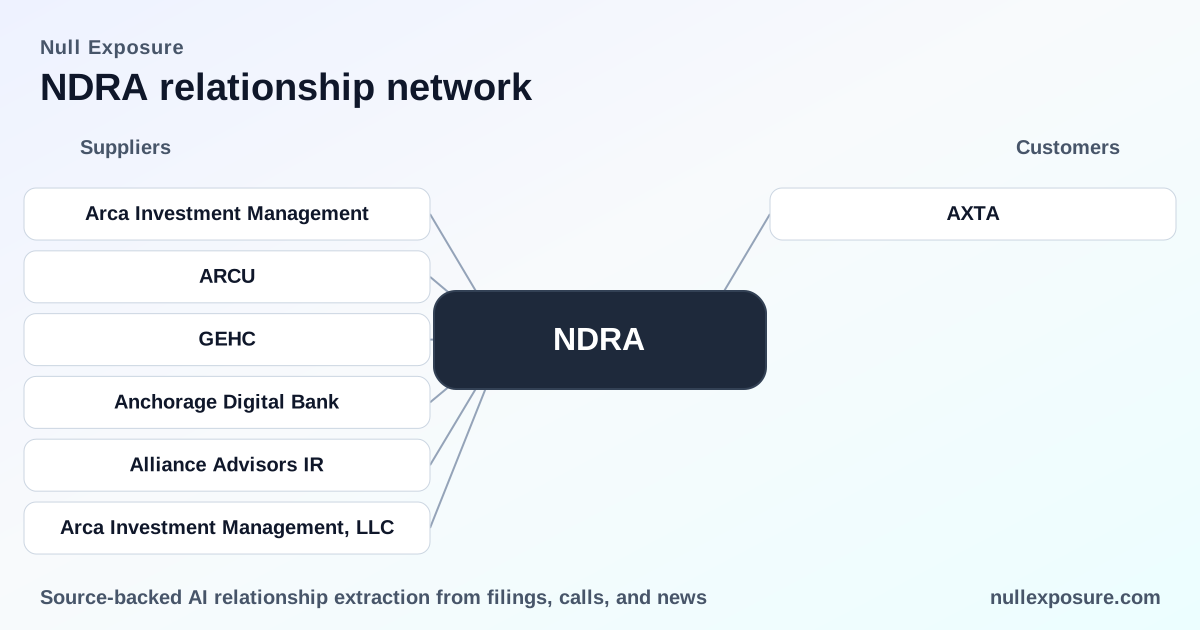
ENDRA Life Sciences (NDRA): Commercial relationships and what they signal for investors
ENDRA Life Sciences develops photoacoustic / thermal-based imaging hardware and intends to monetize primarily through a multi-year subscription model alongside traditional product sales and maintenance. The company sells imaging systems for clinical and preclinical use, will deploy a small direct sales team in primary geographies (initially Europe, then North America), and uses channel partners for broader distribution — a posture that combines recurring revenue emphasis with selective distribution agreements. For a concise view of NDRA’s customer relationships and commercial constraints, see Nillexposure’s coverage at https://nullexposure.com/.
Quick company snapshot for commercial due diligence
ENDRA is a diagnostic-technology developer headquartered in Ann Arbor, Michigan, with a market capitalization in the low millions and no reported TTM revenue, positioning the firm as a pre-commercial / early-commercial technology vendor. Company disclosures describe a transition to a subscription-heavy, long-term contracting model with the option for traditional product sales, and plans to initiate commercialization in Europe before U.S. market entry.
How ENDRA structures sales and contract economics
ENDRA’s public disclosures make its intended go-to-market posture clear: multi-year subscription contracts with monthly recurring revenue are the primary revenue engine, supplemented by one-time product sales and annual upgrade/maintenance fees. This creates four actionable implications for investors:
- Contracting posture: Long-term, subscription-first sales that emphasize recurring cash flows once scaled.
- Sales distribution: Small direct sales team initially, with growth through channel partners and distributors for broader market coverage.
- Geography focus: Initial commercialization targeted at Europe (EMEA) first, with U.S. commercialization following pending regulatory approval.
- Maturity and criticality: The business is early-stage commercially, with concentration risk around early channel partners and the timing of regulatory milestones.
These are company-level operating signals drawn from ENDRA’s commercial disclosures, not from any single customer record.
All recorded customer relationships (complete inventory)
Below are every relationship record returned in the customer search, presented individually with plain-English summaries and source notes.
AXT — exclusive distributor agreement (news report) ENDRA executed an exclusive distributorship for its preclinical photoacoustic CT technology with Australian firm AXT, creating a channel to bring the technology to Australia and surrounding markets. According to a News-Medical report dated August 11, 2015, AXT announced it had “signed an exclusive distributorship agreement with US‑based Endra Life Sciences.” (News‑Medical, Aug 11, 2015)
AXTA — duplicate record referencing the same distributorship announcement A second dataset record lists the same distributorship announcement under the name AXTA; it references the identical News‑Medical article and therefore represents a duplicated capture of the same commercial relationship. The underlying source is the same News‑Medical story from August 11, 2015 that reports AXT’s exclusive distributorship. (News‑Medical, Aug 11, 2015)
What the relationship set tells investors
The relationship inventory is narrow: a dated exclusive distributorship announcement for Australia and a duplicate capture of that same announcement. Despite the limited scope of recorded relationships, the interactions line up with ENDRA’s stated go-to-market approach and provide specific signals:
- Channel-first early expansion: The AXT agreement is consistent with ENDRA’s plan to use local distributors to reach non-U.S. markets while maintaining a small direct sales footprint for reference sites and clinical validation.
- Low customer concentration data: Recorded relationships are few; investors should treat current public evidence as insufficient to conclude broad commercial traction outside isolated distribution agreements.
- Geography validated: The AXT deal aligns with the company’s focus on international commercialization before full U.S. rollout, reinforcing the EMEA/APAC-first expansion narrative stated in company disclosures.
Constraints and how they shape the commercial thesis
ENDRA’s corporate disclosures provide constraints that define risk and opportunity; present here as company-level signals rather than relationship-level claims:
- Contract type: Long-term, subscription-oriented agreements are the planned core revenue mechanism, indicating the company will prioritize recurring revenue over one-off unit sales. This contract posture increases lifetime value if adoption scales but requires customer stickiness and demonstrable clinical outcomes to convert trials into multi-year contracts.
- Sales role: ENDRA positions itself as the seller, deploying a direct sales force for clinical adoption and relying on distributors for broader reach; this hybrid model reduces fixed sales cost concentration but raises dependency on partner execution quality.
- Geographic focus: Initial commercialization is targeted at Europe (with further expansion to North America); regulatory sequencing will therefore drive revenue timing and route-to-market priorities.
- Maturity signal: The references to subscription and channel partners are forward-looking business model plans rather than evidence of large recurring revenue streams today; the company remains pre- or early-commercial, with operating losses and no TTM revenue in the public filings.
These constraints collectively imply that valuation and investment risk will be highly sensitive to three execution points: regulatory progress in targeted geographies, channel partner performance, and the company’s ability to convert pilot and reference sites into recurring subscription contracts.
Investment implications and where to watch next
- Revenue inflection depends on regulatory approvals and partner-led rollouts. Investors should prioritize updates on CE mark/FDA timelines and any newly announced distribution or hospital contracts.
- The subscription-first model is attractive in principle but requires clinical evidence and operational scale to realize predictable MRR; monitor reference-site publications and contract terms when disclosed.
- Given the small public float and low institutional ownership, share moves can be volatile around discrete commercial announcements; public reporting of new distributor agreements, pilot successes, or subscription contracts will be the primary catalysts.
If you want a rapid commercial diligence brief or ongoing monitoring of NDRA’s relationship signals and channel activity, review our investor-focused coverage at https://nullexposure.com/ for structured updates and alerts.
Bottom line
ENDRA is pursuing a subscription-led commercialization strategy and has at least one documented distributor agreement in the Australian market, consistent with its channel-first, EMEA‑then‑U.S. rollout plan. For investors, the core questions are whether ENDRA can convert pilot sites into multi-year contracts, scale distribution beyond isolated agreements, and achieve the regulatory approvals that unlock larger markets.