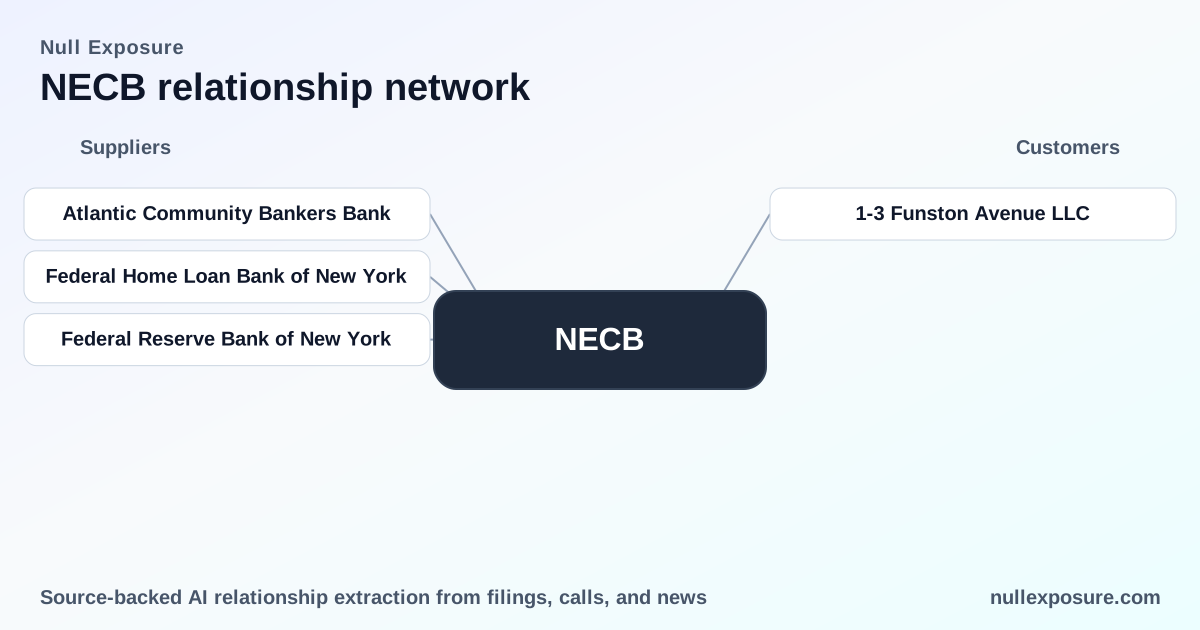
NECB customer relationships: what investors should know
Northeast Community Bancorp (NECB) operates as a regional community bank holding company that earns net interest and fee income by originating short-term construction and commercial loans and gathering retail and brokered deposits across the New York–Massachusetts corridor. Its business model is built on high-concentration construction lending, retail deposit funding, and fee income tied to lending and deposit services, producing above-average margins for a regional thrift. For relationship-level diligence and counterparty screening, NECB’s footprint is domestic, retail-focused, and transaction-driven. For direct access to the full relationship intelligence used to prepare this note, visit Null Exposure: https://nullexposure.com/
Executive takeaway: concentrated, deposit-funded lending creates both leverage and resilience
- High concentration in construction loans amplifies asset sensitivity to regional real estate cycles; at December 31, 2024, construction loans represented roughly 78.6% of the loan portfolio on a net basis, creating material concentration risk but also a clear margin driver in a rising-rate environment (company filing, Dec. 31, 2024).
- Deposits—including large brokered deposits—are critical to funding; brokered deposits totaled $435.3 million at year-end 2024, highlighting reliance on wholesale-like funding even as the bank serves local retail customers (company filing, Dec. 31, 2024).
- Contract duration skews short-term: construction loans typically run 18–36 months and many retail time deposits mature within 12 months, producing recurrent refinancing and repricing dynamics that make liquidity and rate-management central to performance (company filing commentary, FY2024).
These structural signals explain why evaluating NECB’s customer relationships requires both granular loan-level diligence and an appreciation for how quickly credit and deposit exposures can reprice.
What the public signals show about active customer relationships
Below I cover every relationship signal returned for NECB in the reviewed results, with a concise plain-English summary and the public source.
1-3 Funston Avenue LLC — local developer financed by NECB for a recent Spring Valley acquisition
A regional business journal reported that Monsey-based developer 1-3 Funston Avenue LLC purchased two Spring Valley properties and received mortgage financing of $1.3 million from Northeast Community Bank to support the transaction (RCBizJournal, April 17, 2024). This is a direct example of NECB’s core construction/real-estate lending to local developers and reinforces the bank’s role as an originator of short-term property finance in its footprint. Source: RCBizJournal, April 17, 2024.
INTM (Intermedia) — third‑party tech deal that references NEC’s UCaaS business (name distinction matters)
A CRN profile of Intermedia’s FY2025 activity noted that Intermedia entered a definitive agreement to assume NEC’s unified communications and contact center as-a-service business in North America and later partner relationships in Europe (CRN, 2025). The referenced counterparty is NEC (the multinational technology firm), not Northeast Community Bancorp; the item is a media signal captured in NECB’s relationship sweep but does not document banking activity between NECB and Intermedia. Source: CRN, 2025.
MEOH (Methanex) — transcript reference to ‘the NEC’ and port-fee arrangements
A Q3 2025 earnings-call transcript for Methanex includes a line noting a contract with “the NEC” for port fees or port arrangements (InsiderMonkey, Q3 2025). The public transcript references “the NEC” generically; it does not identify a specific banking counterparty or connect the port-fee contract to Northeast Community Bancorp in the available text. This record is therefore a captured signal rather than firm evidence of a customer-supplier banking relationship. Source: InsiderMonkey, Q3 2025 earnings call transcript.
How these relationships fit NECB’s operating model
The relationship signals collectively reinforce the following company-level operating model characteristics drawn from NECB’s public disclosures and the relationship evidence:
-
Contracting posture — short-term and transaction-driven. Construction loans and many deposit maturities are short-dated (18–36 months for construction loans; many CDs mature within one year), producing a continuous pipeline of underwriting and interest-rate risk management. Evidence: company filing commentary on construction loan terms and CD maturities (FY2024/Dec. 31, 2024).
-
Concentration and criticality — real-estate exposure is material to bank economics. With roughly $1.4 billion (78.6%) of loans in construction at year-end 2024, real-estate lending is a core profit engine and the primary point of concentration; simultaneously, deposits are a critical funding source (brokered deposits $435.3M), so liquidity management is a central operational constraint (company filings, Dec. 31, 2024).
-
Counterparty mix — retail/individual-first with targeted commercial relationships. Public disclosures emphasize that deposits are provided primarily by individuals in the bank’s markets and that operations are locally focused across New York and Massachusetts branches, aligning with the 1-3 Funston Avenue lending example as a typical commercial counterpart (company filing, FY2024).
-
Materiality nuances — mortgage servicing immaterial but funding and construction credit critical. The bank reports mortgage servicing rights as immaterial while treating deposits and construction-loan portfolio concentration as business-critical, an important distinction for investors assessing exposure and potential volatility (company filing, Dec. 31, 2024).
-
Role orientation — NECB is principally a service provider and lender. The bank’s operating model centers on delivering loan and deposit products; descriptions in filings frame NECB as the seller of credit and deposit solutions within its market area rather than as a large corporate buyer of external services (company filings).
Risks and what to watch next
- Credit cycle sensitivity: High construction-loan concentration implies earnings and capital exposure to regional real estate cycles; investors should monitor delinquency trends and the evolution of loan-to-value and absorption metrics in the New York metro.
- Funding volatility: Heavy reliance on brokered deposits increases potential funding-cost volatility if market funding conditions change; track brokered-deposit balances and maturity rolls.
- Signal noise in relationship scans: Public feeds can capture mentions of other firms named “NEC” (technology conglomerate) or generic references to “the NEC,” so verify counterparty identity before concluding credit exposure or revenue linkage.
For a practical next step, see how relationship-level signals map to NECB’s loan schedules and deposit composition on the Null Exposure platform: https://nullexposure.com/
Bottom line for investors
NECB is a regionally focused, deposit-funded lender whose economics are driven by short-term construction lending and retail deposit spreads. Local developer financings—like the 1-3 Funston Avenue loan—illustrate the bank’s core lending franchise, while media signals referencing “NEC” in other contexts underline the need for careful entity disambiguation in relationship screening. The balance of concentrated construction exposure and sizeable brokered deposits makes NECB a classic case where asset quality, liquidity, and repricing risk determine forward returns.