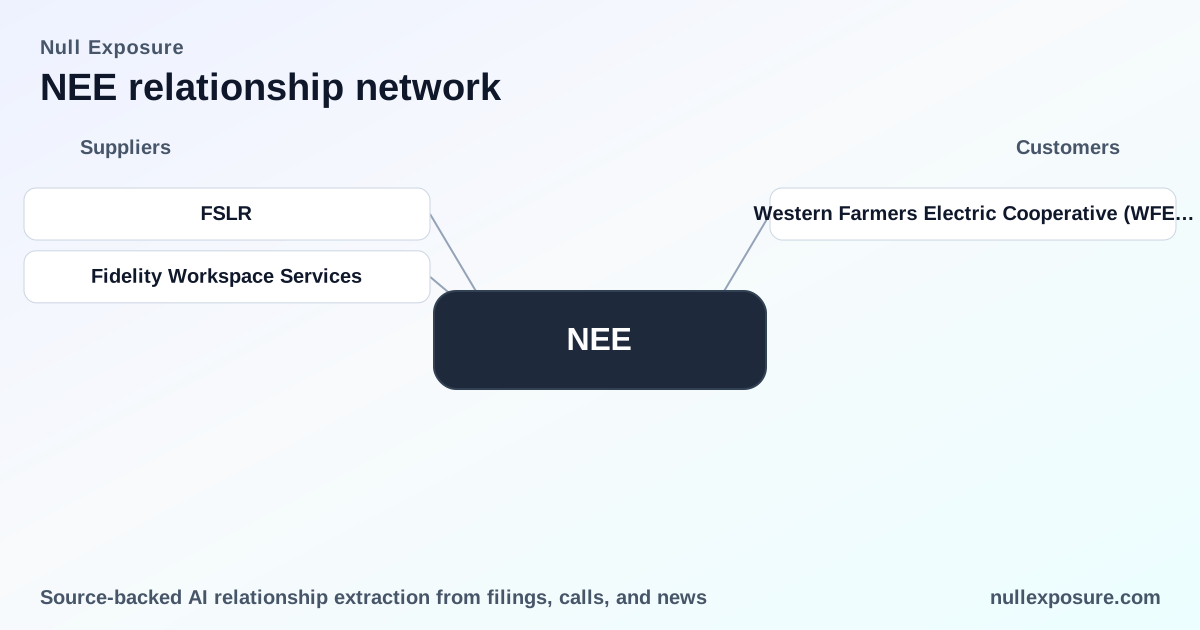
NextEra Energy (NEE): Customer Relationships That Underpin Renewable Growth and Regulated Cash Flow
NextEra Energy operates a two‑pronged commercial model: a rate‑regulated retail utility (Florida Power & Light, FPL) that generates stable tariff revenues, together with a large competitive renewables and services platform (NextEra Energy Resources, NEER) that monetizes project development, long‑term power sales and engineering/operations contracts. Investors should value NEE as a hybrid cash‑flow business—regulated margin stability from FPL plus scalable, long‑duration contracted revenue and backlog in NEER driven by VPPAs, PPAs and large utility partnerships. For a concise map of these customer ties and what they imply for revenue visibility and development risk, see Null Exposure’s research hub: https://nullexposure.com/.
What the company‑level signals tell investors about how NEE contracts and performs
NextEra’s customer footprint and public disclosures establish several operating characteristics that shape investment risk and upside:
- Contracting posture is long‑term and revenue‑backed. NEER sells capacity and energy largely through long‑dated PPAs and fixed‑price contracts; management discloses fixed‑price components stretching into the 2030s and explicit expected revenue recognition from those components.
- Counterparty mix is broad but north‑america centric. Customers include individual retail ratepayers (FPL retail base), municipal and cooperative utilities, investor‑owned utilities, and large enterprise and hyperscaler buyers—concentrated in the U.S. and Canada.
- Revenue criticality and materiality are high in places. FPL’s tariff revenues and franchise agreements account for a substantial share of consolidated revenues, while NEER’s long‑term contracts provide material backlog that supports renewables growth.
- NEER is both a seller and a service provider. The company supplies energy and capacity under PPAs and also provides long‑term O&M, construction and interconnection services to customers and partners, leveraging scale.
- Relationships are active and programmatic. Billing and delivery mechanisms are operationalized (monthly billing, long term PPA performance), indicating mature commercial processes rather than one‑off transactions.
These attributes support revenue durability (regulated retail) and growth optionality (contracted renewables pipeline)—the core trade‑off investors price into NEE.
For a deeper look at the customer evidence driving these signals, visit Null Exposure’s summary page: https://nullexposure.com/.
The named customer relationships and what they mean (company‑by‑company)
Graphic Packaging Holding Company (GPK)
NextEra Energy Resources signed a 250 MW virtual power purchase agreement (VPPA) to develop a West Texas solar project that supplies renewable energy attributes and price certainty for Graphic Packaging’s operations. This is a corporate offtake deal that expands NEER’s contracted backlog. Source: SolarBytes and related press coverage, May 2026.
Salt River Project (SRP)
NEER has secured a large agreement to deliver roughly 3,000 MW of new solar capacity for SRP in Arizona, a multi‑GW commitment that materially expands development scale and multi‑year revenue visibility. Source: regional reporting and PV Magazine coverage of the May 2026 deal.
Xcel Energy (XEL)
Xcel and NextEra reached a definitive non‑exclusive agreement to co‑develop generation, storage and interconnections to accelerate data center development across Xcel’s operating companies—an alliance that leverages NextEra’s development capabilities at utility scale. Source: Xcel Energy remarks in the Q1 2026 earnings call (InsiderMonkey transcript), April–May 2026.
Google (GOOGL)
Public reporting cites direct hyperscaler partnerships, including Google’s collaboration with NextEra to restart the Duane Arnold nuclear plant in Iowa, and broader hyperscaler demand for 24/7 clean power that underpins corporate offtake growth for NEER. Source: TIKR and ad‑hoc coverage of hyperscaler deals, May 2026.
Microsoft (MSFT)
Market commentary highlights hyperscaler demand generally and names Microsoft among the buyers that drive large, multi‑year clean‑power contracts—supporting NEER’s ability to place large offtakes and secure project financing. Source: ad‑hoc market overview, May 2026.
XELLL (historical reference)
A Utility Dive item referencing 2016 procurement notes that NextEra and other large developers bid on Xcel Colorado’s competitive solicitation; this entry functions as a historical data point on NextEra’s participation in all‑source procurement processes. Source: Utility Dive, FY2021 coverage cited in later reporting.
Entergy Arkansas (EAI)
Entergy Arkansas has entered 20‑year purchase agreements for power from NextEra‑built solar projects (some projects owned/operated by NEER subsidiaries, others structured as developer‑built and utility‑owned), demonstrating NEER’s mixed sponsor/contractor models. Source: Entergy corporate announcements (2020–2021).
POR (Portland General Electric / POR)
Reports indicate NextEra operates energy storage facilities under 20‑year storage capacity agreements with PGE, illustrating NEER’s role as a long‑term operator for utility storage procurements. Source: ESS News coverage of 2025–2026 projects.
Western Farmers Electric Cooperative (WFEC)
Project reporting cites a PPA with WFEC for a solar project that serves portions of Oklahoma, New Mexico, Texas and Kansas—an example of NEER serving generation and transmission cooperatives. Source: AGDAILY reporting, March 2026.
XIFR
Earnings call commentary indicates that certain affiliates benefit through long‑term service agreements with NextEra Energy, capturing NEER’s business line that sells operations, engineering and construction services to affiliated or third‑party projects. Source: XIFR Q4 2025 earnings-call excerpt, March 2026.
CRK
Corporate remarks reference a joint data center project partnership with NextEra in the Western Haynesville region, underscoring NextEra’s role in enabling large‑scale industrial and hyperscaler power requirements. Source: CRK Q4 2025 earnings‑call transcript, March 2026.
Chesapeake Utilities Corporation (CPK)
Chesapeake Utilities completed an acquisition of Florida City Gas from NextEra for $923 million, reflecting NextEra’s occasional non‑core asset dispositions and portfolio reshaping in regulated gas distribution. Source: PR Newswire announcement, March 2026.
Basin Electric
Market commentary lists Basin Electric among cooperative and municipal partnership projects, including plans for a 1.5 GW combined‑cycle plant—illustrating NEER’s engagement with large cooperative generation partners. Source: TIKR blog coverage of Q1 2026 commentary.
(Each entry above is drawn from contemporaneous reporting and company call transcripts cited in the linked news items and filings concentrated in 2025–2026.)
What investors should take away from the relationship map
- Backlog and visibility are tangible. Large PPAs and VPPAs—ranging from 250 MW corporate deals to multi‑GW utility contracts—support multi‑year cash‑flow expectations and capital planning for NEER.
- Balanced risk profile across regulated and competitive businesses. FPL’s tariff base supplies predictable cash flow, while NEER supplies growth and higher volatility but with contract protection through long‑dated agreements.
- Counterparty diversity reduces single‑buyer concentration risk. Contracts span retail customers, cooperatives, investor‑owned utilities, and hyperscalers; this mix reduces exposure to any one class of buyer while keeping exposure regional to North America.
- Execution and scale are competitive advantages. Repeated awards and long‑term service agreements point to an operational posture that wins both development and ongoing operations mandates.
- Project concentration and policy/regulatory dynamics remain watchpoints. Large, multi‑year projects concentrate capital deployment and expose economics to permitting timelines, interconnection constraints and municipal/regulatory decisioning.
Bottom line: NextEra’s customer relationships combine the stability of regulated utility revenues with a growing, contractually backed renewables pipeline that scales through large utility and hyperscaler offtakes. For investors focused on durable cash flow plus growth optionality, these named relationships validate both revenue predictability and sizeable addressable opportunity.
For continuous updates to this relationship map and source‑level links, visit Null Exposure: https://nullexposure.com/.