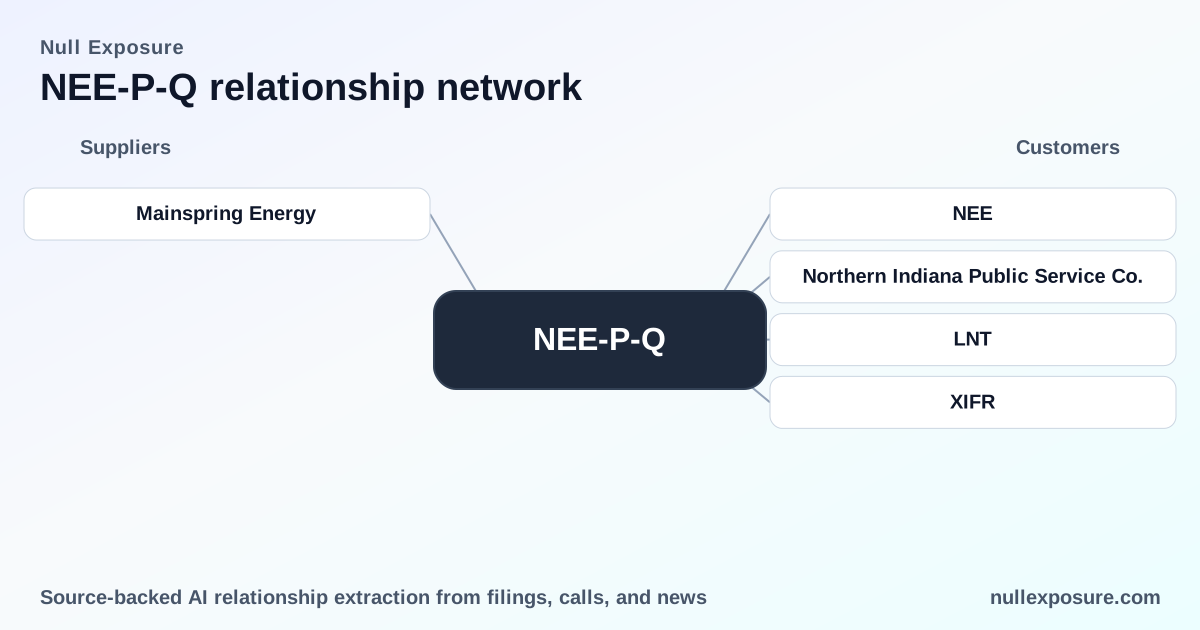
NEE-P-Q: Who buys NextEra’s output, who takes its credit, and how that shapes the investment case
NextEra Energy (through its generation arm NextEra Energy Resources and related entities) builds, owns and operates utility-scale wind, solar and battery assets and monetizes them through a mix of long-term power purchase agreements (PPAs) with utilities and corporate offtakers, asset drop-downs and affiliate financings, and credit-support arrangements with its own sponsored vehicles. The result is a capital-intensive business that converts project capabilities into predictable contracted cash flows while using affiliated structures—partnerships and credit support—to optimize balance-sheet economics. Visit https://nullexposure.com/ for a concise view of customer-derived counterparty risk for preferred holders.
Strategically, NextEra’s customer relationships fall into three clear channels: utility PPAs, large corporate offtakes, and intra-group financing and asset transfers. That trifecta drives cash-flow visibility but also concentrates exposure to long-term contract performance, regulatory transitions in utility relationships, and affiliate-structure counterparty mechanics.
What this set of relationships tells investors about operating posture
NextEra’s customer roster here shows a contracting posture that favors long-term, large-scale offtake deals (PPAs with utilities and corporate buyers), active use of affiliate vehicles for capital recycling, and situations where the parent provides credit support to sponsored entities. Those characteristics create a hybrid risk profile: highly predictable contracted revenues offset by reliance on affiliate support mechanisms and the governance/credit dynamics that accompany drop-down and partnership structures.
Key business-model signals:
- Concentration and counterparty mix: The customer list mixes investment-grade corporates and regulated utilities with sponsored vehicles—diversified by counterparty type but concentrated in long-duration contracts.
- Criticality of relationships: Many arrangements are foundational to project financing and operation (PPAs, credit support), so counterparty performance is operationally critical.
- Maturity and capital approach: Use of drop-downs and cash-sweep/credit support agreements signals an advanced capital recycling strategy that allocates cash and credit across NextEra’s group.
Explore more about how these relationships affect preferred-level risk at https://nullexposure.com/.
Counterparty snapshots — one quick take per relationship
Wells Fargo
Wells Fargo agreed to purchase more than 58 megawatts of solar capacity from the Blackburn Solar project in Catawba County, a transaction structured as a direct offtake for a NextEra-developed facility. This reflects NextEra’s practice of securing large institutional corporate/financial buyers for solar tranches. Source: Duke Energy press release (March 10, 2026).
NEE (intra-group mention)
NextEra itself is referenced alongside the Wells Fargo transaction for Blackburn Solar, underscoring direct involvement of the parent in marketing and contracting project output rather than leaving all sales to project-level entities. Source: Duke Energy press release (March 10, 2026).
Northern Indiana Public Service Co. (NiSource / NIPSCO)
NextEra announced development of 1,000 MW of combined solar and storage projects for Northern Indiana Public Service Co., part of a broad renewables push that also included a 325-MW battery project in California. This highlights NextEra’s scale in servicing regulated utility demand for renewables-plus-storage capacity. Source: E&E News coverage (reported March 2026 referencing project announcements).
NextEra Energy Partners, LP (NEP)
NEP receives credit support from NEE and affiliates under a cash-sweep and credit-support agreement, a deliberate structure that channels parent resources to shore up the sponsored vehicle’s financing profile. This is a clear example of NextEra using intra-group credit mechanics to facilitate capital markets access. Source: PR Newswire investor notice (May 2026).
LNT / Alliant Energy
Alliant Energy’s earlier power purchase agreement with NextEra Energy Resources was shortened by five years, bringing an original contract to an earlier termination date—an operational decision that affected asset disposition and plant timing. This illustrates how renegotiation or contract amendments with regulated utilities can materially change project life and cash-flow timing. Source: World Nuclear News (March 2026).
Meta
NextEra developed the 150 MW Elora Solar project to power Meta’s datacenter hub in northwest Huntsville, Tennessee, demonstrating direct corporate-offtaker relationships where hyperscalers procure renewable capacity from project developers. Corporate offtakes like this provide revenue certainty while also tying project economics to a single large buyer. Source: PV Magazine USA (May 2022).
Alliant Energy (separate listing / same relationship context)
The Alliant Energy mention reiterates the contractual amendment with NextEra that accelerated the end date of a PPA; it reinforces the theme that utility contract terms and amendments are material to project economics. Source: World Nuclear News (March 2026).
XIFR (XPLR Infrastructure)
NextEra created what is now XPLR Infrastructure (NYSE: XIFR) to buy assets via transactions known as “drop-downs,” and later adjusted its strategic relationship with that vehicle. The arrangement is illustrative of NextEra’s ongoing use of listed infrastructure vehicles to monetize assets and transfer operational risk while capturing after-tax value. Source: The Globe and Mail summary (March 2026; referenced coverage of the drop-down strategy).
XPLR Infrastructure (duplicate naming)
The entity XPLR Infrastructure is described as the limited partnership created for asset drop-downs from NextEra, emphasizing the repeatable model of selling completed or operating assets into sponsored public vehicles to recycle capital. This is consistent with NextEra’s asset-lighting/securitization approach to growth and returns. Source: The Globe and Mail / Motley Fool coverage (March 2026).
What investors should watch (risks and levers)
- Credit support and affiliate reliance are structural: The NEP credit-support example illustrates that consolidated cash flows can be contingent on parent-level arrangements, which affects recovery dynamics for holders of preferred or subordinated instruments. Watch disclosures on cash-sweep triggers and support metrics.
- PPAs and contract amendments drive timing risk: The Alliant example shows amendments can materially shorten or change project life, impacting projected distributions and asset valuations.
- Corporate offtakes provide revenue quality but single-buyer concentration exists: Deals like Meta and Wells Fargo provide high-quality counterparties but also concentrate portions of revenue into large single agreements, which is operationally significant for project-level credit.
- Drop-down vehicles change balance-sheet exposure: Asset sales to XPLR/XIFR recycle capital but shift cash-flow sources to a market-listed buyer; governance and market pricing of those vehicles are important to monitor.
Bottom line for NEE-P-Q holders
NextEra’s customer network demonstrates a deliberate model of long-term contracted revenues supplemented by affiliate financing and asset monetization. That model supports a stable cash-flow profile but requires active monitoring of affiliate credit arrangements, utility contract amendments, and the health of sponsored vehicles that receive drop-downs. For investors focused specifically on preferred securities, the critical questions are the durability of credit support lines and the contract amendments that affect project cash flow timing—both of which show up repeatedly across these relationships.
For a summarized counterparty-risk brief and portfolio-level implications tied to customer relationships, visit https://nullexposure.com/ and review the customer linkage mappings used by market analysts.