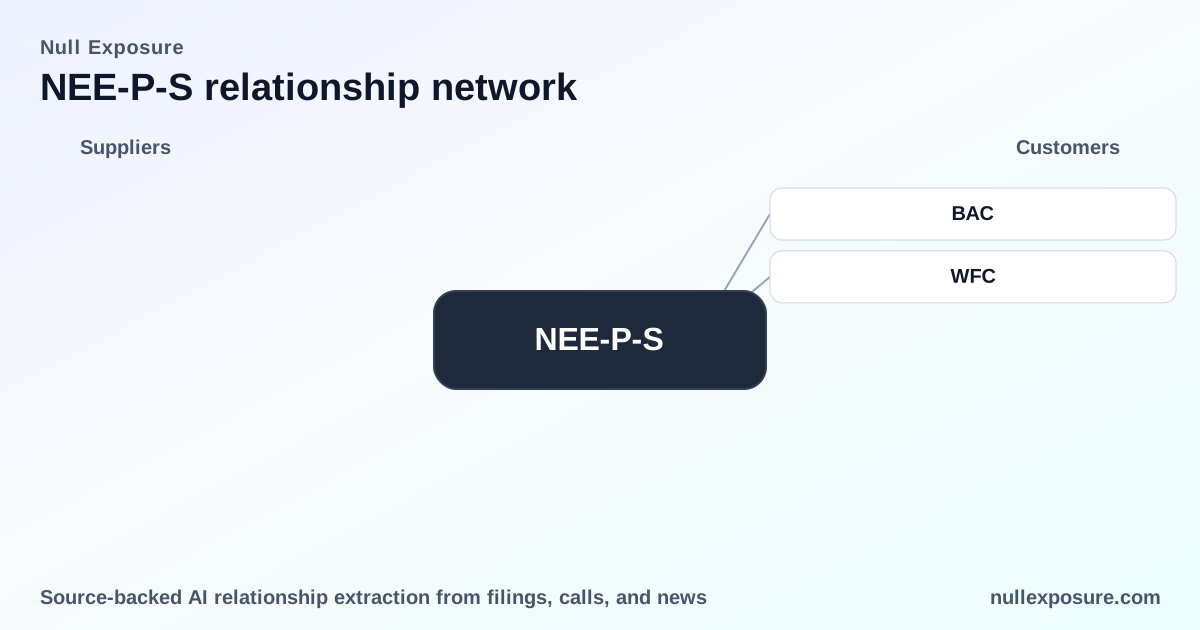
NextEra Energy (NEE-P-S) — Who the company is selling to and what those relationships tell investors
NextEra Energy operates a dual business: a large regulated utility franchise (Florida Power & Light and related local utilities) combined with one of the world’s largest competitive renewable generators and project developers. The company monetizes through regulated rate-based returns on its utility assets, long-term power purchase agreements and merchant sales from its generation fleet, plus financing and capital markets transactions such as equity-unit offerings that transfer risk or raise growth capital. Capital markets counterparties and investment banks are therefore both service providers and strategic partners in NextEra’s growth financing model.
If you want to follow customer and counterparty flows for NEE-P-S, this note parses every relationship flagged in the recent coverage and explains how each connection maps to NextEra’s operating and funding posture. For deeper tracking of counterparties and public filings, visit https://nullexposure.com/.
Quick read: what the relationships mean for investors
NextEra’s most recent public transaction identified a $2.0 billion equity-unit offering handled by major investment banks, showing active use of equity-linked market solutions to fund capital-intensive growth. This underlines NextEra’s approach of accessing large-scale capital through established underwriters rather than through short-term commercial counterparties. Expect continued reliance on lead bookrunners and securities firms for opportunistic financing as renewable buildout and grid investments continue.
The transaction that matters: an equity-unit sale to two lead underwriters
NextEra announced the sale of $2.0 billion of equity units that were placed with major securities firms to facilitate the offering and distribution. According to NextEra’s newsroom release dated June 18, 2024, Wells Fargo Securities and BofA Securities acted as counterparties in the sale of those equity units, supporting NextEra’s capital-raise for growth and balance-sheet management. This is a clear example of NextEra using institutional underwriters to access diversified investor demand for structured equity instruments (NextEra Energy newsroom, June 18, 2024).
What the relationships in the public record are and what they imply
BofA Securities — lead placement for equity units
BofA Securities is named as a purchaser/placement agent in the $2.0 billion equity unit sale, functioning as a capital markets counterparty that helps NextEra monetize future equity-like claims today. According to NextEra’s June 18, 2024 release, BofA Securities participated in the transaction that raises long-duration capital for the company’s growth agenda. (Source: NextEra Energy newsroom, June 18, 2024)
Wells Fargo Securities — co-lead on the same equity-unit deal
Wells Fargo Securities is the other named underwriter in the $2.0 billion equity-unit sale, sharing distribution and placement responsibilities with BofA and providing access to institutional investor channels. NextEra’s press release documents Wells Fargo Securities’ role in placing the offering as part of the company’s FY2024 financing activity. (Source: NextEra Energy newsroom, June 18, 2024)
WFC — duplicate reference to Wells Fargo’s ticker in the transaction record
The same press release is also captured under the ticker shorthand “WFC,” reflecting Wells Fargo’s standard market symbol for reporting purposes; this duplicate entry reinforces that Wells Fargo’s institutional platform was a material counterparty for this specific financing. The underlying disclosure is the June 18, 2024 NextEra announcement listing Wells Fargo among the purchasers. (Source: NextEra Energy newsroom, June 18, 2024)
How these counterparties fit into NextEra’s operating model
- Contracting posture: NextEra routinely engages with large, diversified investment banks to underwrite and place capital-market instruments rather than relying on bespoke bilateral loans for very large financings. That contracting posture signals a preference for market-based liquidity and distribution capacity when funding growth initiatives.
- Concentration and criticality: The named counterparties—BofA Securities and Wells Fargo Securities—are large, broadly capable underwriters; their involvement is important for distribution but not uniquely critical because NextEra can rotate among major global banks. Still, the presence of top-tier underwriters is critical for scale and timing of large equity-linked offerings.
- Maturity and sophistication: The use of equity units reflects an advanced capital-management toolkit consistent with a mature, capital-intensive energy operator that runs both regulated and merchant businesses. NextEra’s scale—about 46 GW of generating capacity and historical revenue base—supports access to these markets.
- Operating signal from constraints: The dataset for this review did not capture contractual constraints tied to specific counterparties. That absence is a company-level signal: public-facing financing activity is visible, while granular contractual limitations or exclusivities are not disclosed in the results provided.
Investor implications and risk considerations
- Financing flexibility is a competitive asset. NextEra’s use of equity units and large underwriters shows it can tap deep capital markets where pricing and investor appetite determine the cost of growth capital. That flexibility supports aggressive deployment of renewables and grid investments without immediate dilution to regulated returns.
- Counterparty credit exposure is limited but non-zero. Investment banks are counterparties for distribution and placement, not operational inputs; default by an underwriter would be disruptive to a single issuance timetable but not to NextEra’s generation operations. The risk is execution and market repricing, not operational failure.
- Visibility and concentration. While the named banks are prominent, NextEra’s ability to substitute other major global underwriters reduces concentration risk relative to reliance on a single provider.
Bottom line: what investors should watch next
The June 18, 2024 equity-unit placement underscores NextEra’s continued reliance on large securities firms for growth financing. Monitor subsequent filings and press releases for the structure and pricing of these equity-linked instruments, because they directly affect dilution, cost of capital, and the pace of capital deployment. For ongoing counterparty intelligence and to map similar financing flows across issuers, see our platform at https://nullexposure.com/.
For dedicated tracking of counterparties, underwriting syndicates and how financing choices change operator economics, visit https://nullexposure.com/ to explore deeper counterparty mapping and issuer relationship histories.