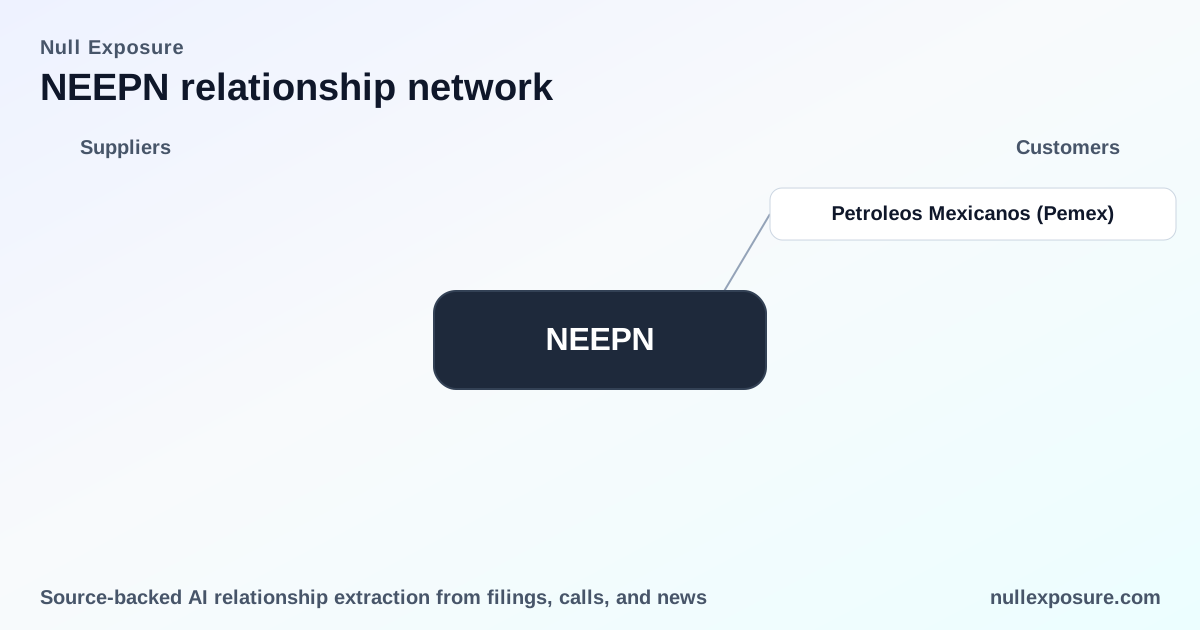
NEEPN Customer Relationships: What One Sovereign Counterparty Reveals to Investors
NextEra Energy Partners, LP (NEEPN) owns and operates long-term contracted renewable energy assets—primarily solar and wind—and monetizes through predictable cash flows secured by power purchase agreements and strategic asset acquisitions. For investors, the company's value proposition is stable, contract-backed revenue from essential energy infrastructure, with growth driven by accretive buy-and-build transactions and the broader energy transition. For a focused investor review, customer relationships are the lens through which counterparty credit, legal exposure, and revenue durability crystallize.
Explore provider-level insight and relationship mapping at https://nullexposure.com/ for a practical audit of partner risk and contract footprints.
One customer relationship, disproportionate signal
NEEPN’s public customer-relations feed in our sample lists a single material counterparty: Petroleos Mexicanos (Pemex). This is notable because Pemex is a sovereign-linked entity rather than a typical utility off-taker for renewable generation. The presence of a sovereign counterparty introduces a different set of legal and political risk vectors than a domestic utility PPA.
Pemex — sovereign counterparty and litigation limits
NextEra’s investor materials explicitly note that Petroleos Mexicanos (Pemex) may claim immunities under the Foreign Sovereign Immunities Act and Mexican law, which could limit the ability of NEP subsidiaries that own certain natural gas pipeline assets in Texas to sue or recover for breach of contract. The company flagged that any deterioration in U.S.–Mexico economic or political relations would exacerbate this legal exposure. (NextEra Energy newsroom, Feb 27, 2023).
- Plain-English takeaway: NEEPN faces a counterparty exposure where normal remedies for contract breach could be constrained by sovereign immunity claims, elevating recovery risk relative to standard corporate counterparties.
Why this single relationship matters to diligence
NEEPN’s business is defined by long-term contracted cash flows, so the creditworthiness and enforceability of those contracts are central to valuation. A sovereign-linked counterparty introduces three specific risk channels:
- Enforceability risk: Sovereign immunity can limit remedies; contractual rights on paper do not guarantee practical recoverability. The company itself disclosed this as a material legal consideration in investor communications (NextEra Energy newsroom, Feb 27, 2023).
- Political/geopolitical sensitivity: Cross-border disputes or shifts in bilateral relations increase the likelihood that a sovereign counterparty uses political tools to resist enforcement or alter commercial terms.
- Asset and contract mismatch: The disclosure references natural gas pipeline assets in Texas connected to the same ownership structure; this indicates that NEEPN (or related NEP subsidiaries) can have contractual or asset exposures that extend beyond pure solar/wind PPAs and into midstream and fuel-supply arrangements, which carry different commercial dynamics.
Company-level signals and operating model constraints
The dataset contains no explicit contractual constraint excerpts beyond the Pemex disclosure. As a company-level signal, that absence should be read in context:
- Contracting posture: NEEPN relies on long-dated contracts and strategic acquisitions to drive cash flow; this posture favors counterparties with investment-grade profiles or sovereign guarantees where appropriate. The Pemex note is an explicit acknowledgement that not all counterparties fit a textbook PPA profile.
- Concentration and criticality: The overview describes a diversified portfolio supported by stable power purchase agreements, suggesting management aims to spread counterparty credit and geographic risk. Nevertheless, the Pemex entry is a reminder that single, unusual relationships can be material if they touch legal enforceability or key assets.
- Maturity and legal complexity: Ownership of long-lived assets and cross-border contractual linkages implies mature commercial arrangements that can involve midstream, fuel, or sovereign entities—adding legal complexity beyond pure generation contracts.
These are company-level signals derived from the pattern of disclosure and corporate description rather than from specific contractual text.
How investors should translate this into action
For valuation and portfolio risk-control, treat the Pemex exposure as a differentiator that elevates legal diligence and counterparty analytics.
- Verify whether the referenced exposure relates to operating assets that underpin distributable cash flow or to non-core legacy agreements; the difference changes valuation leverage.
- Request counterparty credit summaries, dispute-history logs, and any waivers or sovereign consents tied to relevant contracts.
- Stress-test cash-flow projections under scenarios where sovereign immunity blocks recovery or renegotiation efforts, and model timing for dispute resolution or political remediation.
- Evaluate portfolio concentration: a diversified PPA book dilutes a single sovereign counterparty risk; if the portfolio is small or regional, the Pemex link is higher impact.
For rightsized due diligence on counterparties and contract enforceability, see practical audits at https://nullexposure.com/.
Final assessment: a manageable flag, not a valuation breaker
The Pemex disclosure is a clear and explicit legal flag that investors should not ignore: sovereign immunity changes the recovery calculus even when contracts look standard on paper. However, the company description emphasizes a diversified, long-term contracted renewables business, which generally supports predictable cash flows. Investors should therefore treat this as a targeted legal and counterparty diligence item—material in impact if concentrated, but manageable if the broader contract portfolio is robust and geographically diversified.
- Key takeaway: Pemex introduces a legal enforcement risk that requires focused remediation in due diligence; it does not, on its own, invalidate NEEPN’s contract-backed revenue model but it does change recovery assumptions and counterparty credit assessments (NextEra Energy newsroom, Feb 27, 2023).
For a structured partner-risk review and to map contract enforceability across a portfolio, visit https://nullexposure.com/ for methodology and client services.