Newegg Commerce (NEGG) — Customer Relationships and What They Signal for Investors
Newegg operates an online electronics retail platform and monetizes primarily through the sale of hardware and related services on Newegg.com, combining direct retail revenue with partner and third‑party commerce activity. Investor focus should be on channel concentration, geographic exposure, and the mix of hardware sales versus recurring service income, since these drive topline stability and margin volatility for a consumer‑cyclical e‑retailer. For a quick company‑level snapshot and relationship monitoring, visit https://nullexposure.com/ for structured coverage and filings consolidation.
What the filings collectively tell us about Newegg’s customer model
The relationship evidence in the available filings shows a mixed footprint that combines contracted distribution channels, government procurement engagements, and direct commercial customers. At the company level the extracted signals indicate:
- Geographic exposure to APAC: filings include revenue lines "derived from China," signaling material activity or revenue recognition linked to Greater China markets.
- Distributor‑centric revenue model: an explicit statement that over 90% of sales are to distributors is recorded; this indicates a contracting posture where Newegg relies heavily on channel partners to move inventory and drive accounts receivable.
- Business mix across hardware and services: evidence lists branded and proprietary medical hardware alongside after‑sales repair services, which implies a product + service revenue model rather than pure transactional retail.
- Concentration and customer criticality: historic disclosure that two customers represented roughly 13% of revenues each in 2012 is a notable concentration signal for small revenue bases and counterparty risk.
- Contracting roles: the corpus classifies relationships as distributor, seller, and service provider — reflecting both upstream distribution contracts and downstream direct sales / service commitments.
These are company‑level constraints derived from the filings and should be treated as structural signals: Newegg’s operating model favors channel distribution, has tangible APAC links, and generates revenue from both hardware sales and service lines, all of which influence cash flow timing and margin sensitivity.
Documented customer relationships in the record set
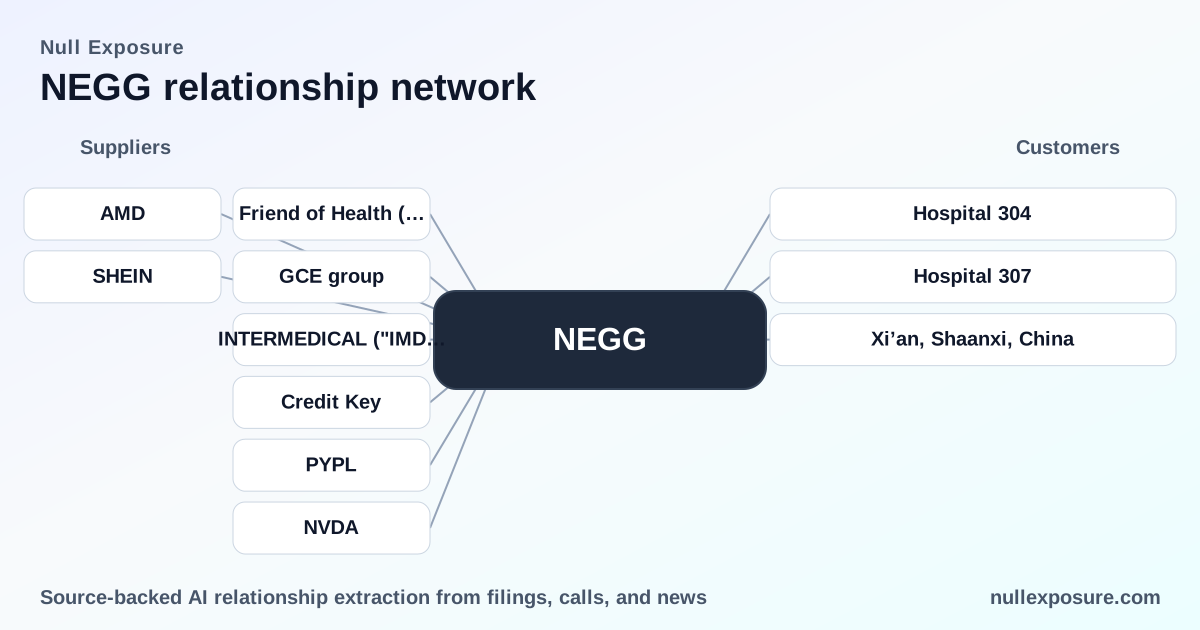
Hospital 304 (Beijing)
Newegg’s FY2012 Form 10‑K records that in September 2012 the company signed three medical equipment procurement agreements with Beijing’s Hospital 304, indicating direct government or hospital procurement engagements in China. This disclosure is from Newegg’s FY2012 10‑K filing.
Source: According to Newegg’s 2012 Form 10‑K (FY2012).
Hospital 307 (Beijing)
The same 2012 Form 10‑K specifies that in September 2012 Newegg signed three medical equipment procurement agreements with Beijing’s Hospital 307, evidencing additional hospital procurement contracts in the Beijing municipal system.
Source: According to Newegg’s 2012 Form 10‑K (FY2012).
Xi’an township hospitals (Shaanxi, China)
Newegg’s FY2012 filing records a March 2012 win in a government procurement bid to provide imaging equipment for township hospitals in Xi’an, Shaanxi, reflecting participation in regional public‑sector equipment programs. This is a procurement‑type contract tied to a Chinese provincial project.
Source: According to Newegg’s 2012 Form 10‑K (FY2012).
Cloudastructure, Inc. (CSAI) — US commercial buyer
A FY2025 SEC filing by Cloudastructure notes that Cloudastructure has purchased computers primarily through Amazon, Exxact Corporation, and Newegg Commerce, Inc., indicating Newegg acts as a commercial supplier for enterprise or cloud infrastructure customers in the U.S. market. This modern mention confirms Newegg’s role as a vendor for corporate hardware procurement.
Source: Cloudastructure FY2025 SEC filing (reported FY2025).
What investors should infer from the relationship mix
The relationships combine older, China‑focused public procurement activity (2012) with contemporary U.S. commercial sourcing (2025). From an investment perspective, that mix implies several structural points:
- Contracting posture: Newegg’s disclosures show a dual approach — awarded government procurement contracts and broad distribution agreements — signaling negotiated contracts on one hand and high‑volume channel sales on the other.
- Concentration risk: historic disclosure that two customers drove ~13% of revenue each in 2012 highlights potential counterparty concentration at times; ongoing exposure should be monitored in current filings and customer schedules.
- Geographic diversification but APAC significance: evidence of China‑derived revenue lines makes APAC an operationally relevant region; investors must weigh FX, regulatory and supply chain risk tied to that exposure.
- Revenue mix and margin implications: the presence of both hardware (medical imaging, branded medical devices) and services (after‑sales repair, distribution services) indicates a mixed margin profile where hardware sales produce thinner transactional margins while services can contribute higher, recurring margin if scaled.
- Maturity and recency of relationships: several relationships in the record are from FY2012 and therefore historical; the Cloudastructure FY2025 mention is a contemporary signal of commercial channel activity in the U.S., suggesting a sustained presence in direct computer hardware supply.
Risk and monitoring checklist for operators and analysts
- Track current quarter and annual filings for updated customer concentration figures and distributor revenue percentages to validate whether the >90% distributor sales signal persists.
- Confirm the status and revenue contribution of any government procurement or hospital contracts, especially those reported historically in APAC.
- Monitor service revenue growth to evaluate whether after‑sales services are becoming a stabilizing, higher‑margin complement to hardware sales.
- Watch receivables and working capital tied to major distributors; heavy distributor reliance can amplify credit risk and seasonality.
For a centralized view of these relationship signals and ongoing monitoring tools, visit https://nullexposure.com/ — the hub that consolidates filing‑level relationship intelligence and constraint signals for investor due diligence.
Bottom line: what matters for valuation and operations
Newegg’s customer footprint blends distributor‑driven volume, targeted public procurement, and direct commercial sales. For valuation, the critical variables are distributor concentration, APAC revenue exposure, and the pace at which service revenue scales relative to low‑margin hardware sales. Investors and operators should prioritize current disclosures on customer concentration and geographic revenue splits to assess counterparty risk and margin stability.