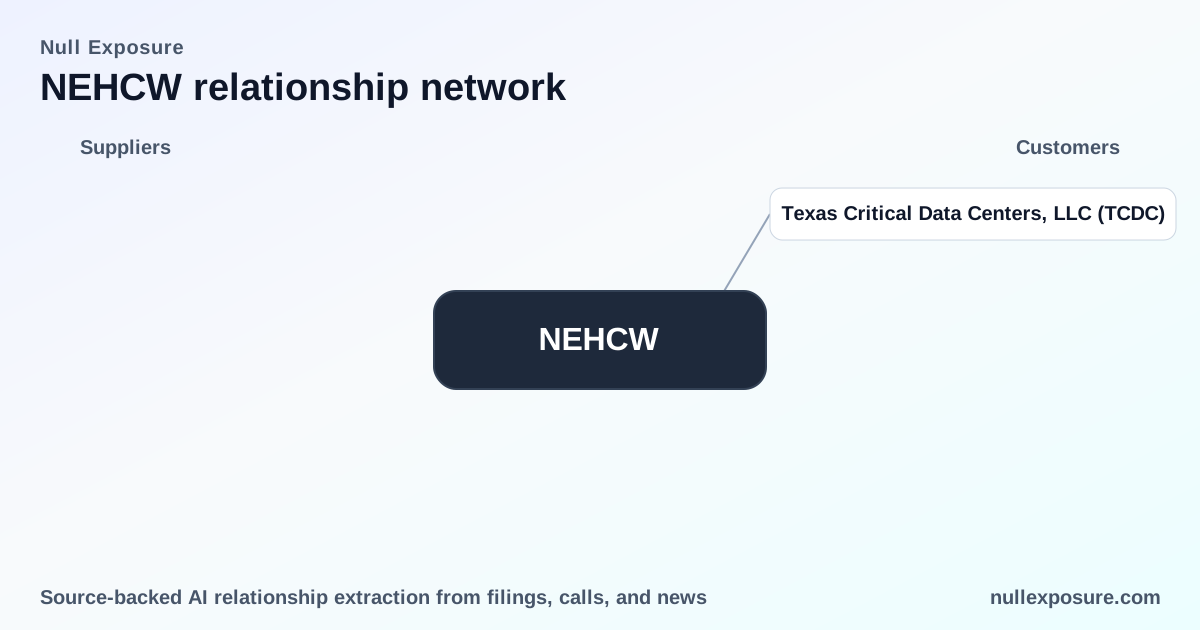
New Era Helium (NEHCW) — Customer Relationships That Matter to Investors
New Era Helium operates as an upstream helium exploration and production concern; as a warrant holder exposure (NEHCW) this translates into leveraged upside tied to the company’s ability to commercialize helium and associated gas streams through direct sales and contractual supply arrangements. Revenue generation is concentrated on resource monetization and energy-related contracts, while the warrant structure amplifies upside and downside for capital providers. For investor-focused customer intelligence, this note maps every named customer relationship in the public record and outlines the operating implications for commercial risk and value capture. For a deeper look at relationship-level reporting, visit https://nullexposure.com/.
Executive takeaway: what investors should hold front of mind
New Era’s public footprint shows targeted commercial agreements rather than broad retail channels. Two named relationships occupy the public narrative: a planned natural gas supply arrangement with a local data center developer and a reported commercial tie-up with a large secondary-ticket marketplace. Both relationships, if executed, are strategically different — one underpins project economics through energy supply, the other signals brand/marketing reach beyond pure commodity sales. Financials show modest trailing revenue and negative operating margins, underscoring early-stage commercialization risk alongside any customer gains (Revenue TTM: $626,100; Operating Margin TTM: -73.77%). For investor tools that track evolution of these relationships, see https://nullexposure.com/.
Business relationships in the public record
Texas Critical Data Centers, LLC (TCDC)
TCDC announced it expects to finalize a natural gas supply contract with New Era Helium in Q2 2025, positioning New Era as a low-cost energy counterparty for data-center operations and offering price stability to the TCDC project. According to FirstAlert7 (report dated Feb 28, 2025), this contract is intended to secure low-cost energy and stabilize operating costs for the Ector County data center build-out.
Source: FirstAlert7, Feb 28, 2025.
STUB (StubHub or related brand use)
A news item on Intellectia.ai (May 4, 2026) reported a partnership announcement between StubHub (labeled STUB) and New Era to deliver personalized merchandise recommendations to fans, framed as a joint market expansion initiative that should increase market share for both firms. The item frames this as a marketing and customer-experience collaboration rather than a commodity supply agreement.
Source: Intellectia.ai, May 4, 2026.
Interpreting these relationships: commercial lens and operational constraints
No formal constraint disclosures were provided in the relationship records; that absence itself is an actionable company-level signal. With no contractual constraints listed publicly, investors should treat the following as company-level characteristics that shape New Era’s customer posture:
- Contracting posture: New Era’s disclosed interactions indicate a willingness to execute both resource supply agreements (commodity/energy contracts) and commercial partnerships that extend beyond commodity sales. The TCDC link reflects a supplier role; the STUB report reflects a brand/marketing partnership posture.
- Concentration: Publicly named customer interactions are sparse and concentrated; two distinct relationships dominate the visible universe, implying high customer concentration risk unless additional agreements exist off-record.
- Criticality of relationships: The TCDC natural gas contract would be economically critical for a project that depends on low-cost, stable energy; that type of counterparty relationship can materially affect project-level cash flows. The STUB partnership is strategically beneficial for reach but not critical to commodity revenue.
- Maturity: Reported relationships suggest early-stage commercial traction rather than large, multi-year legacy contracts. New Era’s financial profile (modest revenue, negative operating margin and negative EBITDA) is consistent with a company still ramping commercialization and dependent on individual agreements to scale profitably.
Why these relationships matter for valuation and risk
- TCDC contract — direct margin impact: A supply contract with a large energy consumer like a data center developer can materially improve utilization and cash generation if priced favorably; this is a project-level lever that affects near-term operating economics. Investors should prioritize verification of contract terms, volumes, duration, and price floors.
- STUB partnership — optionality and brand reach: The StubHub-style tie-up is non-traditional for an energy company and signals management is pursuing revenue diversification or brand/consumer-facing initiatives. This kind of partnership can unlock new channels but does not substitute for core commodity revenues.
- Concentration and execution risk: With a small set of publicly visible counterparties, New Era is vulnerable to customer-specific negotiation outcomes. Contract cancellations or unfavourable re-pricing would disproportionately affect reported revenue.
What to monitor next (practical checklist for investors)
- Public filings or press releases confirming the TCDC gas supply contract terms (start date, volumes, pricing mechanism, contract length, and termination clauses).
- Evidence that the STUB relationship is executed at commercial scale (joint go-to-market activities, revenue-line attribution, or marketing deployments).
- Quarterly revenue and contract-recognition updates to see whether the reported relationships translate into recurring cash flow.
- Any new counterparties or off-balance long-term commercial commitments disclosed in investor materials.
Risk summary and final thoughts
New Era Helium’s commercial profile is defined by targeted relationships that can swing economics materially in either direction. The TCDC supply relationship is the most economically consequential of the two public items; the STUB report is strategically intriguing but secondary to core revenue generation. With limited public disclosures and concentrated counterparties, the stock-equivalent warrant NEHCW retains high operational and execution risk that requires active monitoring of contract confirmations and revenue realization.
For systematic coverage of evolving customer relationships and to receive updates when new contracts are recorded, visit https://nullexposure.com/.