NEN: Tenant Concentration in a Boston-Focused Realty Platform
New England Realty Associates (NEN) is a small-cap real estate limited partnership that acquires, develops, holds and operates multifamily and commercial properties in the Boston metropolitan area, monetizing primarily through rental income and selective property dispositions while returning cash to investors via a steady dividend. The company’s FY2024 disclosures identify named commercial tenants and explicitly flag customer concentration risk, which directly informs underwriting and operational priorities for landlords and investors. For a focused review of tenant relationships and what they mean for portfolio risk, see more at https://nullexposure.com/.
How NEN runs its business — concise investor thesis
NEN operates as a single business segment concentrated on ownership and operation of multifamily and commercial real estate in the greater Boston region. Revenue is driven by recurring rental income from both residential and commercial leases; the firm’s public filings classify certain large retail tenants under commercial rental income and call out customer concentration as a discrete risk. Financially, the company is profitable on the top line (Revenue TTM $90.7M) with positive EBITDA ($46.5M) and a shareholder-return profile that includes a dividend (Dividend Yield ~2.66%). The investment case is therefore one of localized real estate cash flow with concentrated tenant exposure and limited institutional float, which amplifies both stability and idiosyncratic risk.
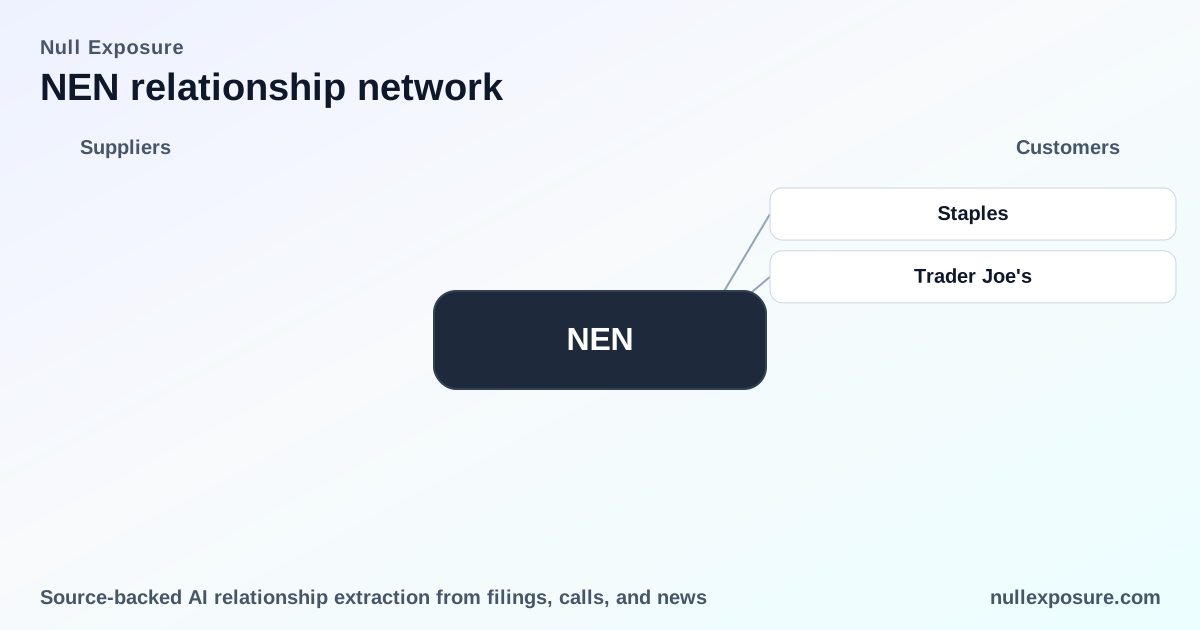
What the FY2024 10‑K specifically names: Staples and Trader Joe’s
Both tenant names below are drawn from NEN’s FY2024 Form 10‑K (filed for the year ended 2024‑12‑31), where they are referenced under commercial rental income and customer concentration discussions.
-
Staples — The FY2024 10‑K lists Staples among the contributors to commercial rental income and includes it within the company’s customer concentration disclosures for the period. According to the filing, Staples is captured as a named commercial tenant that factors into NEN’s concentration analysis for FY2024.
Source: NEN Form 10‑K, fiscal year ended 2024‑12‑31 (commercial rental income / customer concentration). -
Trader Joe’s — Trader Joe’s is likewise listed in the FY2024 10‑K under commercial rental income and is included in the same customer concentration grouping as Staples for the 2024 reporting period. The filing explicitly treats Trader Joe’s as a material commercial tenant for the company’s concentration disclosures in FY2024.
Source: NEN Form 10‑K, fiscal year ended 2024‑12‑31 (commercial rental income / customer concentration).
Why these named tenants matter for underwriting and operations
Both Staples and Trader Joe’s are national retail chains that typically function as anchor commercial tenants where present; anchor tenants influence foot traffic, co-tenant demand, and, importantly, lease economics such as term length and tenant improvement obligations. NEN’s 10‑K treating these tenants as part of a customer concentration disclosure signals that a meaningful portion of commercial rental revenues is attributable to a small set of tenant relationships, which elevates counterparty risk relative to a fully diversified rent roll.
Company-level constraints and what they indicate about NEN’s business model
The filings and metadata provide several company-level signals that shape how investors should view NEN’s operating model:
-
Geographic concentration: The partnership’s properties are located primarily in the metropolitan Boston area (including surrounding suburbs and southern New Hampshire). This regional focus concentrates market, regulatory and macroeconomic exposure in a single metro, which can create strong upside in a local recovery but amplifies downside in a localized downturn. Source: FY2024 10‑K location disclosures.
-
Revenue driver and relationship role: NEN’s filing frames its core receipts as rental income; the relationship role is essentially landlord → tenant. That contracting posture implies revenue stability through lease terms, but also contractual exposure to large retail tenants when they represent a meaningful share of commercial income. Source: FY2024 10‑K rental income and customer concentration notes.
-
Single-segment maturity: The company reports one operating segment—ownership, operation and development of multifamily and commercial real estate—indicating a mature, focused operating model rather than a diversified RE strategy. This concentrates expertise but limits earnings diversification. Source: FY2024 10‑K segment disclosure.
Together, these constraints show a classic small-cap RE platform: geographically concentrated, lease-driven cash flow, and meaningful tenant concentration. Investors should treat tenant credit and lease term structure as first-order underwriting variables.
Balance-sheet and market context for risk sizing
Key public metrics paint the wider financial picture: market capitalization ($210M), trailing EBITDA ($46.5M), Revenue TTM (~$90.7M), and an ongoing dividend distribution (Dividend Per Share $1.60; Yield ~2.66%). Insider ownership is material (insiders ~34.4%) while institutional ownership is light (~3.5%) and the free float is unusually small, a structure that supports stability in voting and strategy but can reduce liquidity for outside investors. These factors mean that while NEN produces recurring cash flow, the stock’s trading dynamics and concentration exposures require active position sizing and liquidity planning.
Risks and opportunities — focused investor checklist
- Concentration risk is explicit. The 10‑K identifies specific commercial tenants in a customer concentration disclosure; investors should quantify the revenue share attributable to named tenants in due diligence.
- Geographic exposure is concentrated in Greater Boston. Local market cycles, zoning, and regulatory changes will disproportionately affect NEN’s cash flows.
- Lease structure is the key control lever. Long-term, triple-net or anchor-tenant lease protections reduce volatility; short-term or percentage-rent arrangements increase it. The filing frames revenue as rental income, which implies traditional lease contracting, but investors should obtain lease abstracts to confirm protections.
- Capital structure and ownership. High insider ownership and low institutional float create both stability and potential governance opacity; M&A or recapitalization outcomes would be insider-driven.
Bottom line: focused real estate cash flow with tenant concentration that requires active monitoring
New England Realty Associates delivers stable rental-derived cash flow within a tightly focused Boston real estate footprint, and its FY2024 10‑K specifically names Staples and Trader Joe’s as commercial tenants included in a customer concentration disclosure. For investors, the essential question is not whether the platform generates rent — it does — but how much of that rent is tied to a small set of commercial counterparties and how well leases protect cash flow if those tenants change behavior or leave.
If you’re evaluating NEN as part of a real estate allocation, prioritize covenant-level lease review, tenant revenue share analysis and local-market rent trend work. For a structured view of customer relationships and public-filing evidence across small-cap RE issuers, visit https://nullexposure.com/ for more detailed relationship profiles and filing-based signals.