Neogen (NEOG): Zoetis Buyout Recasts Revenue Mix — What investors should know
Neogen operates and monetizes through a dual product-and-service model: manufactured diagnostic kits and consumable animal- and food-safety products sold at shipment, and fee-for-service lab and genomics offerings plus software that supports test data management. Revenue recognition is largely transaction-based (products invoiced at shipment; laboratory services invoiced on delivery of results), supplemented by recurring sales to distributors and end users across global markets. The company’s strategic move to sell its animal genomics business to Zoetis for $160 million is a clear pivot to concentrate on core food-safety manufacturing and commercial services while crystallizing value from a non-core services asset. Explore more on the firm’s partner map at https://nullexposure.com/.
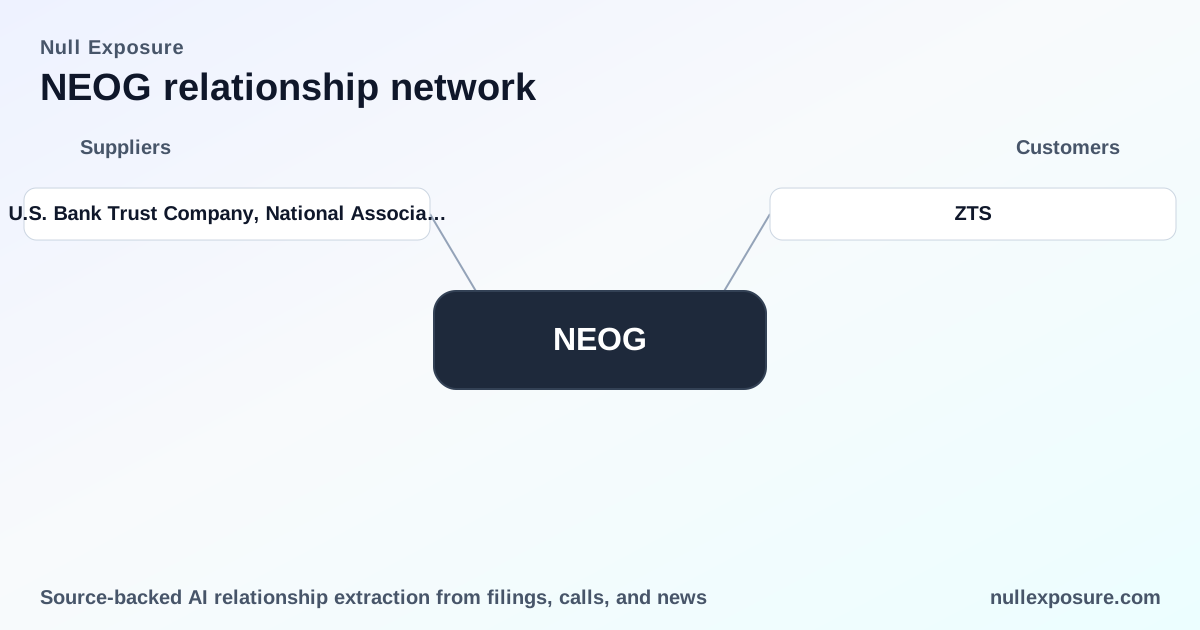
The headline relationship: Zoetis acquires Neogen’s animal genomics business
Neogen has entered into a definitive agreement to sell its animal genomics business to Zoetis (ZTS) for $160 million, subject to customary closing adjustments, with closing expected in the second half of calendar 2026. This transaction transfers the genomics assets and associated service capability to the world’s largest animal-health company and signals Neogen’s purposeful portfolio reshaping toward food-safety products and related services. According to multiple press releases and reports, including Provisioner Online and Finviz (March–May 2026), the deal is positioned as an acceleration of precision animal-health offerings under Zoetis.
Relationship summary (as reported)
- Zoetis / ZTS — Zoetis agreed to acquire Neogen’s animal genomics business for $160 million, with expected closing in H2 2026; the announcement was widely reported across trade and financial outlets in March–May 2026. Sources: Provisioner Online (May 3, 2026) and Finviz coverage (March 2026).
Why this matters to investors: cash, focus, and margin dynamics
The sale is accretive to Neogen’s strategic focus and liquidity: $160 million in proceeds provides immediate capital to reduce debt, reinvest in manufacturing scale for Food Safety, or fund M&A that better fits the company’s core product roadmap. Neogen reports trailing twelve-month revenue of roughly $870.6 million with gross profit of $393.6 million (latest company data through Feb 28, 2026); extracting the genomics business narrows revenue diversity but strengthens concentration on higher-margin test kits and consumables. Company filings and market commentary indicate the company is repositioning operations and workforce as part of this portfolio refocus (company press reports and analyst coverage, March–April 2026).
How the operating model shapes commercial exposure
Neogen’s contract and revenue patterns create distinctive risk/reward characteristics:
- Short-term, transactional contracting posture. Payment terms are generally 30–90 days, and product revenue is recognized on shipment; this creates predictable near-term cash conversion but leaves working capital sensitive to inventory and receivable cycles.
- Spot and performance-linked service revenue. Laboratory and genomics services are invoiced when results are delivered, making a portion of revenue inherently variable and throughput-dependent.
- Low single-customer concentration. The company reports that no single customer or distributor accounted for 10% or more of revenues in recent fiscal years, which materially reduces counterparty concentration risk.
- High geographic diversification. Roughly 50% of revenues come from outside the U.S., and regional presence includes APAC and LATAM offices and distribution centers, which creates both revenue diversification and exposure to FX and regional regulatory regimes.
- Mixed counterparty base. Customers range from small grain elevators to very large global food processors and regulatory agencies, so sales channels must support both high-volume enterprise accounts and numerous small buyers.
- Business maturity and segment mix. Neogen sells manufactured core products (diagnostic kits, consumables) alongside services (genomics, labs) and software for data management — a mix that balances recurring consumables revenue with higher-value, less-frequent service work.
Those characteristics frame expected volatility: stable consumables revenue with episodic service swings, multinational macro sensitivity, and manageable counterparty concentration.
Operational consequences of the divestiture
Selling the genomics unit changes Neogen’s operating profile in tangible ways:
- Strategic simplification: Portfolio aligns more tightly to Food Safety and Animal Safety consumables and diagnostics, enabling concentrated investment in manufacturing and distribution efficiency.
- Service footprint reduction: Loss of in-house genomics services lowers service revenue but reduces capital and operating expense tied to specialized lab facilities and bioinformatics support.
- Working-capital and margin effects: The $160 million proceeds improve liquidity and can be deployed to bolster margins (through scale manufacturing or targeted cost actions) or to accelerate R&D in core diagnostic lines.
These effects are consistent with the company’s public statements and industry coverage around the transaction (CityBiz, Drovers, NJBIZ; March–May 2026).
What investors should watch next
- Execution of proceeds deployment: debt reduction vs. capex vs. share repurchases will materially affect leverage and per-share economics.
- Revenue replacement and margin trajectory in the Food Safety segment as investment reallocates away from the genomics service line.
- International demand stability: with half of revenues from abroad, FX, regulatory changes, and regional supply chains will drive topline momentum.
- Operating cash flow and receivables management given the company’s 30–90 day payment terms and shipment-based revenue recognition.
Neogen’s latest public metrics show trailing revenue of $870.6M and EBITDA of $81.26M, with an analyst consensus target price around $12 (company filings and sell-side coverage through FY2026).
Final read: concentrated focus, improved liquidity, persistent execution risk
The Zoetis transaction is a decisive portfolio unburdening that converts a specialized services asset into immediate capital and aligns Neogen to its higher-volume, product-led strengths. The company’s short-term contracting posture, global footprint, and low customer concentration reduce single-counterparty risk while exposing the business to macro and operational execution variables as it reallocates capital. For investors, the key calculus is whether management converts the $160 million inflow into durable margin improvement and reinvestment that sustains revenue growth in core product lines.
If you want a concise, investor-oriented map of Neogen’s partner moves and strategic posture, see our coverage hub at https://nullexposure.com/.
Key takeaway: Neogen is trading a services arm for capital and strategic clarity — the outcome depends on disciplined deployment and steady execution across a globally diversified customer base.