Minerva Neurosciences (NERV): Capital structure framed by royalties and a concentrated financing syndicate
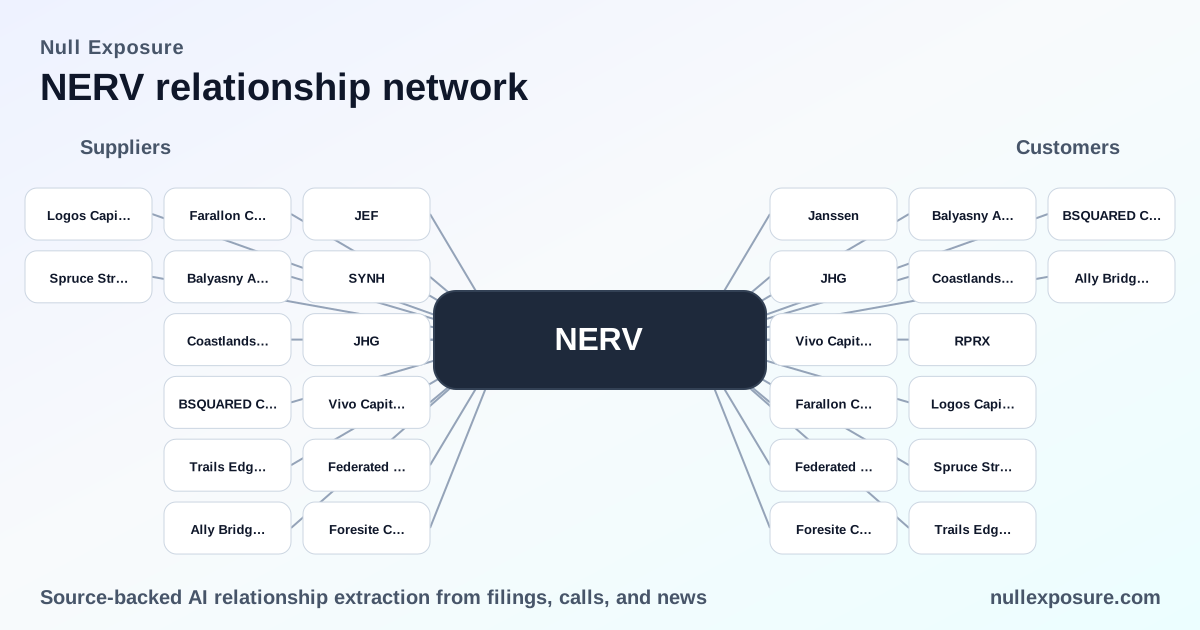
Minerva Neurosciences is a clinical‑stage biotech that develops CNS drug candidates and monetizes primarily through non‑dilutive royalty monetizations and project‑level financings rather than product sales; the company has sold future royalty streams and assembled a syndicate of growth‑oriented investors to fund its Phase 3 development. For investors and operators assessing counterparty risk, Minerva’s model is defined by a long‑term royalty sale commitment, reliance on partner development (Janssen), and a concentrated financing group that underwrites Phase 3 execution. Learn more about how we map counterparty exposure at NullExposure: https://nullexposure.com/
How Minerva generates liquidity and what that means for counterparties
Minerva has no commercial revenues and operates as a prospect-stage developer of CNS therapeutics. Liquidity is produced through asset monetization and financing vehicles rather than product cash flows: the company sold royalty rights to seltorexant and has raised committed capital to advance roluperidone into confirmatory Phase 3 work. The seltorexant transaction generated a $60 million upfront payment and structured milestone upside, and Minerva records that upfront as a liability and amortizes subsequent expected milestone consideration as interest expense — a contractual posture consistent with long‑dated, non‑recourse royalty financing.
This structure creates several operational characteristics investors must track:
- Contracting posture — long‑term: Royalty sales are treated as liabilities amortized over the life of the agreement, embedding multi‑year payment obligations rather than one‑off income. (Company disclosure, FY2024 10‑K.)
- Concentration: Development and monetization hinge on a small set of counterparties: Janssen for Phase 3 development of seltorexant and a handful of institutional investors leading a large financing to support roluperidone.
- Criticality: Partner success and milestone triggers are mission‑critical to future cash receipts; clinical outcomes and partner decisions directly determine upside.
- Maturity and stage: Minerva is a prospect — it has not commercialized products and has no product revenue to date. This keeps counterparty arrangements as primary drivers of near‑term value.
- Geographic focus: Regulatory and commercialization plans explicitly target North America, the EU/EMEA and Latin America, indicating regional go‑to‑market planning but no current sales footprint.
- Government counterparty posture: Filing language explicitly notes a restriction related to government contracting, which is a company‑level signal about the types of counterparty opportunities Minerva will not pursue.
Counterparty map: every customer and financing relationship in the record
Below is a concise, investor‑oriented summary of each counterparty referenced in Minerva’s customer/financing coverage, with source context.
Royalty Pharma (RPRX)
Minerva sold its royalty interest in seltorexant to Royalty Pharma for a $60 million upfront payment and up to $95 million in contingent milestones; Minerva revised its estimated future cash‑flow assumptions related to that Royalty Purchase Agreement during 3Q 2024 and records the transaction as a liability. Source: Minerva FY2024 10‑K (filed 2024‑12‑31) and company financial results press release (GlobeNewswire, March 11, 2026).
Janssen
Janssen is conducting the Phase 3 trial for seltorexant — a program originally co‑developed with Minerva — which creates potential milestone payment triggers for Minerva under existing agreements. Source: SEC 10‑Q commentary / news coverage referencing Phase 3 (TradingView report, March 10, 2026).
Janus Henderson Investors (JHG)
Janus Henderson is listed among institutional participants in a financing that supports Minerva’s Phase 3 confirmatory trial for roluperidone; its participation signals traditional asset managers backing later‑stage CNS programs. Source: InvestingNews financing announcement (March 10, 2026).
Vivo Capital LLC
Vivo Capital led the up‑to‑$200 million financing to advance roluperidone; as lead investor, Vivo provides both capital and an implicit governance voice over trial progression. Source: InvestingNews financing announcement (March 10, 2026).
Federated Hermes Kaufmann Funds
Federated Hermes Kaufmann Funds participated as an institutional investor in the financing vehicle for roluperidone, contributing to the syndicate that will fund Phase 3 operations. Source: InvestingNews (March 10, 2026).
Farallon Capital Management
Farallon is another institutional investor named as a participant in the financing round, reflecting hedge‑fund style capital supporting development risk. Source: InvestingNews (March 10, 2026).
Balyasny Asset Management
Balyasny Asset Management joined the financing syndicate that will underwrite confirmatory trials, adding yet another asset manager to the concentrated investor group. Source: InvestingNews (March 10, 2026).
Logos Capital
Logos Capital is listed among participating investors in the up‑to‑$200 million financing, contributing to the institutional base funding clinical development. Source: InvestingNews (March 10, 2026).
BSQUARED Capital
BSQUARED Capital is included in the investor roster supporting Minerva’s Phase 3 financing, representing specialist health‑care‑focused capital. Source: InvestingNews (March 10, 2026).
Trails Edge Capital Partners
Trails Edge Capital Partners is a participating investor in the financing package for roluperidone, broadening the mix of specialized funds behind the program. Source: InvestingNews (March 10, 2026).
Ally Bridge Group
Ally Bridge Group is named as a participant in the financing syndicate for Minerva’s Phase 3 program, evidencing cross‑border investor interest in CNS therapeutics. Source: InvestingNews (March 10, 2026).
Foresite Capital
Foresite Capital participated in the financing to advance roluperidone, indicating involvement from healthcare‑focused venture and growth investors. Source: InvestingNews (March 10, 2026).
Spruce Street Capital
Spruce Street Capital is listed as one of the institutional participants in the financing that will fund the Phase 3 confirmatory trial. Source: InvestingNews (March 10, 2026).
Coastlands Capital
Coastlands Capital is included among the financing participants backing Minerva’s Phase 3 development, filling out the syndicate of investment managers. Source: InvestingNews (March 10, 2026).
Key investment takeaways and operating risks
- Royalty monetization is the headline liquidity mechanism: the $60 million upfront from Royalty Pharma is recorded as a long‑term liability and establishes future cash dependency on milestone achievement. This transforms future upside into a contractual stream rather than immediate earnings. (FY2024 10‑K.)
- Outcome‑dependent value: the commercial value of seltorexant and roluperidone is conditional on Janssen’s Phase 3 results and Minerva’s ability to execute trials funded by its investor syndicate; clinical risk is therefore the dominant value driver.
- Concentrated partner and investor exposure: a relatively small group of institutional investors plus one large royalty purchaser define Minerva’s counterparty footprint; operational failure at the program level would sharply compress anticipated cash receipts.
- Geographic commercialization planning is multi‑regional: Minerva plans to seek approvals and either build or contract commercialization capacity across North America, EU/EMEA and Latin America, which imposes regulatory and market execution tasks once approvals are achieved.
If you need a counterparty risk scorecard or a contractual cash‑flow timeline for Minerva’s royalty and financing arrangements, visit NullExposure for structured analytics and dashboarding: https://nullexposure.com/
Minerva’s current valuation and optionality are tightly coupled to a handful of external players — Royalty Pharma’s purchase and the investor syndicate’s financing are the two levers converting development milestones into corporate liquidity, and both warrant continuous monitoring through filings and clinical milestones.