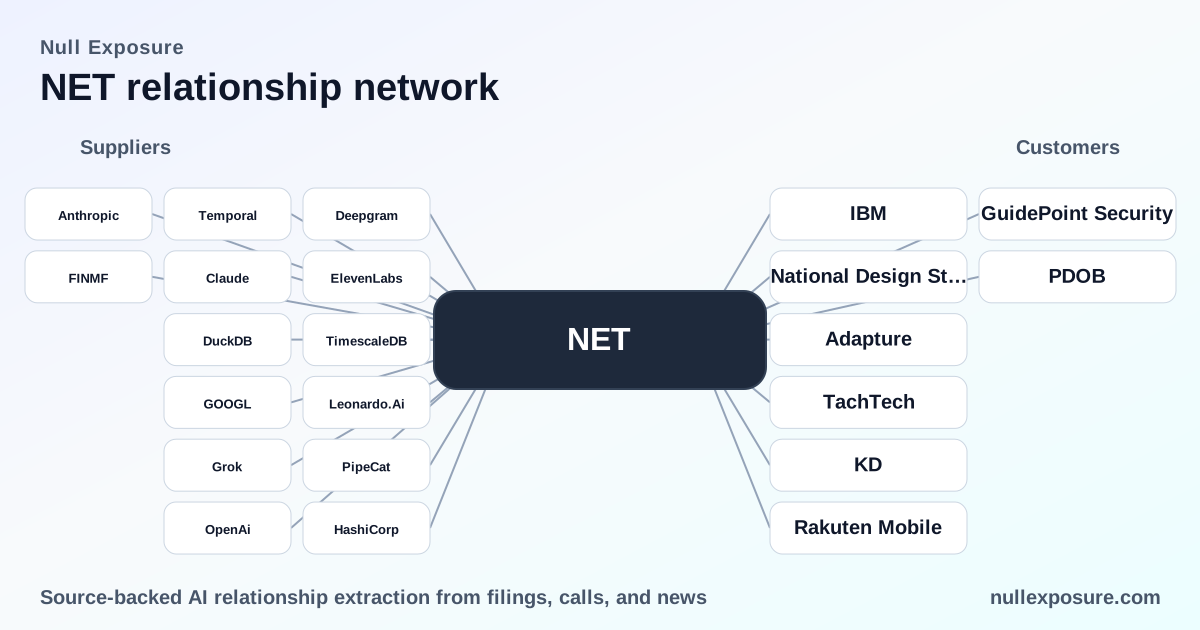
Cloudflare (NET): Customer Relationships that Drive Edge Growth and Risk Exposure
Cloudflare operates a global edge network that sells subscriptions and usage-based services—from CDN and WAF to serverless compute and Logpush telemetry—to a diversified base of enterprises, governments, and SMBs; the company monetizes through a mix of recurring enterprise agreements, shorter-term pay-as-you-go plans, and metered consumption for developer and bandwidth usage. For investors, the customer map shows broad adoption across security and AI tooling partners, channel expansion with global systems integrators, and low revenue concentration but clear operational dependence on uptime and telemetry integrity. Learn more at https://nullexposure.com/.
What the customer list tells you about Cloudflare's commercial engine
Cloudflare’s revenue model combines subscription predictability (Enterprise/Business contracts) with variable, high-margin usage from Workers and bandwidth metering. The company’s contracting posture is a hybrid: long-term, non-cancelable enterprise contracts (1–3 years) sit alongside monthly pay-as-you-go accounts and metered developer consumption, which together enable predictable ARR growth while preserving upside from variable AI and edge workloads. The customer roster below highlights three strategic themes for investors: platform integration with security vendors, channel-led distribution, and early adoption by AI/agentic web customers where metered usage can accelerate revenue per user.
If you want a concise, investor-focused dossier on customer signals and relationship evidence, visit https://nullexposure.com/ for our data-driven summaries.
Operating-model constraints and company-level signals investors should price
- Contract mix and revenue recognition: Cloudflare runs a dual contract model—enterprise subscriptions that are often multi-year and non-cancelable alongside usage-based billing for Workers and excess bandwidth. This structure preserves recurring revenue while allowing rapid monetization of surges in traffic or AI agent workloads (company filings, FY2024–FY2025).
- Customer concentration and materiality: No single customer represented more than 10% of revenue in recent years, indicating low concentration risk even as large customers increasingly contribute a larger share of revenue (FY2022–FY2024 filings).
- Service criticality and uptime exposure: Many contracts include service-level commitments (Business and Enterprise), creating operational leverage: availability incidents can have outsized reputational and financial impact.
- Geographic and segment breadth: Cloudflare’s network is truly global, with material revenue split across North America, EMEA, and APAC, supporting a diversified counterparty base of large enterprises, mid-market, SMBs, governments, and non-profits.
- Customer maturity and scale: The company reports hundreds of thousands of paying customers with a meaningful cohort of large accounts (annual revenue > $100k), indicating a mature, multi-segment commercial funnel.
Relationship roll-call: what each customer link means (complete coverage)
Below are every relationship cited in the results set, with a plain-English summary and the original source.
-
Coinbase — Coinbase is reported to be leveraging Cloudflare’s infrastructure for stablecoin-based AI agent payments via the x402 protocol, reflecting Cloudflare’s role in supporting emerging agentic payment flows and crypto-integrated applications (TradingKey, Market Movers, March 18, 2026: https://www.tradingkey.com/news/Market-Movers/261695718-market-movers-net-20260318).
-
National Design Studio — Cloudflare lists National Design Studio as a partner running work in production for government beta sites such as CIO.gov, showing public-sector adoption and developer platform usage for government digital services (Cloudflare blog, AI Week 2025 wrap-up; Cloudflare data platform and developer platform posts, FY2025: https://blog.cloudflare.com/ai-week-2025-wrapup/; https://blog.cloudflare.com/cloudflare-data-platform/; https://blog.cloudflare.com/cloudflare-developer-platform-keeps-getting-better-faster-and-more-powerful/).
-
Adapture — Adapture moved a client from a 600-seat to a 5,000-seat deployment of Cloudflare Access, indicating Cloudflare’s utility in identity and zero-trust rollouts at scale for managed service providers (Cloudflare blog, Shadow AI analytics, FY2025: https://blog.cloudflare.com/shadow-AI-analytics/).
-
Elicio Therapeutics (ELTX) — Elicio’s press materials explicitly reference Cloudflare services and cookies used for load-balancing and website operation, illustrating the commonplace, background integration of Cloudflare’s delivery and DNS services in biotech web properties (Elicio press releases, FY2024–FY2026: https://elicio.com/press_releases/elicio-therapeutics-reports-full-year-2025-financial-results-and-provides-corporate-updates/; https://elicio.com/press_releases/elicio-therapeutics-to-present-new-preliminary-data-...).
-
SentinelOne — Multiple reports indicate an expanded partnership to integrate Cloudflare Logpush telemetry into SentinelOne’s Singularity AI SIEM, turning edge telemetry into live signals for automated detection and response and potentially lifting both product stickiness and contract value (Investing.com and TradingKey reporting, March–May 2026; Sahm Capital coverage, FY2026: https://www.investing.com/news/insider-trading-news/cloudflare-ceo-matthew-prince-sells-332-million-in-stock-93CH-4604359; https://www.tradingkey.com/news/Market-Movers/261695718-market-movers-net-20260318; https://www.sahmcapital.com/news/content/sentinelone-expanded-cybersecurity-partnership-with-cloudflare-2026-03-16).
-
IBM / IBM Cloud — Cloudflare has expanded strategic partnerships across global service integrators including IBM Cloud, signaling channel amplification and co-sell motion into IBM’s enterprise customer base (MarketScreener coverage, FY2025: https://www.marketscreener.com/news/cloudflare-channel-business-accelerates-with-new-program-advancements-ce7d5ad8d089f421).
-
GoDaddy — Cloudflare and GoDaddy announced integration of AI Crawl Control into GoDaddy’s hosting platform to manage AI-driven traffic, demonstrating Cloudflare’s role in controlling generative/agentic crawls at scale across millions of hosted sites (Sahm Capital reporting, April 2026: https://www.sahmcapital.com/news/content/godaddy-cloudflare-deal-puts-ai-content-control-and-valuation-in-focus-2026-04-23; https://www.sahmcapital.com/news/content/the-bull-case-for-godaddy-gddy-could-change-following-its-new-ai-agentic-web-push-learn-why-2026-04-10).
-
TachTech — Cloudflare cites TachTech as a partner leveraging Cloudflare One and SASE to accelerate Zero Trust and safe AI deployments, underscoring channel/partner-led adoption of Cloudflare’s security stack (Cloudflare blog, Shadow AI analytics, FY2025: https://blog.cloudflare.com/shadow-AI-analytics/).
-
Kyndryl — Listed among Global Service Integrator partners, Kyndryl’s inclusion signals enterprise systems-integration channels for Cloudflare’s managed deployments (MarketScreener, FY2025: https://www.marketscreener.com/news/cloudflare-channel-business-accelerates-with-new-program-advancements-ce7d5ad8d089f421).
-
Rakuten Mobile — Named in Cloudflare’s channel expansion, Rakuten Mobile reflects telco and edge distribution partnerships supporting mobile and regional network integrations (MarketScreener, FY2025: https://www.marketscreener.com/news/cloudflare-channel-business-accelerates-with-new-program-advancements-ce7d5ad8d089f421).
-
GuidePoint Security — GuidePoint appears as a managed security partner, evidencing reseller and MSSP pathways into government and regulated customers (MarketScreener, FY2025: https://www.marketscreener.com/news/cloudflare-channel-business-accelerates-with-new-program-advancements-ce7d5ad8d089f421).
-
Presidio — Presidio’s inclusion in partner lists shows further channel depth for enterprise security and networking deployments (MarketScreener, FY2025: https://www.marketscreener.com/news/cloudflare-channel-business-accelerates-with-new-program-advancements-ce7d5ad8d089f421).
-
Mastercard — Mastercard teamed with Cloudflare to provide cybersecurity tools for small businesses and government entities, indicating strategic alliances with payments firms to broaden product reach into SMB security offerings (Sahm Capital coverage, Feb 2026: https://www.sahmcapital.com/news/content/mastercard-partnerships-reshape-growth-story-in-digital-payments-and-cybersecurity-2026-02-25).
-
Zoom — Historical reporting notes Cloudflare involvement in service restoration after outages affecting Zoom and LinkedIn, a reminder that Cloudflare’s operational performance directly affects major SaaS customers and news visibility (New York Post reporting, FY2023 referenced: https://nypost.com/2023/02/07/zoom-to-cut-1300-jobs-ceo-eric-yuan-will-take-98-pay-cut/).
Investment implications and risks — concise takeaways
- Growth lever: Integration with security vendors (SentinelOne), payments (Coinbase/Mastercard), and major channels (IBM, Kyndryl, GoDaddy) accelerates cross-sell and usage-based uplifts—positive for revenue per customer.
- Operational risk: High dependence on network availability and telemetry integrity means outages or data integrity issues translate to reputational and contractual risk.
- Contract balance: The mix of multi-year enterprise contracts and metered consumption protects baseline ARR while offering incremental upside from AI and edge compute usage.
- Low single-counterparty concentration reduces top-client risk, but aggregated exposure to regulated sectors and public-sector contracts can amplify compliance and performance requirements.
For a compact investor briefing and to explore relationship-level signal maps, visit https://nullexposure.com/.