NewMarket (NEU): Customer relationships that shape margins and downside
NewMarket operates two tightly integrated businesses: petroleum additives (Afton/ethyl brands) that formulate and sell fuel and lubricant packages to refiners, marketers and distributors, and specialty materials that supply critical chemical components — including hydrazine and ammonium perchlorate — to defense and aerospace customers. The company monetizes through product sales, contracted manufacturing services, and selective acquisitions that add proprietary feedstocks and government-facing supply lines, with stable cash generation reflected in a high dividend and healthy operating margins.
For a concise, investor-focused view of customer risk and opportunity, review NewMarket’s customer relationships below and how they interact with the company’s contracting posture, geography and role in supply chains. For full platform access, visit https://nullexposure.com/.
Why customers matter for NEU’s P&L and valuation
NewMarket’s revenue profile is driven by three structural levers: 1) formulation and margin capture when selling concentrated additive packages to lubricant manufacturers and fuel marketers, 2) volume and price exposure from distribution channels and refiner customers, and 3) contracted manufacturing and government supply that command premium pricing and require compliance and reliability. The company’s FY2025 regional mix — roughly North America ~40%, EMEAI ~30%, Asia Pacific ~20%, Latin America remainder — gives it a geographically diversified revenue base while keeping specialty materials sales concentrated in the United States. (Company disclosures, FY2025.)
Named customers and what they mean for NEU’s revenue and risk profile
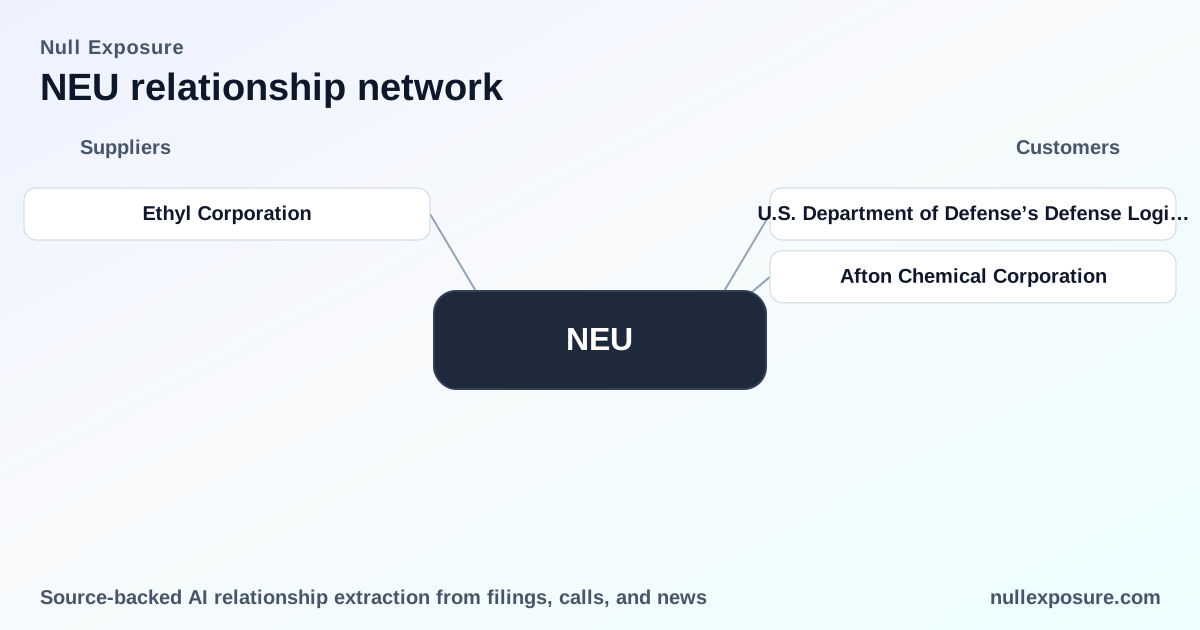
The U.S. Department of Defense’s Defense Logistics Agency – Energy: a strategic defense customer through Calca
NewMarket’s acquisition of Mars TopCo, the parent of Calca Solutions, brings a trusted supplier relationship for high‑purity hydrazine to the U.S. Defense Logistics Agency – Energy, providing direct exposure to long-standing defense supply channels that demand high reliability and regulatory compliance. This acquisition was completed in March 2026 and cited Calca’s more-than-70-year history as a DLA‑Energy supplier (CityBiz, March 10, 2026).
Afton Chemical Corporation: contracted manufacturing and channel relationships
NEU’s Ethyl unit provides contracted manufacturing and related services to Afton Chemical, and Ethyl also functions as a marketer of antiknock compounds in North America — a relationship that underpins feedstock-to-market integration and margin capture across the petroleum additives value chain (MarketScreener, March 10, 2026).
ACAD (Acadia Pharmaceuticals): an outlier mention without a clear customer link
The item tagged ACAD references Acadia’s expanded licensing arrangements with Neuren for trofinetide and NNZ‑2591 in a 2026 trading/SEC filing; the cited report does not establish a direct customer relationship between Acadia and NewMarket and therefore reads as a non‑customer mention captured in the source set (TradingView/SEC summary, March 9, 2026).
Operating constraints and what they signal about NewMarket’s business model
- Contracting posture — usage-based and short-term orientation. NewMarket operates supplier‑managed inventory arrangements in which revenue is recognized when a customer consumes product; many petroleum additives contracts are satisfied at a point in time (shipment, delivery or consumption). These terms produce lower forward revenue visibility but tight alignment of cash with physical usage (company disclosures, FY2025).
- Spot and short-term contracts dominate. Contracts lack long-dated financing components and extended payment schedules, which reduces receivables duration but increases sensitivity to cyclical demand.
- Counterparty mix includes governments and large enterprises. The company supplies specialty materials to U.S. government agencies, government contractors and allied space/defense programs, while petroleum additives are sold extensively to major fuel marketers, refiners and distributors — a mix that balances credit quality with concentration risk.
- Geographic diversification with North America concentration for specialty materials. Petroleum additives are diversified globally (NA ~40%, EMEAI ~30%, APAC ~20%, LATAM remainder), yet specialty materials sales remain predominantly U.S.-focused, concentrating regulatory and geopolitical risk domestically.
- Role in the value chain — both manufacturer and distributor. NEU supplies finished additive formulations to lubricant manufacturers and sells directly and through qualified distributors for specialty chemicals, which increases its bargaining power on formulations but also creates downstream dependency on large OEMs and refiners.
- Credit loss exposure is immaterial. The allowance for credit losses was reported as not material at year‑end 2025, supporting the view of a high-quality receivables book (company financial disclosures, FY2025).
These constraints combine into a business model that delivers strong margins and cash but limited revenue visibility: the company benefits from high-margin formulations and defense supply premiums, while being exposed to demand cyclicality and customer concentration in specific product lines.
For more context on how investor-grade customer intelligence is assembled, see https://nullexposure.com/.
Investment implications — upside drivers and warning flags
- Upside drivers: accretive M&A that adds government‑facing specialty chemical capacity, steady demand for fuel and lubricant additives tied to global vehicle fleets and refining throughput, and disciplined pricing power embedded in proprietary chemistries.
- Warning flags: short-term, usage-based contracts lower forward visibility, concentrated specialty materials exposure to U.S. defense programs and the operational demands of compliance and export controls, and cyclicality in refinery utilization that feeds through to additive volumes.
- Risk mitigants: high operating margins, immaterial credit losses, established distributor and OEM relationships, and a demonstrated ability to integrate acquisitions (e.g., Calca).
Bottom line for investors
NewMarket combines a resilient margin structure with selective government exposure and global additive distribution, delivering predictable cash flow and shareholder return potential while retaining sensitivity to cyclical end markets and short-term contractual arrangements. The March 2026 Calca acquisition strengthens NEU’s foothold in defense supply chains; Ethyl’s contracted manufacturing relationships preserve integration benefits; and outlier mentions like the ACAD filing do not substantively change NEU’s customer risk profile based on the cited sources.
If you evaluate counterparty concentration, regional exposure, or contractual terms as part of your thesis, NewMarket’s disclosures and recent transaction activity warrant close attention to order patterns in supplier‑managed inventory, government contract retention, and refining demand trends. For follow-up data and transaction-level customer intelligence, explore our coverage at https://nullexposure.com/.