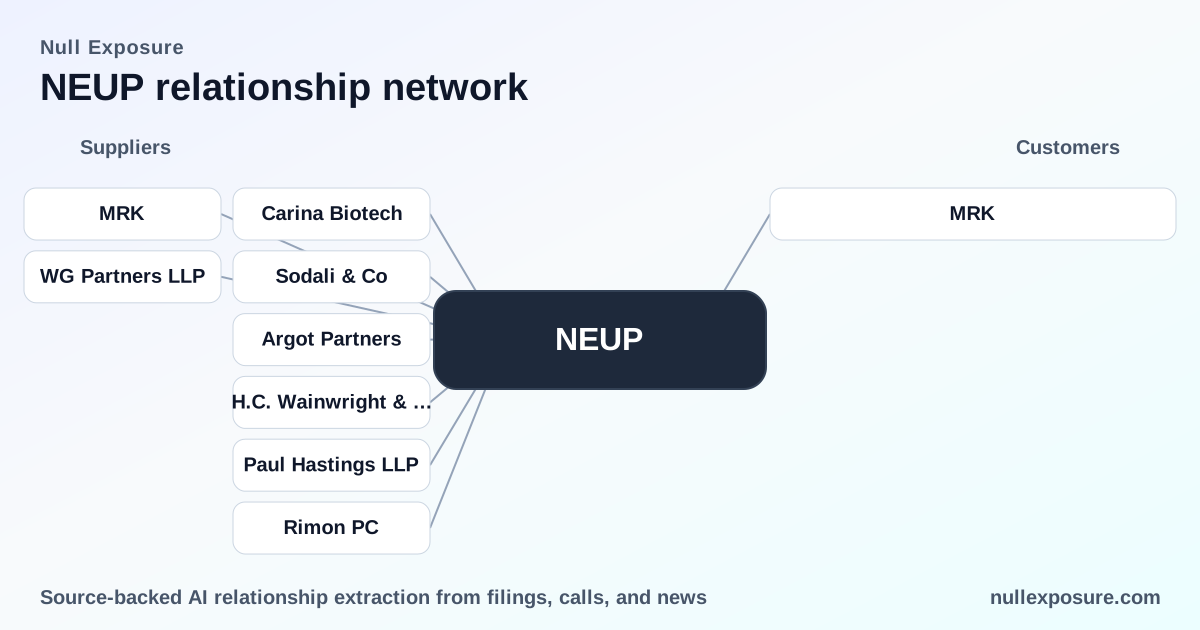
Neuphoria Therapeutics (NEUP): Partnering to De‑risk R&D and Monetize Early‑Stage CNS Assets
Neuphoria Therapeutics operates as a clinical‑stage biotech focused on psychedelic and CNS drug candidates and monetizes primarily through partnered development and licensing: it licenses IP, advances its own pipeline selectively, and captures milestone and royalty economics from larger collaborators who fund late‑stage programs. Investors should value NEUP as a small‑cap developer whose capital needs and near‑term commercial optionality are driven by a handful of strategic partner relationships rather than by standalone product sales. Explore broader customer and counterparty signals at https://nullexposure.com/.
Why the Merck relationship changes NEUP’s financial profile
Neuphoria’s commercial profile is dominated by a single strategic relationship with Merck & Co. Under that collaboration, Merck is funding the development of certain positive allosteric modulators and is responsible for program costs, while Neuphoria retains rights to milestone payments (cited up to $450 million) and royalties on net sales. This structure transforms NEUP’s contracting posture into a capital‑light, upside‑capture model: risk is shifted to a global partner while NEUP keeps high‑leverage payout mechanics.
Key operating characteristics from the Merck arrangement:
- Concentration: A large portion of clinical and near‑term value is tied to one counterparty, increasing counterparty concentration risk.
- Criticality: The Merck programs are strategically critical — they materially affect NEUP’s valuation given the magnitude of potential milestones and royalty streams.
- Maturity: The programs are early to mid‑stage (Phase 2 led by Merck for at least one candidate), so binary clinical outcomes remain the primary driver of value.
- Contracting posture: NEUP is in a licensor/partner role for core candidates, receiving development funding rather than directly bearing late‑stage costs.
Detailed relationship hits from news and filings
Below are the individual pieces of coverage captured in the monitoring set; each entry is a direct signal about the Merck collaboration and its commercial terms.
-
FierceBiotech (March 10, 2026) reported that Neuphoria has an ongoing partnership with Merck to advance two positive allosteric modulator candidates, and that Merck is fronting program costs while NEUP is eligible for up to $450 million in milestone payments.
Source: FierceBiotech, March 10, 2026. -
The same FierceBiotech article reiterated that one candidate is in a Merck‑led Phase 2 Alzheimer’s study and confirmed Merck’s financial commitment to the program.
Source: FierceBiotech, March 10, 2026. -
A Globenewswire release (October 20, 2025) stated Merck is responsible for all costs on the program and that Neuphoria is eligible for up to $450 million in development and commercial milestones plus royalties on net sales.
Source: GlobeNewswire press release, October 20, 2025. -
A duplicate GlobeNewswire entry (captured again in March 2026) repeats the message that Merck funds the program and that NEUP retains milestone and royalty upside.
Source: GlobeNewswire (company release), captured March 2026. -
That GlobeNewswire text is mirrored in another pull (same release), reaffirming the same commercial terms and Merck’s cost responsibility.
Source: GlobeNewswire (company release), October 2025 / March 2026. -
Investing.com (May 3, 2026) covered the market reaction to a failed late‑stage anxiety trial and noted Neuphoria’s ongoing partnership with Merck, referencing MK‑1167 in a Merck‑led Phase 2 Alzheimer’s trial and the $450 million milestone and royalty provisions.
Source: Investing.com, May 3, 2026. -
A second Investing.com item (also May 3, 2026) repeated the firm’s ongoing collaboration with Merck and the potential $450 million in milestone payments plus royalties tied to any commercialized medicines.
Source: Investing.com, May 3, 2026. -
A Globe and Mail press release (March 10, 2026) communicated that Neuphoria has a strategic partnership with Merck with two drugs in early‑stage clinical trials targeting cognitive deficits in Alzheimer’s disease and other CNS indications.
Source: The Globe and Mail (company press release), March 10, 2026. -
That Globe and Mail release is present in another capture in the monitoring set and again affirms the strategic Merck partnership and the early‑stage status of two drugs in the collaboration.
Source: The Globe and Mail (company press release), March 10, 2026. -
(Duplicate captures within the monitoring set reiterate the above points: Merck funds programs, candidates are in Merck‑led studies, and NEUP retains milestone/royalty upside.) Each capture is consistent with the commercial terms described in the GlobeNewswire and media reports.
Sources: Multiple captures of GlobeNewswire / media releases, late‑2025 through early‑2026. -
(Final capture) The aggregated coverage across outlets consistently ties NEUP’s near‑term commercial optionality to Merck’s funding of development and the potential $450 million milestone pool plus royalties.
Source: Consolidated media coverage (FierceBiotech, GlobeNewswire, Investing.com, The Globe and Mail), late‑2025 to mid‑2026.
Licensing with Carina Biotech — a separate revenue channel to track
Company filings disclose a distinct licensing relationship with Carina Biotech that is material on a different axis: Neuphoria acts as the licensor and is eligible to receive up to approximately $75.8 million in development and regulatory milestones plus low‑ to mid‑single‑digit royalties on net sales if Carina advances the therapy to Phase 3. Carina triggered a milestone payment (A$1 million) in October 2024 following first‑in‑human dosing, confirming the relationship is active and moving through early clinical milestones. These terms indicate NEUP is pursuing a mixed model of partner‑funded development (Merck) and out‑licensed programs (Carina) to diversify risk and monetize IP.
Source: Company filings (IP license agreement disclosure; milestone activity reported October 2024).
Investment implications — what operators and allocators should watch
-
Real cash optionality exists through milestones and royalties: The Merck partnership carries up to $450 million in contingent consideration; the Carina license adds another defined milestone pool and recurring royalty structure. These flows are central to valuing NEUP beyond its current revenue base.
-
Clinical binary risk dominates near‑term value: One Merck‑led Phase 2 and recent late‑stage readouts for other NEUP assets have driven sharp share moves; clinical outcomes, not organic sales, will determine value inflection points.
-
Counterparty concentration is high: One large pharma partner accounts for the lion’s share of de‑risking capital and upside; investors should price in counterparty execution risk and negotiation leverage at the point of commercialization.
-
Licensing strategy reduces capital burn but limits upside capture to royalties and milestones: NEUP trades off full commercialization economics for immediate non‑dilutive development funding.
-
Governance and disclosure cadence matter: Frequent press and filing updates (company press releases, GlobeNewswire, and media coverage) are the primary signals on milestone triggers and development status.
If you track counterparty exposure across small‑cap biotechs, our monitoring consolidates these same signals and timelines — see how the capture looks across relationships at https://nullexposure.com/.
Bottom line
Neuphoria is a classic micro‑cap biotech leveraging strategic partners to fund development and crystallize value through milestones and royalties rather than internal commercialization. Merck is the single largest commercial lever; Carina Biotech represents an active licensing stream that supplements NEUP’s monetization roadmap. For investors and operators, the risk/reward hinges on upcoming clinical readouts and partner execution — not on near‑term product revenues.