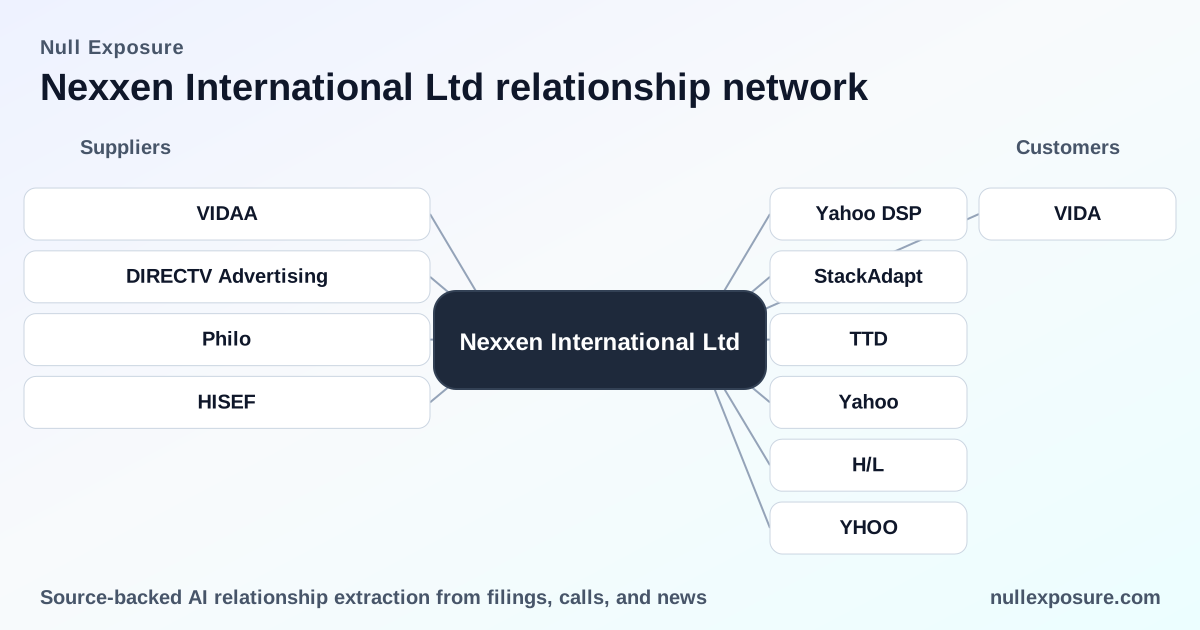
Nexxen’s customer map: who pays for its CTV data and why it matters to investors
Nexxen operates an end-to-end advertising platform that converts Automatic Content Recognition (ACR) and cross-platform viewership signals into license fees, programmatic inventory, and performance-driven DSP services. The company monetizes by selling audience segments to demand-side platforms, running programmatic placements on high-attention CTV surfaces, and extracting fees for its DSP and optimization stack — a diversified revenue mix that blends data licensing with media monetization and software services.
For a concise view of Nexxen’s client footprint and what each relationship contributes to revenue and strategic positioning, read on. If you want the full dataset and signal layer behind this analysis, visit https://nullexposure.com/.
How to read these customer relationships — one line, one source
Below I cover every customer relationship surfaced in Nexxen’s recent filings and press coverage. Each entry is a plain-English 1–2 sentence summary followed by the source context that disclosed the relationship.
The Trade Desk (TTD)
Nexxen named The Trade Desk as a strategic DSP partner and the platform was referenced as the company's first strategic DSP relationship in Q4 commentary, signaling priority programmatic distribution for Nexxen’s ACR segments. Coverage from industry press also notes The Trade Desk’s early adoption of Nexxen’s programmatic home-page ad units on Hisense CTV as a positive 2026 catalyst. Source: Nexxen Q4 2025 earnings call (March 2026) and industry reporting citing Needham/Investing.com (May 2026).
Yahoo DSP / Yahoo (YHOO)
Nexxen licensed its ACR audience segments to the Yahoo DSP, making those segments available in the U.S., U.K. and Germany — a clear example of direct data-licensing revenue and geographic expansion of programmatic reach. Source: Nexxen Q3/Q4 2025 earnings commentary (reported March 2026) and GlobeNewswire press releases (Nov 2025 / Mar 2026).
StackAdapt
StackAdapt is listed among the “major DSPs” with which Nexxen expanded its TV data partnerships, indicating continued distribution breadth across the programmatic ecosystem. This relationship reinforces Nexxen’s strategy of multi-DSP licensing to maximize audience monetization. Source: Nexxen Q4 2025 earnings call (March 2026).
Vida (VIDA)
Nexxen renewed and expanded a partnership with Vida through 2029, extending exclusive global access to ACL data and securing third-party ad monetization exclusivity on Vida’s North American media — a structural deal that locks in content access and exclusive monetization pathways. Source: Nexxen Q3 2025 earnings call (reported March 2026).
Luquire
Luquire (agency media team) publicly credited Nexxen’s cross-channel data in delivering a campaign that reduced waste and maximized reach, demonstrating Nexxen’s ability to sell outcomes to agency partners as well as raw segments. This endorsement highlights agency-level adoption for performance-driven CTV planning. Source: GlobeNewswire product launch release and customer quote (Mar 31, 2026).
H/L
H/L partnered with Nexxen on smarter data-driven CTV strategies and is cited as the first to activate Nexxen TV home-screen PMPs through the Nexxen DSP, underscoring the company’s high-attention inventory play on TV homescreens. H/L’s activation lends validation to Nexxen’s PMPs and home-screen monetization strategy. Source: GlobeNewswire partnerships releases (Feb–Apr 2026).
Tinuiti
Tinuiti publicly referenced Nexxen DSP’s incrementality measurement as a meaningful advance over standard attribution, indicating demand from performance-focused agencies for Nexxen’s measurement and optimization capabilities. This is a sign that Nexxen sells not only reach but attribution-grade performance analytics. Source: GlobeNewswire product release (Mar 24, 2026).
Division-D
Division-D commented on Nexxen’s nexAI DSP assistant, noting the tool’s ability to connect live campaign data to Nexxen’s knowledge base and surface actionable optimization insights — evidence that Nexxen is packaging AI-driven workflow features alongside media execution. Source: GlobeNewswire DSP UI launch release (Apr 6, 2026).
What the relationship map implies about Nexxen’s operating and business model
- Contracting posture: Nexxen engages a mix of short-to-medium term licensing and longer-term exclusive agreements (for example, the Vida renewal to 2029). That combination creates a hybrid revenue stream: recurring licensing plus locked-in monetization rights on select properties.
- Concentration and distribution: The roster shows deliberate distribution across major DSPs and agencies (The Trade Desk, Yahoo DSP, StackAdapt, Tinuiti, Division‑D), which reduces single-buyer concentration risk while preserving strategic anchor partners that enable scale.
- Criticality to clients: Several customers highlight Nexxen’s unique role in CTV measurement and home-screen inventory activation, indicating high functional criticality for advertisers seeking accountable CTV outcomes rather than vanilla reach.
- Maturity and scalability: The mix of enterprise renewals (Vida), strategic DSP alignments (TTD, Yahoo), and product endorsements from agencies suggest Nexxen is transitioning from proof-of-concept to product-market fit with scalable programmatic distribution.
No explicit customer-level constraints were captured in the available relationship signals, so there are no documented contractual limitations or regulatory caveats disclosed in the same corpus. This absence is itself a company-level signal — Nexxen’s disclosed partner activity focuses on growth and product launches rather than litigated or constrained customer arrangements.
Before you act on these relationship signals, review the company’s filings and product announcements in full at https://nullexposure.com/.
Investment implications and risk considerations
- Revenue diversification is improving. Licensing to major DSPs and programmatic home-screen inventory monetization convert data assets into multiple revenue channels, which supports margin leverage.
- Execution risk centers on distribution and measurement credibility. Growth depends on continued uptake by large DSPs and agencies and on Nexxen’s ability to maintain accurate ACR signals and incrementality measurement against industry scrutiny.
- Customer concentration risk exists but is mitigated. Strategic anchors like The Trade Desk are important, but Nexxen’s intentional multi-platform strategy reduces single-customer dependency.
- Upside from product-led adoption. AI-native DSP tools and proof points from agencies (Tinuiti, Division‑D, Luquire) could accelerate budget migration from legacy TV buys to Nexxen-enabled programmatic CTV if those case studies scale.
Bottom line for investors
Nexxen is selling three things at once — data licensing, programmatic inventory, and performance software — and its disclosed customer relationships validate that commercial strategy. The customer list reads like a balanced go-to-market: DSP partners for scale, agency partners for ROI storytelling, and exclusive publisher deals for differentiated inventory. Monitor renewals (Vida), DSP integrations (TTD, Yahoo, StackAdapt), and adoption metrics for Nexxen DSP features as the clearest near-term drivers of revenue acceleration.
If you want a deeper dive into contract terms and signal-level analytics behind these relationships, find the full platform at https://nullexposure.com/.