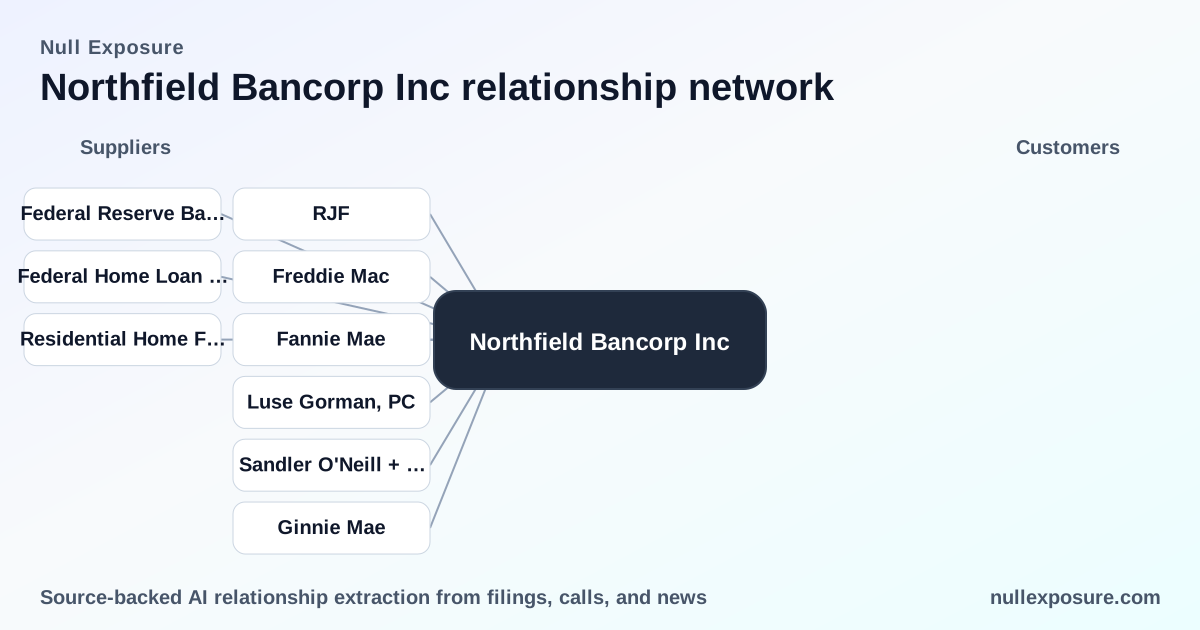
Northfield Bancorp (NFBK): Customer relationships, funding posture, and the Columbia Financial exit
Northfield Bancorp is a regional bank holding company that earns through net interest margin on commercial and consumer lending, complemented by fee income from deposit services, card interchange, and cash-management products. The bank’s operating model concentrates local deposit franchises and municipal relationships in New Jersey and New York while underwriting a mix of long‑amortizing real‑estate loans and shorter‑term commercial credit. For investors evaluating counterparty risk and go‑to‑market implications, the recent sale to Columbia Financial crystallizes the value of those customer ties and the funding profile that underpins them. For a deeper look at relationship-level exposures and sourcing, see Null Exposure’s research hub: https://nullexposure.com/
The headline relationship: Columbia Financial acquisition — immediate implication
Columbia Financial agreed to acquire Northfield Bancorp in a deal valued at approximately $597 million, a transaction announced in early May 2026. This strategic outcome converts Northfield’s local deposit and service relationships into an exit for shareholders and transfers all customer contracts and funding relationships to the acquirer. According to a news report on Investing.com dated May 3, 2026, the deal value was reported at ~$597m, which is roughly in line with Northfield’s reported market capitalization of about $580.9 million on the public profile. (Investing.com, May 3, 2026; company profile data).
Every listed relationship (one entry) and why it matters
- Columbia Financial (inferred symbol CLBK): Columbia Financial is the buyer in the announced acquisition; the transaction folds Northfield’s deposit base, service contracts (ACH, remote deposit, cash management), and loan portfolio into Columbia’s franchise and materially shifts counterparty exposure to that acquirer. (Investing.com news report, May 3, 2026).
How customers, contracts and products shape the franchise
Northfield’s revenue mix and operating posture are defined by a blend of long‑duration mortgage-style assets, shorter commercial commitments, and immediate-service fee income:
- Long-term lending exposure: Multifamily real-estate loans typically amortize over 30 years, creating extended credit duration and stable interest income for the bank. This is a structural feature of the balance sheet and supports asset sensitivity over the long run. (Company filing disclosures).
- Short-term commitments and guarantees: Certain commercial credits have maximum terms of up to three years, and standby letters of credit generally extend up to one year and are reported as fully collateralized, reflecting a mixture of short-dated contingent liabilities in the funding profile. (Company filing disclosures).
- Spot/transaction revenue: Service charges, ATM and card interchange, and other fees are recognized immediately when services are rendered, contributing to predictable non‑interest income that is less rate-sensitive than interest margin. (Company revenue recognition disclosures).
These contracting postures produce a hybrid funding and earnings model: long-term asset cash flows anchored by multifamily loans, short-duration commercial credit lines and guarantees, and recurring fee streams from transactional services.
Customer composition, concentration and criticality
- Significant municipal funding: Municipal deposits totaled $859.3 million, representing 20.8% of total deposits at December 31, 2024, and municipal and governmental deposits are an important stable funding source for Northfield. The filings also note uninsured deposits (excluding certain collateralized governmental deposits) of approximately $896.5 million, underscoring sensitivity to deposit flight if confidence weakens. (Company 2024 disclosures).
- Retail and commercial mix: The bank services individuals, small businesses and corporate customers across Staten Island/NY and New Jersey counties, with unsecured small-business loans reported at $28.9 million at year‑end 2024. This mix positions the bank as a local commercial and retail depository institution rather than a wholesale or national lender.
- Geographic concentration: Operations are concentrated in New York and New Jersey (with some eastern Pennsylvania presence), operating a network of branches and a home office in Woodbridge, NJ — a regional footprint that drives both customer loyalty and geographic risk concentration. (Company location disclosures).
Bottom line: Municipal deposits are material and central to the balance-sheet funding mix; retail and small-business customer relationships provide transactional income and deposit stability, but geographical concentration increases sensitivity to regional economic shifts.
Product and service relationships: where value is created
Northfield offers cash management, ACH and wire transfers, positive pay and remote deposit capture for commercial clients, and a spectrum of deposit accounts for retail and municipal customers. These services are highly recurring, tight to local business operations, and transferable in an acquisition — a key reason Columbia Financial priced the deal the way it did. Service-fee revenue and card interchange are recognized on performance, supplying steady non‑interest income that complements loan yield. (Company service disclosures).
Operational constraints and relationship-stage signals
Company-level signals from filings paint a clear operational profile:
- Mature customer relationships and stable funding: Filings describe a "diversified deposit base" and long‑standing client relationships that provide stable funding, indicating mature relationship stage and predictable withdrawal behavior absent systemic shock.
- Service-provider role: Northfield operates as a service provider to its commercial customer base (cash management and transaction services), which are mission‑critical to those clients’ day-to-day operations and therefore create stickiness.
- Spend band and asset concentration: The largest multifamily loan had a principal balance near $29.8 million, suggesting the bank underwrites mid‑sized exposures within a $10m–$100m spend band for significant commitments.
Collectively, these constraints show a bank with stable but locally concentrated customer relationships, a mix of long- and short-term obligations, and material municipal exposure.
Risk factors and what the Columbia Financial transaction changes
- Concentration risk: The 20.8% municipal deposit concentration is material and central to funding; under new ownership, Columbia Financial inherits this concentration and the collateralization practices that secure uninsured deposits. (Company 2024 disclosures).
- Contract nativity and transferability: Most customer services are operational and contractual (ACH, remote deposit capture, cash management) and are inherently transferable in an acquisition, reducing execution risk in the deal close.
- Balance‑sheet duration mismatch: Long‑amortizing multifamily loans paired with shorter-term deposit guarantees create a duration and liquidity management challenge that acquirer management will prioritize post-close.
Investor takeaways and watchlist
- Acquisition converts franchise value into a single cash event: The Columbia Financial deal values the business at roughly the bank’s market cap and captures the value of municipal funding and fee-generating services. (Investing.com; company profile).
- Monitor post-merger funding strategy: Watch how Columbia Financial manages the municipal deposit concentration and the collateralization practices for uninsured deposits that were noted in Northfield’s filings as of December 31, 2024.
- Operational integration risk is limited on services but credit oversight matters: Transactional services are sticky and transfer smoothly; the greater risk lies in credit portfolio management and maintaining deposit confidence during integration.
For actionable relationship-level intelligence and to see how these customer exposures compare across regional peers, visit Null Exposure: https://nullexposure.com/
Conclusion
Northfield’s business was built on a regional deposit franchise, municipal funding strength, and recurring transactional services. The Columbia Financial acquisition monetizes those customer relationships and passes the funding concentration and credit profile to the buyer. Investors should treat the deal as a consolidation of a mature, service-oriented regional bank franchise with material local deposit concentration and a hybrid long/short contract profile that will determine the acquiror’s integration priorities.