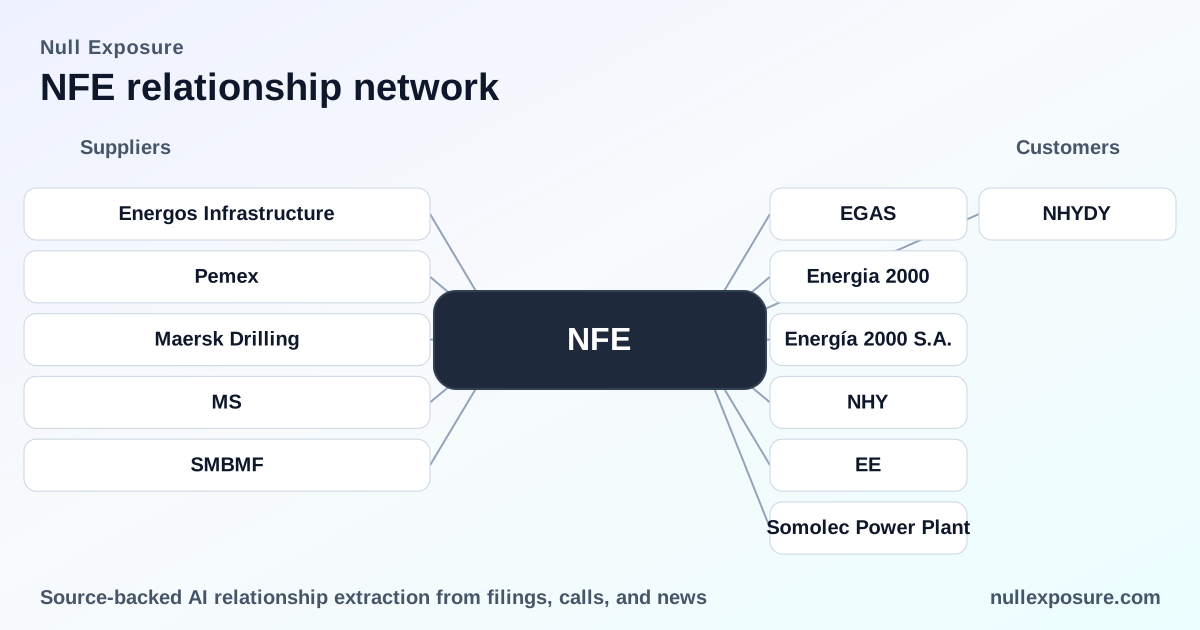
New Fortress Energy: customer relationships that drive cash flow and concentration risk
Thesis — New Fortress Energy (NFE) operates an integrated gas-to-power platform that monetizes LNG production, FSRU charters, long-term gas sales and power purchase agreements, plus operations & maintenance contracts; the company’s revenue profile is driven by long-term, take-or-pay style contracts and a small set of large counterparties, while incremental upside comes from vessel and project-level commercial activity such as FSRU charters and asset sales. For investors, the rubric is simple: stability of cash flows from long-term contracts versus concentration and execution risk from project-level deals. Learn more at https://nullexposure.com/.
How the customer picture shapes the business model
NFE’s commercial posture is dominated by long-duration supply contracts and PPAs, which convert commodity exposure into predictable contractual cash flows through index-based pricing plus fixed fees and minimum volume commitments. The constraints data reinforce this: multiple excerpts state NFE “primarily operate[s] under long-term contracts” and uses “take-or-pay” constructs, while also disclosing a smaller set of short-term arrangements. This creates a hybrid model where durable recurring revenue coexists with episodic merchant activity.
Other company-level signals matter for risk assessment:
- Concentration: three customers represented 48% of 2024 revenue, a material concentration that magnifies counterparty credit and country risk.
- Global footprint: projects and customers span North America, LATAM and EMEA, reducing single-market demand risk but increasing geopolitical and execution complexity.
- Counterparty mix: evidence shows NFE contracts with government-affiliated entities and industrial counterparties, implying both sovereign credit and state-led procurement exposure.
- Role diversification: NFE acts as seller of gas, charter operator (FSRUs/vessels), and service provider (O&M contracts), which smooths revenue volatility but requires cross-disciplinary project execution capabilities.
These characteristics define the investment trade-off: predictable contracted cash flows versus concentrated counterparties and project execution risk.
Individual customer relationships and what they mean for investors
Below are the relationships captured in the reporting set; each entry includes a concise, plain-English summary and a source reference.
Energia 2000 — earnings call mention
NFE announced in its Q1 2025 earnings call that it chartered the Freeze to Energia 2000, indicating active FSRU deployment in the Dominican Republic market (NFE Q1 2025 earnings call, transcript posted Mar 7, 2026).
EGAS — earnings call mention
NFE stated in the same earnings call that it chartered the Eskimo to EGAS, reflecting vessel-level commercial activity where NFE provides FSRU or LNG shipping capacity under charter (NFE Q1 2025 earnings call, Mar 7, 2026).
Energía 2000 S.A. — MarineLink report
MarineLink reported on March 10, 2026 that NFE’s subsidiary executed a three-year charter for the Energos Freeze FSRU with Energía 2000 in the Dominican Republic, a formal multi-year revenue stream tied to vessel leasing (MarineLink, March 10, 2026).
Energía 2000 S.A. — company press release via Yahoo Finance
A March 10, 2026 company announcement carried on Yahoo Finance confirmed that the charter covers the 125,000 m³ Energos Freeze FSRU on a three-year term, reinforcing near-term contracted utilization and charter revenue (NFE press release, Yahoo Finance, Mar 10, 2026).
Norsk Hydro — MarineLink background on Barcarena
A MarineLink piece (citing NFE projects) highlights that Norsk Hydro (Alunorte alumina refinery) will receive gas under a long-term supply tied to NFE’s Barcarena terminal, linking a major industrial customer to NFE’s Brazilian gas-to-power footprint (MarineLink, FY2023 coverage).
NHY (ticker reference) — duplicate MarineLink mention
The MarineLink coverage also lists the relationship with NHY (Norsk Hydro) as a core long-term supply contract supporting NFE’s Barcarena development and associated power projects (MarineLink, FY2023).
EE — earnings call reference to commercial outcome
In the Q1 2025 call, NFE management said it worked exclusively with Excelerate and completed a sale sooner and at a higher price than forecast, signaling one-off asset recycling / monetization activity (NFE Q1 2025 earnings call, Mar 7, 2026).
Excelerate — earnings call reference
The earnings call repeated that NFE chose Excelerate exclusively for the transaction, indicating a negotiated counterparty relationship around asset sales or transfers (NFE Q1 2025 earnings call, Mar 7, 2026).
Somolec Power Plant — report on Mauritania project
An industry report described NFE’s role to supply natural gas to the existing 180 MW Somolec plant and a planned 120 MW combined-cycle plant in Mauritania, tying NFE to supply and power development in offshore/onshore gas projects (Oil & Energy Digital, FY2021 coverage).
NHYDY — earnings call disclosure of deliveries and term
NFE disclosed in its Q1 2025 call that deliveries to Norsk Hydro began in March 2024 under a 15-year gas supply agreement, confirming long-tenor contracted supply and revenue visibility (NFE Q1 2025 earnings call, Mar 7, 2026).
Norsk Hydro — earnings call reiteration
The same earnings call reiterated the start of deliveries under the 15-year contract with Norsk Hydro, reinforcing that this is a material, long-duration customer engagement (NFE Q1 2025 earnings call, Mar 7, 2026).
Excelerate Energy — Offshore-Technology report on asset sale
Offshore-Technology reported that NFE completed the sale of its Jamaican assets and operations to Excelerate Energy for $1.05 billion, a sizeable divestiture that crystallized value and reduced operating exposure in that market (Offshore-Technology, FY2025).
EE — Offshore-Technology ticker reference
The Offshore-Technology coverage repeated the transaction detail naming EE (Excelerate Energy) as the buyer, documenting the counterparty to the $1.05bn asset sale (Offshore-Technology, FY2025).
(If you want a compact dashboard of these entries and source links, visit our analysis hub at https://nullexposure.com/.)
Investment implications and where to focus diligence
- Credit and concentration risk dominate valuation sensitivity. With three customers accounting for ~48% of revenue in 2024, a deterioration at one large counterparty or in a host country would meaningfully depress cash flow.
- Long-term take-or-pay economics provide downside protection on volumes but create counterparty credit exposure. The company-level constraint excerpts confirm a deliberate reliance on index-plus-fee contracts and minimum volumes.
- Project execution and vessel commercialization are active value drivers. The string of FSRU charters and the $1.05bn asset sale to Excelerate show NFE can monetize assets and redeploy capital, but these are episodic and execution-sensitive.
- Geographic diversification lowers single-market demand risk but raises political, regulatory and operational complexity. Government-affiliated counterparties and operations across LATAM, EMEA and North America necessitate robust local execution and political-risk management.
- Service revenue (O&M) creates recurring annuity-like cash flows but is smaller in scale. Genera PR and similar contracts are stabilizers rather than primary value drivers.
Bottom line
New Fortress Energy’s commercial book is a mix of durable contracted cash flows anchored by long-term gas supply agreements and PPAs, together with project-level upside from charters and asset transactions. Investors should balance the predictability from take-or-pay contracts against concentration, counterparty credit and execution risk across jurisdictions. For a concise, source-linked roundup of these customer relationships and what they imply for NFE’s cash flow profile, see our coverage at https://nullexposure.com/.