National Fuel Gas (NFG): Customer Relationships, Constraints, and Investment Implications
National Fuel Gas Company monetizes a vertically integrated portfolio that spans upstream production (Seneca Resources), midstream pipeline and storage, and a regulated local distribution utility. Revenue is generated through commodity sales from production, tariff-based transportation and storage fees, and retail utility charges to about three-quarters of a million customers, with long-term contracts and regulated tariffs providing cash-flow stability and predictable margin capture across the value chain. For investors analyzing customer-facing counterparty risk and revenue durability, the Centrica MiQ agreement and the company’s contract and regulatory profile are the most relevant signals today.
Visit Null Exposure for more company relationship intelligence: https://nullexposure.com/
Deal spotlight — Centrica and a first-of-its-kind MiQ agreement
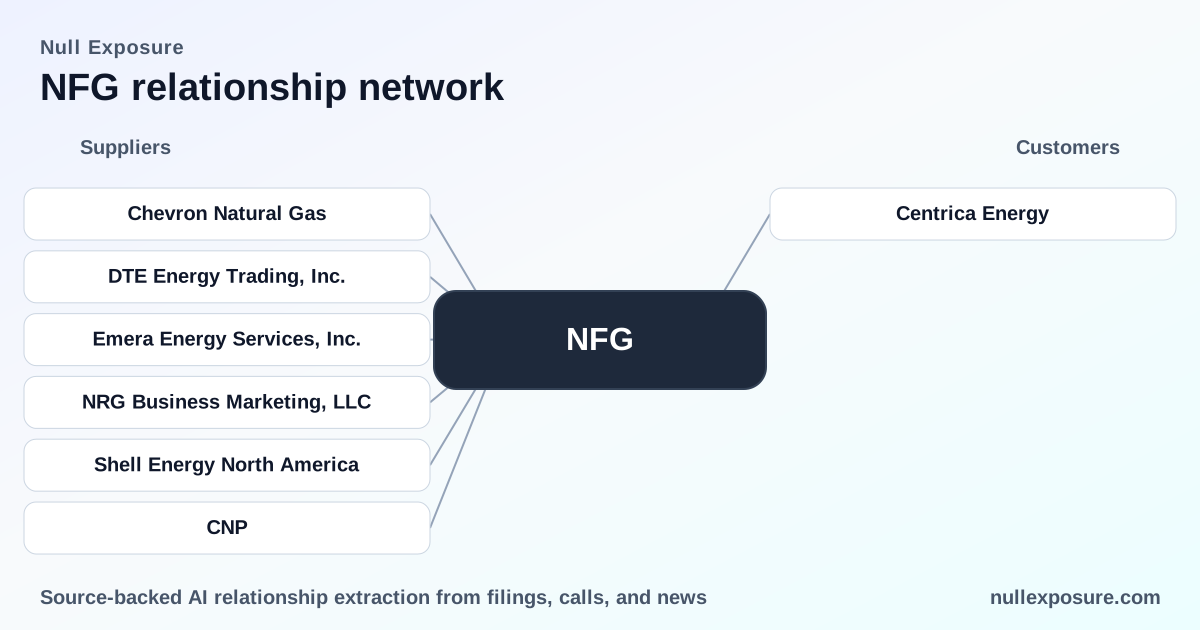
Centrica Energy signed a ten-year agreement with Seneca Resources to procure 250,000 MMBtu per day of MiQ-certified gas certificates, positioning Centrica to meet methane-reduction commitments while creating a long-term offtake pathway for Seneca’s certified output. According to National Fuel’s press release on March 10, 2026, the deal frames Seneca as the supplier of MiQ-certified attribute certificates tied to Appalachian natural gas production. (National Fuel press release, March 10, 2026.)
What this relationship means in plain terms
- The agreement is a long-term commercial commitment for emissions-certified gas attributes rather than a simple spot sale, giving Seneca a recurring revenue stream tied to environmental credentials. Source: company press release, FY2026.
- For buyers such as Centrica, the contract reduces scope-3 and methane exposure through certificate procurement while creating predictable demand for a specific tranche of production. Source: company press release, FY2026.
Relationship catalogue: the single customer relationship identified
- Centrica Energy — Seneca Resources will supply MiQ-certified methane emissions certificates under a ten-year agreement covering 250,000 MMBtu per day, aligning production-level methane credentials with Centrica’s sustainability procurement goals. Source: National Fuel corporate news, first reported March 10, 2026.
Company-level operating constraints and what they imply for customers and investors
The textual evidence supplied around NFG’s business operations sets several company-level signals that shape contract risk, concentration, and criticality for customer relationships:
-
Long-term contracting posture. Company disclosures indicate that Distribution Corporation and other units enter firm, long-term transportation and storage contracts with rights-of-first-refusal with multiple upstream pipeline companies. This demonstrates a deliberate, defensive procurement and commercial stance that prioritizes capacity certainty and reduces volumetric volatility for customers and affiliates. (Company filings; contract excerpts.)
-
Regional concentration in North America. NFG’s operations and customers are geographically focused in western New York, northwestern Pennsylvania, and the Appalachian Basin for production. This concentration creates regulatory and market exposure specific to northeastern U.S. gas flows and Northeast/Canadian demand corridors. (Company filings; regulatory descriptions.)
-
Material internal market flows. The Pipeline & Storage segment generated roughly 35% of its 2025 revenues from services provided to the Utility and Integrated Upstream segments, indicating substantial internal capture of midstream capacity and a vertically integrated cash-flow loop that both stabilizes activity and concentrates counterparty flows inside the company. (Company filing excerpt referencing 2025.)
-
Dual role as seller and service provider. National Fuel sells produced gas on the commodity market and also provides transportation and storage services to third parties on tariffed terms; Distribution Corporation also functions as a retail utility. This dual role diversifies revenue lines but requires active management of affiliate transactions and regulatory scrutiny. (Company segment descriptions.)
-
Regulated maturity and scale. Distribution services operate under tariff-based rates regulated by NYPSC and PaPUC, while interstate transport/storage is regulated by FERC — signaling mature, rate-regulated cash flows for large portions of revenue and reducing commercial cyclicality relative to pure merchant exposures. (Regulatory excerpts.)
Taken together, these signals portray a company that locks in capacity and cash flows through long-term contracts and regulated rates, while concentrating production and customer exposure in a defined North American geography. That structure benefits predictability but concentrates regulatory and regional demand risk.
Financial and strategic context for investors
National Fuel’s financial profile supports the qualitative signals above: strong operating margins (approx. 40% TTM) and meaningful EBITDA scale underscore the value of integrated operations, and the company’s PE and EV/EBITDA multiples suggest the market prices a blend of regulated stability and commodity exposure. The Centrica transaction adds a non-traditional revenue vector—payments for certified methane attributes—that leverages Seneca’s production footprint without necessarily changing pipeline flow economics.
Key takeaways:
- Stability driver: Regulated utility and tariff-based transport produce predictable revenue and high operating margins. (Company financials.)
- Growth/price sensitivity: Upstream commodity sales and certificate revenues expose NFG to gas price cycles and evolving demand for environmental attributes.
- Concentration risk: Geographic concentration and significant intra-company flows (35% internal midstream revenue) increase exposure to regional shocks and regulatory changes.
Investment risks tied to customer relationships
- Regulatory shifts in NY/PA/FERC jurisdiction could alter tariff structures or service obligations, affecting a large share of NFG’s cash flows.
- Regional demand deterioration in northeastern markets, or pipeline constraints, would stress both distribution throughput and certificate monetization pathways.
- Counterparty and product evolution risk: The MiQ market is nascent; its price discovery, verification standards, and buyer base will determine whether certificate sales become a material earnings driver or a marginal adjunct.
Where to look next (practical follow-ups for analysts)
- Monitor long-term contracting language in filings for rights-of-first-refusal, capacity release terms, and the duration of pipeline commitments to quantify commercial stickiness.
- Track MiQ certificate pricing and volume recognition policies in upcoming quarterly disclosures to assess how the Centrica deal flows into revenue and margin lines.
- Watch regulatory dockets at NYPSC, PaPUC and FERC for any rate case developments that could reset tariff economics.
For a concise feed of customer-relationship signals and ongoing updates on NFG and its counterparties, visit Null Exposure: https://nullexposure.com/
Bottom line
National Fuel’s customer profile is defined by regulated, long-duration contracts and significant vertical integration, which together create predictable cash flows and internal demand capture—while the Centrica MiQ agreement introduces a durable, sustainability-linked revenue channel for Seneca’s Appalachian production. Investors should value NFG for its defensive contract posture and regulated exposure, while monitoring regional and regulatory developments that can reprice those advantages.