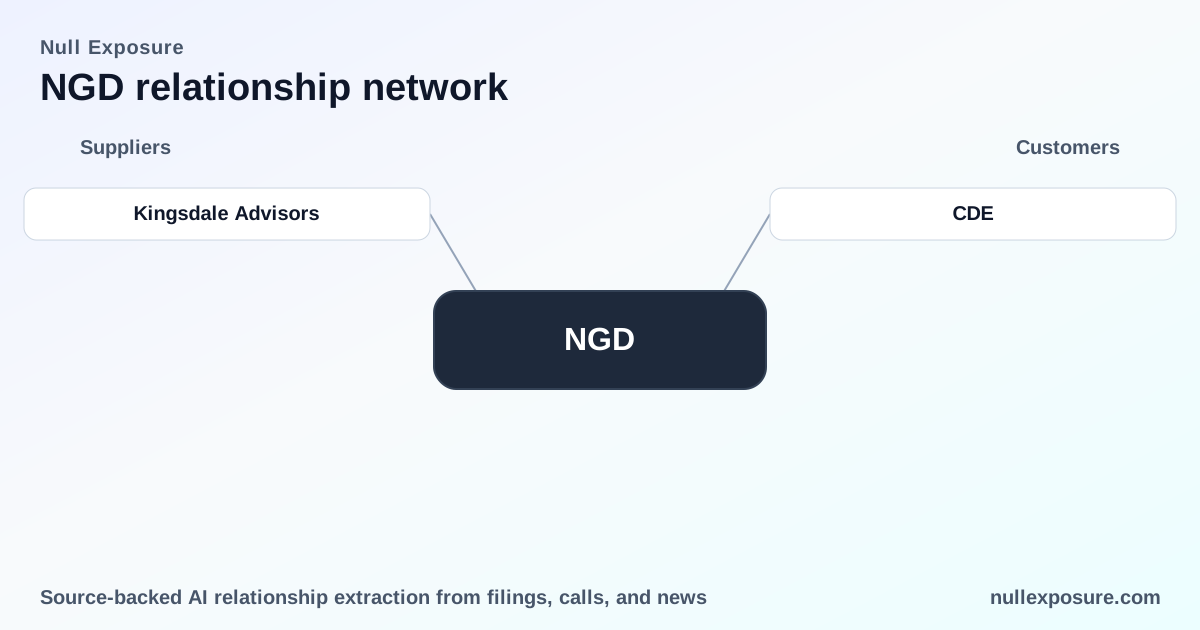
NGD Customer Relationships: The Coeur Mining Transaction Rewrites Counterparty Risk
New Gold (NGD) is a producing mining company that traditionally monetizes through metal sales and asset-level transactions; in the current cycle its most consequential commercial relationship is not a smelter or offtake contract but a strategic acquisition agreement. Shareholder approval of a plan of arrangement with Coeur Mining transfers economic exposure from NGD’s public equity holders to a single corporate buyer, concentrating counterparty risk and shifting the company's commercial profile from independent operator to asset within a larger mining portfolio. For a consolidated view of the transaction and its investor implications, see https://nullexposure.com/.
Why this transaction matters to investors today
The corporate development announced in March 2026 converts NGD’s customer/counterparty footprint into a binary corporate event: either the sale to Coeur Mining completes and NGD ceases to exist as a standalone public operator, or regulatory intervention prevents closing and NGD resumes independent operations under heightened market scrutiny. That binary elevates regulatory approval and integration execution to the top two monitoring priorities for holders and counterparties.
According to a Finviz news item on March 10, 2026, NGD shareholders approved the previously announced plan of arrangement under which a wholly owned subsidiary of Coeur Mining will purchase all outstanding NGD shares. A March 10, 2026 report from Intellectia noted that the acquisition still requires approval under the Investment Canada Act and that market sentiment had turned negative, with NGD shares falling sharply on the uncertainty.
The reported relationships — line-by-line coverage
CDE (Finviz report, March 10, 2026)
Finviz reported that a wholly owned subsidiary of Coeur Mining (ticker CDE) is set to purchase all outstanding NGD shares under the approved plan of arrangement, reflecting shareholder acceptance of the deal terms. — Finviz, March 10, 2026: https://finviz.com/news/294991/new-gold-ngd-shareholders-approve-previously-announced-plan-of-arrangement-to-advance-coeur-mining-deal
Coeur Mining (Finviz report, March 10, 2026)
The same Finviz item references Coeur Mining by name as the acquirer, confirming that the buyer is an operating mining company using a subsidiary vehicle to effect the transaction. — Finviz, March 10, 2026.
CDE (Intellectia report, March 10, 2026)
An Intellectia market note reiterated the acquisition linkage to CDE while highlighting that the transaction remains subject to regulatory review under Canadian rules, a gating condition for closing. — Intellectia, March 10, 2026: https://intellectia.ai/news/stock/new-gold-shares-drop-17-amid-market-uncertainty
Coeur Mining (Intellectia report, March 10, 2026)
Intellectia further reported that market reaction to the pending acquisition was negative in the immediate term, with NGD shares down roughly 17% amid uncertainty over regulatory approval. — Intellectia, March 10, 2026.
What the relationships reveal about NGD’s operating and business model
With no additional counterparty relationships disclosed in these reports, the dominant signal is corporate consolidation. Present company-level characteristics inferred from the transaction are:
- Contracting posture: exit-oriented. The company is executing a plan of arrangement rather than signing incremental offtake contracts or JV agreements; the agreement transfers shareholder claims to a single buyer.
- Concentration: extremely high. Economic exposure that was previously distributed across public shareholders is now concentrated with one corporate acquirer and its balance-sheet and strategic priorities.
- Criticality: elevated. The Coeur relationship is transformational — regulatory approval is a gate that determines NGD’s survival as an independent operator and affects counterparties that rely on NGD production or contracts.
- Maturity and timing: advanced but incomplete. Shareholder approval signals advanced deal maturity; however, the presence of regulatory review under the Investment Canada Act introduces a near-term execution risk that investors must track.
These are company-level signals derived from the transaction flow; they are not tied to any other counterparty unless a constraint or disclosure explicitly names one.
Key investor risk factors and monitoring checklist
- Regulatory approval under the Investment Canada Act is the single highest short-term risk; a negative decision would reopen strategic alternatives and likely prolong operational uncertainty. Monitor Canadian regulatory filings and public comments from both companies.
- Shareholder-to-buyer transition execution. Post-approval steps — financing, subsidiary closing mechanics, and integration plans — will determine the timeline for de-listing and any covenant or counterparty step-ins.
- Market sentiment and liquidity impact. The reported share-price reaction is a market signal that the transaction terms or regulatory path have priced in downside; watch trading liquidity and short interest for potential volatility.
- Counterparty exposure reallocation. Suppliers, lenders, or contractors whose exposure was calibrated for an independent NGD must reassess counterparty credit based on Coeur’s balance sheet and strategic intentions.
- Operational continuity. If the buyer integrates assets, operational targets and capital allocation could shift, altering production profiles and related cash flows that underpin existing commercial arrangements.
Bottom line for investors and operators
This transaction transforms NGD’s counterparty landscape from a dispersed public equity base into a concentrated relationship with Coeur Mining. That concentration simplifies a number of strategic outcomes but substitutes regulatory and execution risk for the diversified market exposure that public equity provided. Investors should treat the deal as a near-term binary event and prioritize regulatory filings, official disclosures from both parties, and any commentary from Canadian authorities.
For a focused tracker and deeper relationship analytics on NGD and its counterparties, visit https://nullexposure.com/.
Bold takeaways: shareholder approval is complete, regulatory approval remains outstanding, and market reaction has already priced meaningful uncertainty into NGD’s equity. Stay alert to regulatory milestones and post-closing integration details as the determinative next moves for value realization.