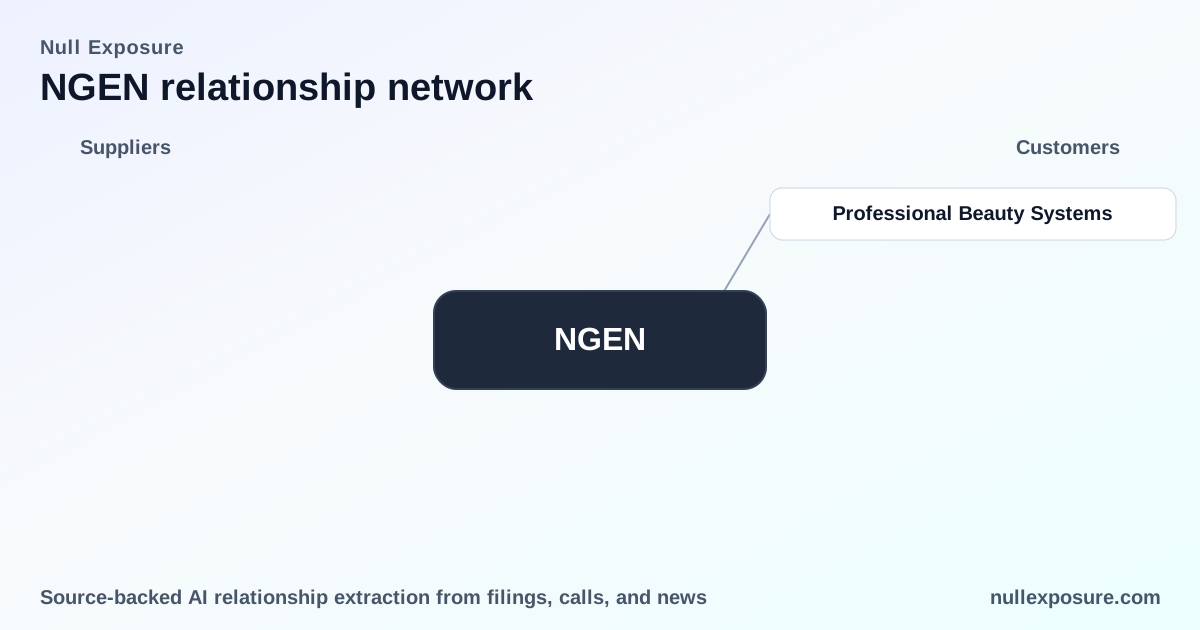
NGEN / Nanogen: A compact customer map with outsized partner dependency
NGEN is listed as NervGen Pharma Corp. on public exchanges, but the customer intelligence reviewed here references commercial arrangements executed by Nanogen Inc., notably around the Nanocovax vaccine and the disposal of a consumer beauty asset. The commercial model observable in the record is straightforward: monetize through licensing, technology transfer, and selective asset sales—leveraging third‑party manufacturers and regional distributors to scale reach and limit capital intensity. For investors, the practical consequence is revenue optionality tied to partner execution and geographic reach rather than heavy in‑house manufacturing.
If you want a concise company profile and relationship mapping to use in your research workflow, see the homepage for further resources: https://nullexposure.com/
What the relationship set reveals about how this business runs
The disclosed customer relationships point to a partner‑centric operating posture. Nanogen converts proprietary products into cash flows primarily by granting rights and transferring know‑how to regional players rather than building global supply chains. That model lowers capital burn and shortens time to market, but it creates concentration and execution risk: a small number of partners control distribution and production in key markets, so counterparty performance directly impacts revenue realization.
- Contracting posture: Predominantly licensing and tech‑transfer agreements that allocate manufacturing and distribution responsibilities to local partners, rather than vertical integration.
- Concentration: Only a few named partners appear in public items; this implies limited commercial diversification at the partner level.
- Criticality: Partner relationships are high impact—each deal unlocks large addressable markets (e.g., global vaccine supply, India distribution). Operational failures by partners would have immediate commercial consequences.
- Maturity: The nature of the transactions (rights grants, tech transfers, and an M&A-style sale of a beauty brand) signals a company that is executing commercialization and portfolio pruning, consistent with a business transitioning from R&D into market execution.
Detailed customer relationships (short, source‑anchored summaries)
HLB Inc. — global supplier rights for Nanocovax (ex‑India/Vietnam)
HLB Inc. secured rights from Nanogen to supply the Nanocovax vaccine to the world outside India and Vietnam, positioning HLB to be the primary international distributor for that product. This arrangement was reported in a May 2026 article in Vietnam Investment Review covering prior FY2021 agreements and regional licensing activity. (Vietnam Investment Review, May 2026)
Vekaria Healthcare LLP — tech transfer, production and India distribution
Nanogen signed an agreement with India’s Vekaria Healthcare LLP for technology transfer plus local production and distribution of Nanocovax, giving Vekaria operational responsibility for India market penetration. The deal was referenced in the same May 2026 coverage of Nanocovax commercial partners. (Vietnam Investment Review, May 2026)
HLB Pharmaceutical — an additional HLB group commercial expansion deal
HLB Pharmaceutical, a separate entity within the HLB group, executed a deal with Nanogen in December (reported in the coverage) to further expand global market presence for Nanocovax‑related products. The report ties this transaction to the company’s broader strategy of outsourcing regional commercialization to HLB affiliates. (Vietnam Investment Review, May 2026)
Professional Beauty Systems — sale of Medik8 / premium hair and beauty assets
Alantra acted as sole advisor to Medik8 Limited and Nanogen on the sale of a premium hair‑loss fibers and treatment brand to Professional Beauty Systems (PBS), indicating Nanogen’s willingness to divest non‑core consumer assets. The transaction was described in a March 2026 advisory announcement by Alantra covering the M&A process. (Alantra deal announcement, March 2026)
What investors should read into each relationship
Each named partner executes a different commercial role: HLB entities for international distribution, Vekaria for India manufacturing and distribution, and Professional Beauty Systems as an acquirer of consumer assets. Collectively, these contracts show a lean commercial footprint focused on licensing and capital‑light monetization. That structure accelerates top‑line access while shifting operational and regulatory risk onto partners.
- Revenue gating factors: Partner regulatory approvals, manufacturing scale‑up, and distribution logistics in local markets.
- Dilution of operational burden: Tech transfer and licensing reduce capex needs but give up direct control of production quality and timing.
- Balance‑sheet implications: Asset sales (e.g., the Medik8 transaction) provide near‑term cash and simplify the portfolio, but reduce future revenue diversity if not offset by recurring licensing streams.
Key investment implications and risks
- Upside: Rapid market access through established regional players; lower capital needs; ability to monetize IP through multiple transaction types (licenses, tech transfers, divestures).
- Downside: Single‑counterparty concentration in critical markets is a tactical risk; partner execution failures translate to immediate revenue disruption and reputational exposure.
- Valuation sensitivity: Given the commercial model, valuation will be highly sensitive to announced partner milestones (regulatory clearances, first shipments, production ramp metrics) rather than internal manufacturing KPIs.
Investors should monitor deal counterparty performance, regional regulatory timelines, and any follow‑on agreements that diversify the partner base or convert one‑time sales into recurring revenue streams.
For a structured view of counterparties and newsroom signals related to NGEN/Nanogen, you can check the research hub at https://nullexposure.com/
Bottom line: concentrated partners, scalable rights monetization
Nanogen’s public customer record shows a clear, repeatable playbook: license the product, transfer the know‑how, and let regional partners scale manufacturing and distribution—occasionally monetizing non‑core brands via sale. This approach trades operational control for speed and capital efficiency. The company’s near‑term commercial fortunes are therefore tethered to the performance of a few named partners; confirming those partners’ manufacturing capability and regulatory progress is the highest‑leverage due diligence an investor can perform.
Bold, partner‑structured commercialization creates rapid optionality—but it also concentrates execution risk. Track partner milestones and regulatory checkpoints as primary investment signals.