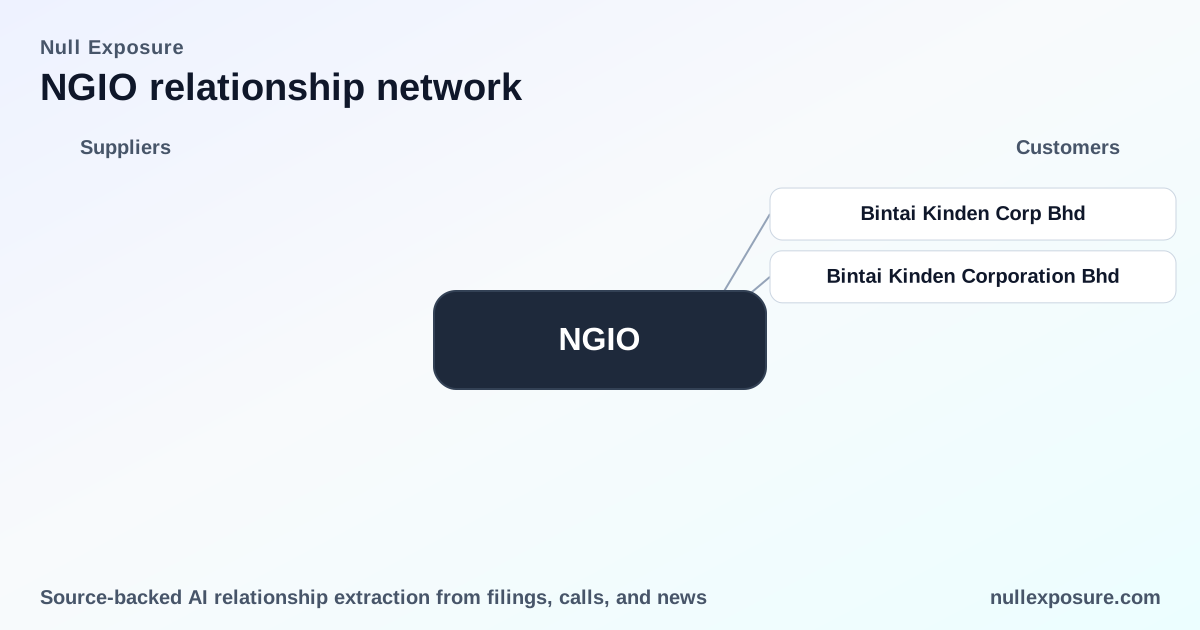
NGIO and Its Customer Footprint: Licensing, regional partners, and early-stage commercialization
NuGenerex Immuno-Oncology, Inc. (NGIO) operates as an intellectual-property driven life‑sciences company that commercializes a proprietary Ii‑Key peptide vaccine platform through licensing, development agreements, and regional distribution arrangements. NGIO monetizes by licensing platform technology to partners, entering funded development or management agreements, and granting exclusive regional commercialization rights that convert technology into near‑term cash via license and development fees and into longer‑term royalties and distribution economics.
For investors evaluating NGIO’s customer relationships, the most material commercial touchpoint in the available record is a recurring partnership with Malaysia’s Bintai Kinden Corporation Bhd and its healthcare subsidiary. For deeper company-level coverage and archived relationship records, see NullExposure’s collection at https://nullexposure.com/.
How NGIO captures value — a concise operating thesis
NGIO’s operating model is partner‑centric and capital‑lite: the company leverages its patented peptide immunotherapy technology and transfers development, regulatory and commercialization responsibilities to regional partners under licensing or development contracts. This posture produces three strategic characteristics:
- Contracting posture: NGIO acts primarily as an IP licensor and technology vendor rather than as a large-scale commercial manufacturer; revenue realization depends on structured deals (up‑front payments, development funding, licensing fees).
- Concentration: Observable customer exposure is concentrated toward a small set of strategic partners active in specific geographies; this increases revenue volatility but also enables outsized upside if a partner executes.
- Criticality: For regional partners, NGIO’s platform is a differentiated input (a patented immune activation technology) that can be critical to a localized vaccine or therapeutic offering; for NGIO, partners are critical conduits to commercialization and cash.
- Maturity: Relationships documented are development‑stage and licensing‑oriented rather than large, mature commercial supply contracts, implying early commercial maturity and dependency on milestone realization and successful regulatory progress.
Investment takeaway: NGIO’s path to sustainable revenue runs through partner execution of development and regional commercialization programs; investors should underwrite partner capabilities and contract economics when modeling cash flow.
The Bintai Kinden relationship — everything on record
Below are summaries of every documented relationship result in the available records. Each entry is presented in plain English with its source.
-
Bintai Kinden subsidiary signed a US$12.625 million deal to develop a synthetic peptide Covid‑19 vaccine with Generex/NuGenerex. According to a CodeBlue report first seen March 10, 2026, Bintai Healthcare Sdn Bhd signed a US$12.625 million (RM52.4 million) agreement with Generex Biotechnology Corp and NuGenerex Immuno‑Oncology Inc to develop a peptide vaccine against the coronavirus, indicating funded collaborative development activity in FY2020. Source: CodeBlue article, March 10, 2026 — https://codeblue.galencentre.org/2020/10/malaysian-engineering-company-signs-deal-for-covid-vaccine-with-unknown-clinical-research/
-
Generex executed a US$50 million licensing and development agreement (reported as positive for Bintai Kinden’s regional rights). A report on The Edge Malaysia noted Generex signed a US$50 million Licensing and Development Agreement with a Chinese consortium for the Ii‑Key vaccine platform, and that Bintai Kinden asserted exclusive rights to distribute and commercialize the Covid‑19 vaccine across multiple Southeast Asian markets, underscoring the partner’s regional market access claim (reported March 10, 2026). Source: The Edge Malaysia, March 10, 2026 — https://theedgemalaysia.com/article/generex%E7%AD%BE%E7%BD%B2likey%E7%96%AB%E8%8B%97%E5%B9%B3%E5%8F%B0%E6%8A%80%E6%9C%AF%E5%8D%8F%E8%AE%AE
-
Bursa Malaysia filing: MOU to fund/manage a synthetic peptide vaccine leveraging Ii‑Key technology. A Bursa Malaysia filing summarized by The Edge Malaysia and flagged in May 2026 shows Bintai Kinden inked a memorandum of understanding with Generex to fund and manage synthetic peptide vaccine development using the Ii‑Key immune activation technology, reflecting a structured commercial collaboration recorded in FY2023. Source: The Edge Malaysia summary of a Bursa Malaysia filing, May 3, 2026 — https://theedgemalaysia.com/article/company-signed-mou-tripled-its-share-price
-
Local press amplified the licensing story and the claimed exclusive distribution footprint. The Sun Malaysia reiterated that the Generex US$50 million licensing deal and the associated regional distribution rights were material to Bintai Kinden’s prospects, highlighting the partner’s commercial narrative and market positioning in Southeast Asia (reported May 3, 2026). Source: The Sun Malaysia, May 3, 2026 — https://thesun.my/news/malaysia-news/generex-inks-agreement-for-li-key-vaccine-platform-technology-ej5218305/
Net relationship signal: All records point to a sustained commercial engagement between NGIO (via Generex) and Bintai Kinden focused on licensing, funded development, and exclusive regional commercialization rights across multiple Southeast Asian jurisdictions.
What this means for investors — concentration, execution risk, and upside
- Concentration risk is real. The public relationship record for NGIO’s customer footprint in this sample centers on a single regional partner, which implies revenue concentration and dependence on that partner’s execution of funded development and commercialization plans.
- Execution and regulatory milestones drive value. The commercial economics referenced (license and development agreements, MOUs, and exclusive territorial rights) convert into cash only when development milestones are met and regulatory pathways are navigated successfully.
- Upside resides in successful partner commercialization. If Bintai Kinden and counterparties fulfill development and market authorization steps, NGIO’s licensing model allows rapid scale through third‑party distribution without heavy capital investment on its balance sheet.
Constraints and company‑level signals
There are no explicit constraints captured in the available relationship constraints feed for NGIO’s customer scope. At the company level, the absence of constraint entries is itself a signal: no structured limitations, encumbrances, or flagged counterparty restrictions were present in the provided records, but that absence does not substitute for contract review. Investors should obtain underlying agreements to validate exclusivity parameters, termination clauses, and payment schedules.
Final perspective and next steps
NGIO’s commercial model is clear: license the Ii‑Key platform, secure funded development partners, and monetize territory‑by‑territory through regional distributors. The partnership with Bintai Kinden demonstrates that model in practice but also highlights single‑partner concentration and execution dependence.
For a consolidated view of NGIO’s partner ecosystem and to track future relationship filings and press updates, review NullExposure’s coverage at https://nullexposure.com/. Conduct contract‑level due diligence and partner capability assessments before sizing NGIO exposure in financial models.