National HealthCare Corporation (NHC): Customer Relationships and What Investors Should Know
National HealthCare Corporation operates a diversified post-acute and senior care platform and monetizes through fee-for-service healthcare operations, management contracts that are usage‑based, and real‑estate leasing. The company runs and manages skilled nursing, assisted and independent living, home health and hospice businesses, and also leases owned properties to third‑party operators; management services are typically charged at 6% of facility net operating revenues, while ownership and lease structures provide recurring real‑estate income and strategic control. For deeper background on the firm and its financial profile, see https://nullexposure.com/.
Short thesis: predictable revenue from operations plus fee and lease economics
NHC combines operating cash flow from patient services with recurring fee income and property leasing to create a stable, service‑centric revenue base. With trailing revenue of roughly $1.52 billion and a substantial gross profit pool, investors should view NHC as a healthcare operator whose customer relationships are both the revenue engine and the operational nexus of value creation.
How NHC engages customers and partners
NHC’s commercial posture blends several monetization levers and contractual features that shape customer economics:
- Usage‑based management contracts: The company charges a standard management fee equal to 6% of managed centers’ net operating revenues, which aligns NHC’s revenue to facility performance and creates variable, recurring fee income.
- Long‑dated real‑estate arrangements: Leases for owned properties typically run 2 to 15 years, producing predictable rental cash flows and longer contractual locks with operators.
- Service provider and licensor roles: NHC functions both as an operator/manager and as a licensor/landlord—owning ten healthcare properties and leasing them to third parties—concentrating economic returns across operating and real‑estate channels. These operating features are embedded in the company’s filings and explain why service revenue accounts for the vast majority of top‑line activity.
Geographic and payor footprint that defines customer risk
NHC operates in nine U.S. states, primarily in the Southeast and Midwest, which concentrates operational exposure regionally while preserving scale advantages in those markets. Reimbursement concentration is meaningful: Medicare accounts for ~33% and Medicaid ~29% of net patient revenues, so public payors collectively supply the majority of patient revenue. In fiscal 2024, 95.7% of net operating revenues were derived from healthcare services, making the company’s customer relationships functionally critical to overall enterprise value. These are company‑level characteristics pulled from the FY2024 filing and public disclosures.
Relationship overview: every customer relationship found in the record
Below is the single customer relationship identified in the provided results and a concise plain‑English rundown.
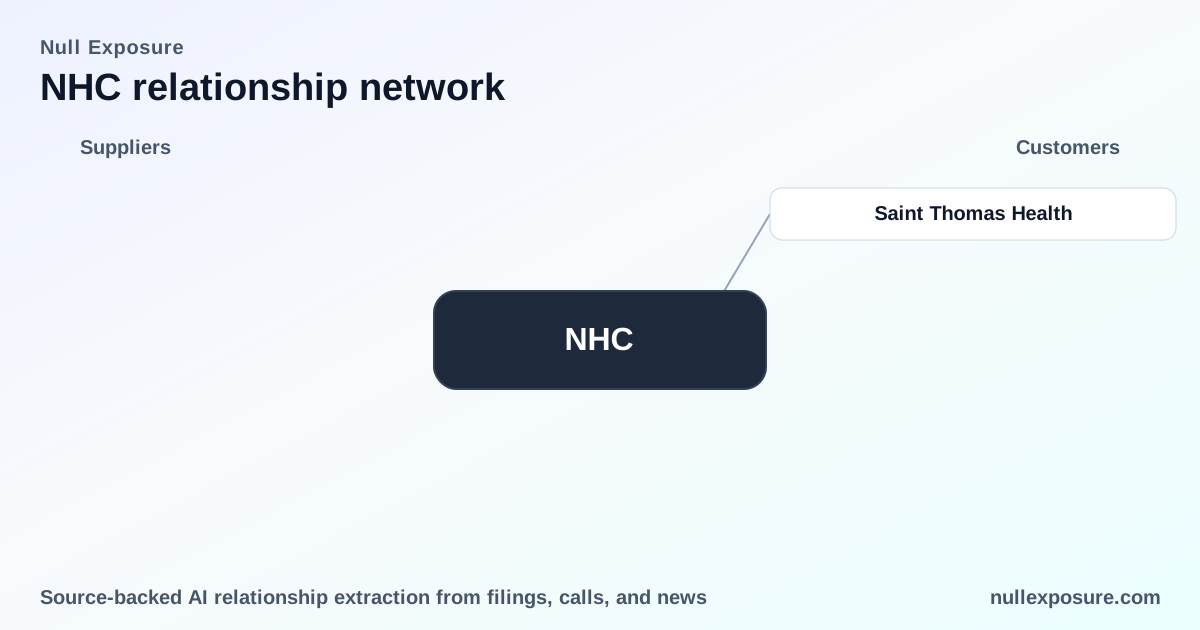
Saint Thomas Health — three‑year patient transition partnership
NHC entered a three‑year partnership with Saint Thomas Health to coordinate patient transitions from hospital to post‑acute settings, which improves continuity of care and increases downstream referrals to NHC‑managed skilled nursing and similar facilities. This relationship was reported in a Tennessean news article in 2016 describing the coordination and transition program between the hospital system and NHC. (Source: Tennessean, Aug 15, 2016)
Constraints and what they signal about NHC’s business model
The public constraint signals and filing excerpts clarify how NHC structures relationships and what investors should expect operationally:
- Contracting posture: long‑term + usage‑based — The firm’s lease terms (2–15 years) and its 6% management fee structure indicate a hybrid model that combines long-term landlord economics with revenue‑sensitive service fees. This creates both downside protection through leases and upside linkage to facility performance through management fees.
- Counterparty concentration: heavy government payor exposure — With Medicare and Medicaid forming a combined majority of net patient revenues, NHC’s cash flows are tightly coupled to public payor rates and regulatory policy. This elevates reimbursement risk relative to commercial‑payor‑heavy peers.
- Materiality and focus on services — Service revenue dominates the company’s income statement (95.7% in FY2024), so customer relationship health directly drives profitability and free cash flow.
- Role diversity: operator, manager, licensor — NHC acts as a direct service provider to residents, offers management/administrative services to third‑party operators, and leases owned real estate; those multiple roles diversify revenue streams but introduce mixed counterparty dependencies.
- Geographic maturity: regional scale in the U.S. — Operating in nine states with concentrated Southeast/Midwest exposure gives NHC operational expertise and scale where it competes, but limits geographic diversification versus national peers.
These constraints are company‑level signals derived from NHC’s filings and public disclosures rather than attributes of any single partner unless explicitly stated.
Investment implications: what to watch and why it matters
NHC’s customer relationship model produces clear levers for investors:
- Revenue stability with growth sensitivity: Lease revenue and management fees provide steady cash flows, while overall top‑line growth depends on occupancy, case mix and payor reimbursement dynamics.
- Regulatory and payor risk dominate: Given the public payor mix, any shifts in Medicare/Medicaid reimbursement or policy present direct earnings implications. Investors should model reimbursement scenarios explicitly.
- Operational advantage in referral relationships: Partnerships with hospital systems, such as the Saint Thomas Health arrangement, act as referral pipelines that can raise occupancy and mix quality; management of these partnerships is a durable competitive asset.
- Balance sheet and real‑estate optionality: Ownership of healthcare properties and long lease terms give NHC optionality to monetize or redeploy assets, but also a degree of capital intensity that investors must reconcile with operating returns.
Key monitoring items for quarters ahead include occupancy and revenue per patient trends, payor mix shifts, contractual renewals on leased properties, and the pipeline of hospital and health system partnerships that feed admissions.
Bottom line and next steps
National HealthCare Corporation’s customer relationships combine contractual length, usage‑linked fees, and public‑payor exposure, producing a business whose cash flows are predictable but sensitive to reimbursement dynamics. Hospital system partnerships—exemplified by the Saint Thomas Health three‑year initiative—are strategically important as referral and coordination channels that lift utilization and downstream revenue.
For a concise, investor‑grade synthesis of NHC’s customer and partner landscape, and to compare these relationship signals across peers, visit https://nullexposure.com/.
If you want a tailored memo that stress‑tests NHC’s earnings under different reimbursement scenarios or models the impact of changes in occupancy and referral flows, that analysis can be prepared on request.