National Healthcare Properties (NHPBP): Customer Relationships and Operational Constraints that Matter to Investors
National Healthcare Properties, Inc. (NHPBP) operates as a healthcare-focused REIT that acquires, owns and leases skilled nursing and assisted living facilities across the United States and monetizes primarily through long-term net leases and operating income from property-level services. The company generates recurring cash flow via contractual rent and SHOP revenues while managing portfolio risk through geographic diversification and a mixture of lease terms. For a concise view of NHPBP’s customer footprint and legal/market signals, review coverage and datasets at https://nullexposure.com/ — the source used to assemble this report.
Quick thesis for investors
NHPBP is a cash-flow-driven real estate operator in the healthcare facilities niche: it captures stable recurring rent from healthcare operators and supplemental fees from resident services; portfolio performance depends on lease term structure, tenant credit and the operational health of provider partners. That combination creates an income-oriented equity profile with sensitivity to operator liquidity and regional healthcare demand.
What the recent press activity indicates
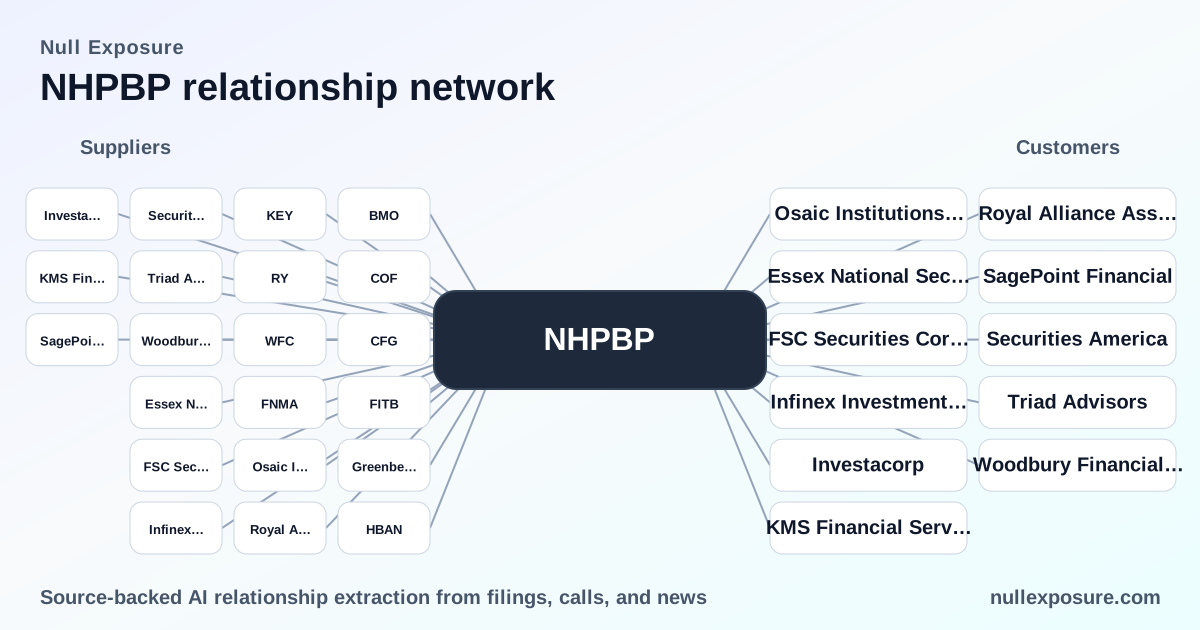
A cluster of securities-firm names surfaced in a March 2026 notice circulated by KlaymanToskes and distributed via multiple press channels; the communications targeted customers of Osaic Institutions and referenced purchases of NHPBP shares. These mentions are transactional/holding notices rather than operational partner announcements, but they illustrate investor interest and distribution channels for NHPBP equity among broker-dealer networks. According to the YDR press release on March 10, 2026, and a parallel notice via the Des Moines Register the same day, the communication warned or informed customers across Osaic’s affiliated broker-dealers about positions in National Healthcare Properties for FY2026.
All identified relationships and what they mean for investors
-
Osaic Institutions, Inc. — The press release addresses Osaic customers who purchased NHPBP shares, indicating Osaic’s networks distributed or held positions in NHPBP for FY2026; this notice was circulated by KlaymanToskes and published on March 10, 2026. (Source: YDR press release, March 10, 2026; Des Moines Register, March 10, 2026.)
-
Essex National Securities — Named as one of the broker-dealers within the Osaic network whose customers could hold NHPBP positions, signaling retail and advisor-level placement through legacy channels. (Source: YDR press release, March 10, 2026.)
-
FSC Securities Corporation — Listed among Osaic-related brokerages in the distributed notice, implying FSC clients had exposure to NHPBP holdings via Osaic’s consolidated advisory network. (Source: YDR press release, March 10, 2026.)
-
Infinex Investments, Inc. — Cited as part of the Osaic lineage of firms; Infinex clients are included in the press outreach tied to NHPBP share purchases. (Source: YDR press release, March 10, 2026.)
-
Investacorp — Included in the list of broker-dealers associated with Osaic, representing another retail/advisory channel where NHPBP shares were held or sold. (Source: YDR press release, March 10, 2026.)
-
KMS Financial Services — Identified in the Osaic firm list circulated with the KlaymanToskes notice; this highlights distribution breadth across smaller independent firms. (Source: YDR press release, March 10, 2026.)
-
Royal Alliance Associates — Appears in the Osaic network list, demonstrating that legacy broker platforms routed NHPBP exposure to a broad base of advisors. (Source: YDR press release, March 10, 2026.)
-
SagePoint Financial — Named among the affiliated brokerages in the client notice, reinforcing that NHPBP equity was present across multiple advisory franchises. (Source: YDR press release, March 10, 2026.)
-
Securities America — Included in the notice’s roster of Osaic-related firms, adding another distribution node for NHPBP holdings among advisors and retail clients. (Source: YDR press release, March 10, 2026.)
-
Triad Advisors — Listed in the Osaic network referenced by the notice, indicating Triad-advised clients were known purchasers of NHPBP stock. (Source: YDR press release, March 10, 2026.)
-
Woodbury Financial Services — Appears in the consolidated list of Osaic legacy firms associated with the customer notice, showing exposure via a further advisory channel. (Source: YDR press release, March 10, 2026.)
Takeaway: the relationship set is fundamentally distribution/ownership-oriented: the press notices signal where retail and advisor-level investors acquired NHPBP shares rather than direct operating counterparties of the REIT.
Operational constraints and business-model signals investors should weigh
NHPBP’s operating model is shaped by a mix of contractual designs, tenant types and geographic concentration patterns that collectively drive revenue stability and risk.
-
Lease tenors vary but skew long-term at the portfolio level. Corporate filings report a weighted average remaining lease term of roughly 6.5 years for leases as of December 31, 2024, reinforcing the REIT’s reliance on multi-year net leases for income predictability.
-
Short-term resident contracts exist alongside long leases. Certain resident-level arrangements in the SHOP segment are month-to-month and are recognized as monthly service revenue, which increases revenue variability relative to pure net leases.
-
Counterparty mix includes individuals and institutional tenants. Resident rent and service fees in SHOP operations are recognized monthly, while the OMF segment is leased to institutional healthcare operators that pay rent and pro rata expenses.
-
Geographic diversification across the United States is a structural strength. NHPBP owns properties in 31 states (193 properties as of 12/31/2024), which reduces single-region concentration risk and ties cash flows to national demographic trends.
-
Tenant concentration is immaterial by standard thresholds. The company reports no tenant accounting for 10% or more of annualized rental income, which reduces single-tenant counterparty risk at the portfolio level.
-
Role duality in cash flows: buyer and seller economics. NHPBP acts as a seller of real estate services (landlord collecting rent) and as buyer of acquisition opportunities; portfolio cash flows reflect both landlord income and property-level operational revenue in SHOP assets.
-
Active, revenue-producing portfolio. Annualized rental income metrics for leases in place as of year‑end 2024 confirm the portfolio is active and producing contracted cash flows, although SHOP service revenues inject higher variability.
-
Model tags a large spend/scale signal. Constraint extraction shows a spend-band classification of $100m+, indicating portfolio-level revenue scale consistent with large, institutional REIT operations.
Investment implication: these constraints combine to produce a cash-flow profile that is resilient to localized demand shocks but sensitive to operator credit and resident occupancy trends; lease term structure and tenant credit quality are the primary risk levers.
Risk highlights and monitoring checklist
- Watch operator liquidity and reimbursement dynamics for skilled nursing providers; tenant stress directly affects rent collections.
- Track SHOP segment occupancy and resident-service margins because these are short-term revenue drivers.
- Monitor portfolio lease expirations and market rental rate alignment given the long weighted-average lease tenor.
For deeper position analytics and consolidated relationship maps, visit our research hub at https://nullexposure.com/. If you want an investor-focused summary tailored to portfolio due diligence, our portal provides the primary-source links and signal scoring used to build this note.
Final verdict for allocators
NHPBP is a classical healthcare REIT with diversified geographic exposure, a predominantly long-term lease backbone and supplementary operational revenue from resident services. The March 2026 broker-dealer notices underscore broad retail and advisor participation in the equity, but they do not change the underlying landlord-tenant economics. Investors should underwrite rent collection risk and operator credit while valuing the stability that multi-year net leases deliver to distributable cash flow.