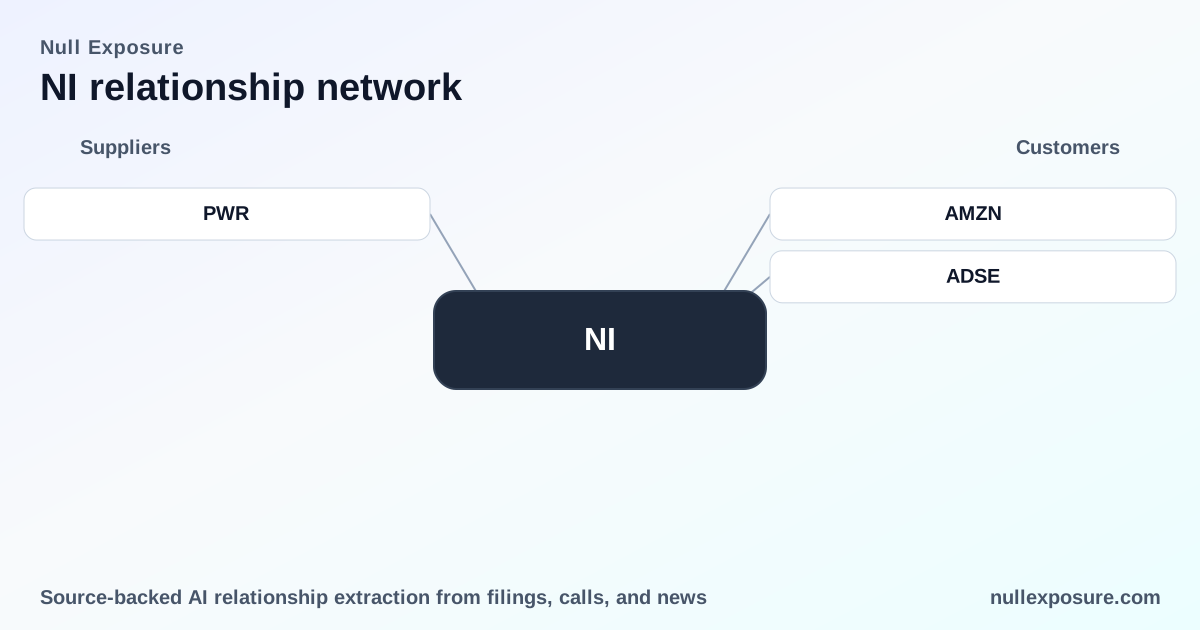
NiSource's big‑tech pivot: Amazon and Alphabet underwrite a new regulated growth leg
NiSource is a traditional, fully regulated utility that monetizes through tariffed delivery, generation capacity charges and regulated returns on invested capital; its recent strategy layers a GenCo build‑and‑serve model to supply large data‑center customers under long‑term contracts, unlocking incremental EBITDA while preserving regulated cash flows. The Amazon and Alphabet agreements convert large‑scale capacity investment into predictable, multi‑year cash returns and meaningful customer bill credits, shifting NiSource’s risk/return profile toward contracted merchant relationships backed by regulated recovery mechanisms.
For relationship intelligence and primary‑source tracking, consult Null Exposure: https://nullexposure.com/
Why these commercial contracts matter to investors
NiSource’s core monetization remains regulated distribution and commodity delivery, but management has structured the GenCo program to capture the lucrative middle ground between merchant generation and regulated utility service. Under the announced agreements NiSource will:
- Build and operate up to 3,000 MW of dispatchable generation for large data‑center customers, recovering capital through a combination of fixed capacity charges and pass‑through infrastructure costs.
- Capture outsized earnings growth while returning a portion of value to retail customers via contract‑driven bill credits (management cites approximately $1 billion of customer flowback tied to the Amazon deal).
- Maintain regulated retail exposure (distribution and commodity sales) while adding high‑credit, long‑term counterparties that materially raise the spend band and strategic profile of NIPSCO’s service territory.
Key takeaway: these are long‑dated, large‑ticket contracts that materially change NiSource’s asset footprint and earnings cadence without abandoning its regulated revenue base.
Contract and operating constraints that shape valuation
NiSource’s disclosures and filings reveal contract features and company‑level signals that directly affect underwriting:
- Long‑term, capital‑returning structures. Management describes investment recovery over an initial fifteen‑year term, signaling cashflow profiles that support multi‑year EBITDA uplift and regulated return mechanics.
- Usage‑based revenue mix remains primary. Tariffed sales and delivery obligations mean performance obligations are satisfied over time as energy and delivery occur, preserving usage volatility exposure on the commodity side even as capacity revenue becomes steadier.
- Geographic concentration in northern Indiana. NiSource’s GenCo and large‑load opportunity set are concentrated in its NIPSCO service territory, increasing local economic importance and regulatory focus.
- Materiality and scale. Management notes the Contract Assets’ generating capacity will be roughly equivalent to NIPSCO’s existing fleet when fully operational, and total development costs are currently estimated near $7 billion — a company‑level signal that capex intensity and permitting risk will be central underwriters’ concerns.
- Dual role exposure. NiSource functions as both regulated seller (delivery/distribution) and commercial supplier (generation/wholesale), creating complex tariff, cost‑allocation and affiliate‑transaction considerations for regulators and investors.
- Spend band elevated. The scale of the build and the counterparty credit profiles place these arrangements in the >$100 million spend band, changing capital markets access and interest‑rate sensitivity for project financings.
For a concise briefing on how these signals interact with credit and equity valuation, visit Null Exposure’s relationship intelligence hub: https://nullexposure.com/
Counterparties: the relationships you need to underwrite
Amazon
NiSource disclosed a landmark agreement with Amazon that will supply power to Amazon’s data centers and return approximately $1 billion in value to NIPSCO retail customers over the life of the contract, with management estimating a $7–$9 monthly bill reduction per customer once Amazon fully ramps. This was highlighted in NiSource’s 2025 Q4 earnings remarks and regulatory filings with the Indiana Utility Regulatory Commission (IURC) (NiSource 2025 Q4 earnings call, March 2026).
AMZN
Multiple market reports and analyst notes repeat the same commercial facts: Amazon/AMZN is the anchor of a long‑term supply arrangement that supports NIPSCO GenCo economics and an 8–9% EPS CAGR guide through 2033, per management commentary cited in sell‑side notes (MarketBeat and company earnings commentary, FY2026).
Amazon.com, Inc.
NiSource has publicly framed the Amazon relationship as an expansion and acceleration of prior agreements to energize sites sooner and accelerate household credits, reinforcing the strategic priority of the Amazon commercial footprint in northern Indiana (news coverage: InsiderMonkey / SahmCapital, April–May 2026).
Amazon Data Services
NiSource specifically identified Amazon Data Services (the data‑center arm) as a counterparty for long‑term electricity supply, tying accelerated site energization to customer credit schedules and transmission upgrades (news reports and analyst notes, March–May 2026).
Amazon Data Services, Inc.
Analyst coverage and press releases name Amazon Data Services, Inc. when describing the expanded commercial terms that speed electricity delivery to new sites and support the GenCo activation timeline (Investing.com and MarketScreener, April–May 2026).
Amazon subsidiary ADS
Some filings and market stories refer to an Amazon subsidiary, ADS (Amazon Data Services), as the customer party in the contracted supply arrangement; NiSource frames these as commercial, credit‑backed agreements supporting regulated recovery of related infrastructure costs (SahmCapital / MarketBeat coverage, FY2026).
ADS
Trade coverage using the ADS ticker references the same Amazon data‑center deals and underscores NiSource’s intent to treat ADS as a creditworthy, anchor large‑load customer for GenCo development plans (SimplyWallSt / news reports, March–May 2026).
ADSE
A minority of sources label the Amazon subsidiary ADSE when summarizing the long‑term contracts; the substance is identical: NiSource enters multi‑year supply relationships with Amazon’s data‑center entities to support generation and transmission investments (SimplyWallSt, March 2026).
Alphabet
NiSource announced a long‑term energy supply agreement with a subsidiary of Alphabet to serve a large data center in northern Indiana, with operations expected to begin in summer 2026; investment banks and analysts framed the deal as de‑risking energy availability for cloud expansion (SimplyWallSt / Mizuho / Investing.com, April–May 2026).
Alphabet Inc.
Analyst notes and press releases explicitly name Alphabet Inc. as the counterparty in a long‑term power deal for a significant Indiana data‑center campus, reinforcing the strategic importance of NiSource’s GenCo model to hyperscale cloud providers (MarketScreener / JP Morgan coverage, April–May 2026).
Sell‑side commentary references Google and Project Maize (a data‑center campus in Michigan City, Indiana) as the practical locus of the Alphabet deal, tying expected commercial operations to 2026–2027 in analyst updates (Mizuho / Investing coverage, FY2026).
GOOGL
Research bulletins and market alerts use ticker references (GOOGL) when describing Alphabet’s credit backing for the long‑term supply agreement and the consequential reduction in local energy‑supply uncertainty for cloud expansions (MarketBeat and Marketscreener, April–May 2026).
Investment implications and risk checklist
- Upside: High‑credit counterparties and long terms materially increase predictable cash flow and support elevated EPS growth guidance; customer flowback can improve retail affordability narratives for regulators.
- Execution risk: Permitting, construction and transmission development across a $7 billion project base are principal execution risks; the GenCo build‑out is company‑level and will consume capital and management bandwidth.
- Regulatory risk: Dual roles (regulated distributor and contracted supplier) invite close regulatory scrutiny on cost allocation and tariff constructs; filings with the IURC are now central to project economics.
- Concentration risk: Benefits are concentrated in northern Indiana — the region that will bear most construction, permitting and reliability impacts.
Bottom line: NiSource has transformed a regional regulated utility profile into a hybrid model that pairs regulated returns with large, long‑term commercial contracts from Amazon and Alphabet; this materially raises growth optionality while also elevating capex and regulatory execution risk. For source‑level tracking and relationship maps, visit Null Exposure: https://nullexposure.com/