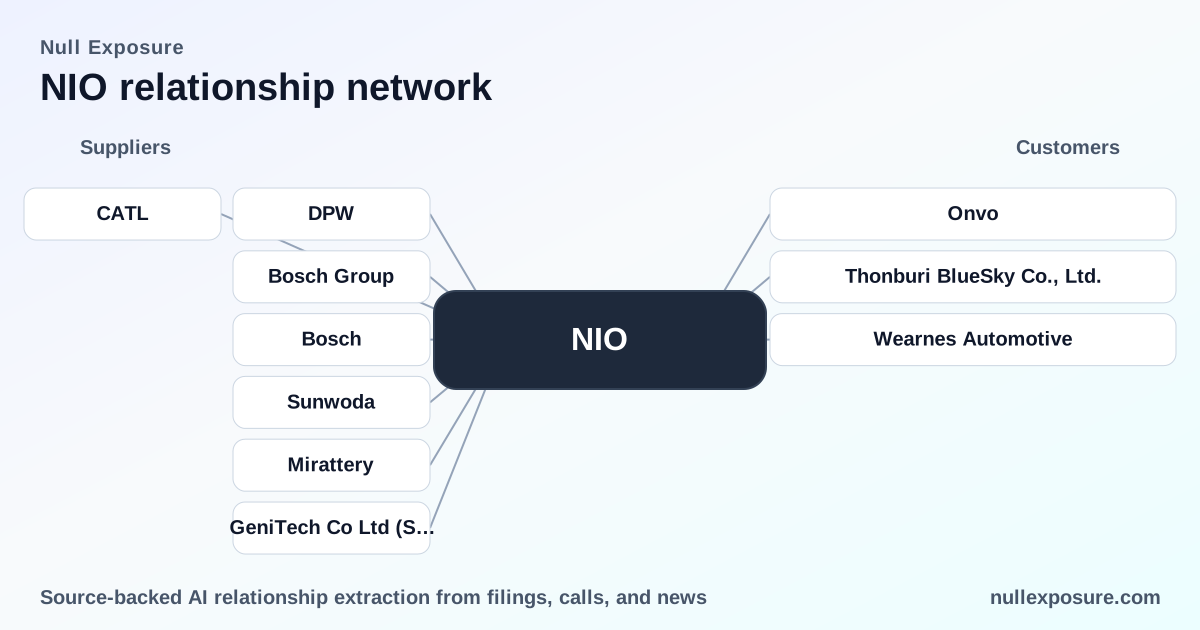
NIO customer relationships: what investors should know
NIO is an integrated electric-vehicle platform that sells vehicles, subscriptions, and adjacent services (charging and battery‑swap networks, software and insurance partnerships) and monetizes through vehicle sales, recurring service subscriptions (including Battery-as-a-Service), and network-enabled customer retention services. Its strategy combines product sales with proprietary infrastructure to lock in customers and create recurring revenue streams while expanding through OEM, retail and distribution partnerships.
If you want a concise mapped view of who NIO works with and what each relationship delivers for revenue or strategic optionality, see the relationship drilldown below. For ongoing monitoring and a consolidated view of these partner links, visit https://nullexposure.com/.
High-level takeaways for investors
- NIO operates a hybrid hardware + services model. Vehicle P&L drives revenue today while the charging/swapping network and software/subscription services create higher-margin, recurring opportunities.
- Partnerships are mostly commercialization and distribution-driven. NIO leverages local distributors, sub-brands, and shared infrastructure to scale geographically without duplicating all capital investment.
- Platform criticality and concentration are non-trivial risks. Shared use of NIO’s swapping/charging network by partners increases utility and utilization, but also concentrates operating leverage in the company-owned network.
- Financial posture remains expansionary. NIO’s most recent trailing figures show substantial top-line scale (Revenue TTM
87.5B) with negative EBITDA (-6.9B), indicating growth at cost and reliance on service monetization to improve margins.
Customer relationships: who NIO works with and why it matters
Lotus (LOT)
NIO announced a cooperation with Lotus to share NIO’s charging and battery‑swap infrastructure with Lotus users across China, explicitly offering Lotus customers access to NIO’s charging and swapping network. This is a distribution and network‑utilization play that extends NIO’s infrastructure economics. According to NIO’s press release on March 10, 2026, the companies will share charging and swapping resources to improve customer service for Lotus owners (NIO press release, March 10, 2026: https://www.nio.com/news/nio-and-lotus).
CheChe Group (CCG)
A news item reported that NIO deepened an insurance partnership with CheChe Group amid strong delivery growth, indicating an expansion of NIO’s insurance and after‑sales service ecosystem to capture more service revenue per vehicle. The StockTitan notice referenced a partnership update on September 8, cited in a March 9, 2026 posting (StockTitan news, March 9, 2026: https://www.stocktitan.net/news/CCG/cheche-group-announces-receipt-of-notification-letter-from-x2srwr3c2x5c.html).
Onvo (NIO sub‑brand / affiliated)
Onvo vehicles already share battery‑swap stations with NIO’s flagship brand, increasing network utilization and providing cross‑brand customer benefits even as Onvo develops its own product roadmap. Separately, Onvo confirmed the upcoming L90 will be equipped with NIO’s in‑house Shenji NX9031 autonomous driving chip, indicating vertical technology reuse across sub‑brands. These notes were reported in market coverage and an industry piece in March–April 2026 (StockTwits coverage, March 10, 2026; CNEVPost, April 11, 2026: https://cnevpost.com/2026/04/11/nio-onvo-to-equip-updated-l90-with-shenji-nx9031-chip/).
Noetix Robotics
The founder and chairman of Noetix Robotics was reported as the owner of the 100,000th third‑generation ES8, which is an endorsement of NIO’s product uptake among corporate and founder-level customers in industrial technology circles. This milestone was covered by CNEVPost in April 2026, noting the owner of the milestone vehicle (CNEVPost, April 23, 2026: https://cnevpost.com/2026/04/23/nio-third-gen-es8-reaches-100000-deliveries/).
UXIN
NIO Capital invested in UXIN, a used-car retailer, and UXIN’s retail platform sells previously produced NIO models such as the ES8, creating a secondary-market channel for NIO vehicles that helps preserve residual values and supports trade-in and remarketing flows. The investment and product mention were reported in March 2026 (Eletric‑Vehicles.com, March 10, 2026: https://eletric-vehicles.com/nio/nio-capital-invests-20-million-in-china-used-car-retailer-uxin/).
Wearnes Automotive
Wearnes Automotive served as the local partner for NIO’s Firefly right‑hand‑drive rollout in Southeast Asia, enabling market entry and first deliveries in Singapore through an established distributor network rather than NIO building a full captive retail footprint. This commercial entry was reported in coverage of Firefly’s Southeast Asian reveal in early 2026 (GlobalChinaEV, January–March 2026: https://globalchinaev.com/post/nios-firefly-brand-officially-enters-thailand-as-its-2nd-right-hand-drive-marke).
Thonburi BlueSky Co., Ltd.
Thonburi BlueSky, part of the Thonburi Group, acted as the local distributor and contract manufacturer partner for NIO in Thailand, providing established distribution channels and manufacturing relationships that accelerate market access in a right‑hand‑drive market. This was reported in industry coverage of Firefly’s Bangkok debut (GlobalChinaEV, March 2026: https://globalchinaev.com/post/nios-firefly-brand-officially-enters-thailand-as-its-2nd-right-hand-drive-marke).
For a consolidated tracker of these customer links and their commercial implications, visit https://nullexposure.com/ to see how partner footprints intersect with NIO’s infrastructure and revenue streams.
What the relationship map implies about NIO’s operating model and constraints
There are no explicit contractual constraints listed in the feed for these customer links; taken together, the relationships convey clear company‑level signals about how NIO operates:
- Contracting posture: NIO acts as both product supplier and infrastructure landlord—agreements are a mix of co‑operation (infrastructure sharing) and commercial distribution deals rather than simple OEM one‑offs. That posture supports recurring revenue capture from network use and services.
- Concentration: Partnerships are geographically and functionally targeted (China core, selective Southeast Asian expansion), so counterparty concentration is moderate—critical partners exist for new markets and services, but NIO maintains direct control of its core charging/swapping assets.
- Criticality: NIO’s swapping/charging network is strategically critical for partners that adopt it; shared network use increases lock‑in for end customers and drives utilization economics for NIO.
- Maturity: The model is mid‑stage commercial—large installed vehicle base and active partnerships demonstrate scale, but negative EBITDA and ongoing capital needs indicate growth‑phase economics reliant on improved service margins and higher utilization to reach sustained profitability.
Investment implications and risks
- Upside: Shared infrastructure deals and sub‑brand technology reuse (e.g., Shenji chip across Onvo) accelerate monetization of proprietary platforms and create cross‑sell avenues for high‑margin services.
- Key risks: Network concentration (dependency on proprietary swap/charge assets), execution risk in new markets via distributors, and ongoing margin pressure given current negative EBITDA and a negative profit margin. Regulatory and geopolitical dynamics in NIO’s operating jurisdictions also intersect with partner arrangements.
Bold strategic relationships with Lotus, Onvo, and regional distributors underpin NIO’s plan to convert capital‑intensive infrastructure into recurring revenue and higher margins. Investors should focus on utilization trends for the swap/charge network, subscription penetration per vehicle, and the pace of commercial rollouts through partners.