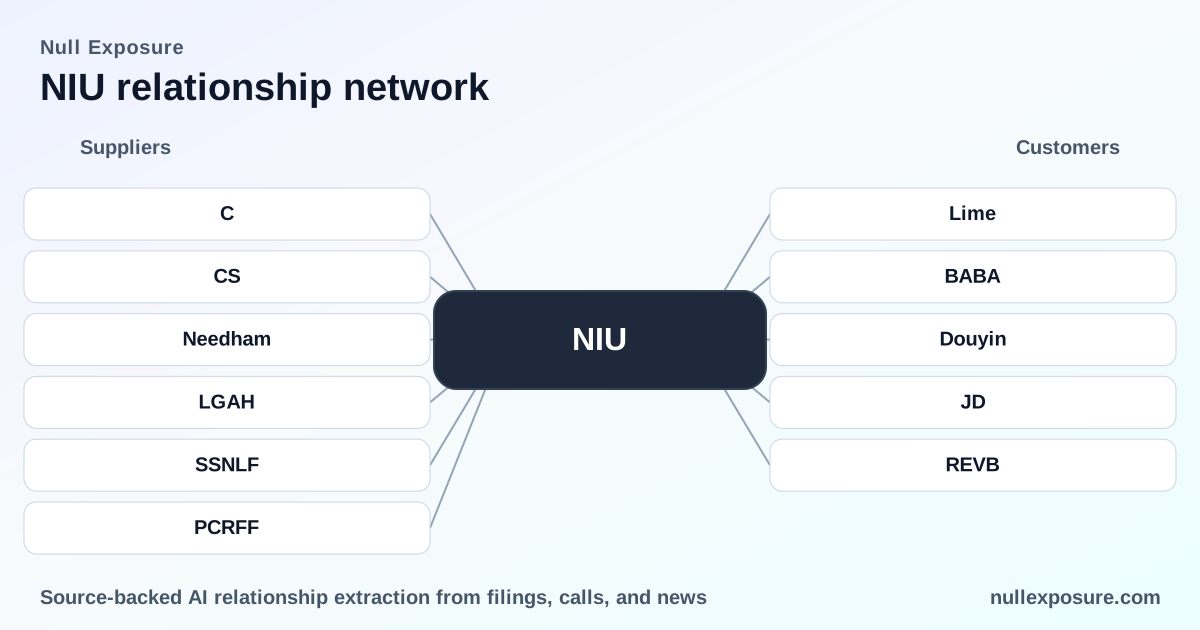
NIU Technologies: customer map and what it means for investors
Niu Technologies designs, manufactures and sells smart electric two-wheelers in China and monetizes primarily through retail and wholesale hardware sales to consumers and fleet operators, complemented by digital services tied to its connected-vehicle platform. Revenue is driven by direct e‑commerce channels and strategic fleet relationships, while product-level margins and geographic mix determine near-term profitability as NIU scales. For investors and operators evaluating customer risk and commercial traction, the combination of retail platform wins during seasonal sales and selective fleet deployments frames both upside and concentration risks.
Learn more about how we track corporate relationships at https://nullexposure.com/.
How NIU reaches buyers: retail platforms, fleet partners, and component suppliers
NIU sells to three distinct customer archetypes:
- Mass retail consumers through dominant Chinese e‑commerce platforms and social commerce channels;
- Shared‑mobility fleets that buy bulk units for scooter/moped rentals; and
- Tier‑1 component suppliers that provide advanced sensors and modules for premium models.
This multi‑channel go‑to‑market gives NIU scale in urban China while exposing it to platform promotional cycles (for example, the “618 Shopping Festival”) and to the procurement calendars of fleet customers. The company’s FY2026 disclosures show meaningful revenue scale (Revenue TTM: 4,307,866,000) but operating margins remain negative (-15.2% TTM), underscoring that top-line distribution wins have yet to be fully monetized into profitable operating leverage.
Customer relationship roll call — what public signals show
Below I cover every customer relationship surfaced in the available reporting. Each entry is a concise, plain‑English take with the original source noted.
Lime
NIU’s electric mopeds have been adopted by shared‑mobility operators such as Lime, positioning NIU as a supplier to international fleet companies that require rugged, high‑range urban vehicles. According to an Inverse technology piece (March 2026), NIU’s higher‑end mopeds are used by rental services including Lime. (Inverse, March 2026)
REVB
NIU’s vehicles are listed as vehicles used by REV Mobility (REVB) in press coverage, indicating NIU supplies fleet operators in U.S. urban mobility programs. An Inverse article referenced NIU mopeds in connection with Revel/REVB (reported March 2026). (Inverse, March 2026)
Revel
Coverage specifically names Revel as a customer for NIU’s electric mopeds, reflecting NIU’s penetration into U.S. fleet pilots and rental programs. The same Inverse news item cites Revel’s use of NIU hardware. (Inverse, March 2026)
HSAI (Hesai)
NIU is integrating advanced perception hardware into select models; Hesai has started supplying solid‑state LiDAR for NIU’s electric two‑wheelers, which signals product differentiation efforts on higher‑end trims. CNEVPost reported in April 2026 that Hesai (HSAI) began providing solid‑state LiDAR for Niu Technologies’ electric two‑wheelers. (CNEVPost, April 2026)
BABA (Alibaba)
NIU’s high‑end models topped rankings during China’s “618 Shopping Festival,” with strong distribution and promotional performance on Alibaba’s Tmall marketplace. A StockTwits news article covering FY2025 sales performance noted NIU’s top rankings on Alibaba’s Tmall during the 618 event. (StockTwits news, March 2026)
Alibaba (Tmall)
Separately called out as a platform partner, Tmall is a primary retail channel for NIU’s consumer models and drives seasonal volume spikes tied to platform events. The FY2025 sales commentary highlighted top placements on Tmall during the June 18 shopping festival. (StockTwits news, March 2026)
JD.com
NIU’s premium models also performed strongly on JD.com during the 618 sales period, reinforcing a multi‑platform retail strategy rather than dependence on a single e‑tail channel. This performance was reported in the FY2025 sales coverage. (StockTwits news, March 2026)
Douyin
NIU’s presence on Douyin (China’s TikTok) contributed to product visibility and direct‑to‑consumer conversion during promotional periods, with high‑end models ranking among best sellers on the platform during the 618 festival. The FY2025 coverage included Douyin as a key channel for NIU. (StockTwits news, March 2026)
What these relationships collectively tell investors
- Channel diversification is real but concentrated at the platform level. NIU places products across Alibaba/Tmall, JD.com and Douyin, which reduces single‑platform dependence but creates exposure to promotional timing and platform fee dynamics during major shopping events. The FY2025 coverage of 618 results shows NIU can win visibility on multiple platforms simultaneously. (StockTwits news, March 2026)
- Fleet partnerships give strategic optionality but are not a substitute for retail scale. Relationships with Lime and Revel indicate product suitability for shared‑mobility fleets and provide validation for durability and operational use cases. However, fleet procurement cycles are lumpy and competitive. (Inverse, March 2026)
- Product differentiation through components is underway. Integration of Hesai’s solid‑state LiDAR into two‑wheelers signals NIU is pursuing premium differentiation at the hardware level, which can support higher ticket prices but also raises unit BOM and integration complexity. (CNEVPost, April 2026)
Operating model and business‑model constraints (company‑level signals)
There are no public contract excerpts in the available coverage that disclose fixed long‑term purchase agreements or guaranteed offtake; this absence is itself informative: NIU’s public commercial posture relies on retail channel momentum and project‑level fleet wins rather than long‑dated, disclosed supply contracts. Key company‑level signals:
- Contracting posture: Predominantly transactional — retail listings and project sales to fleets rather than headline long‑term supply contracts disclosed in coverage.
- Customer concentration: Distribution is spread across several large Chinese platforms, but promotional dependence (e.g., 618) creates timing concentration risks.
- Criticality: For premium fleet customers, NIU provides differentiated hardware; for retail platforms, NIU is one of many brands competing for top placement during promotional windows.
- Maturity: Financials show scale (Revenue TTM ~4.31B) but negative operating margins (-15.2%) and negative EPS, indicating growth stage with ongoing margin compression pressures as it balances R&D, hardware investment, and channel marketing.
Investment implications and risks
- Upside: Continued top‑rankings on major e‑commerce platforms and selection by fleets like Lime/Revel support volume scalability and brand validation. Integration of Hesai sensors could expand ASPs on higher‑margin models.
- Downside: Heavy reliance on promotional platform cycles, negative operating margins, and the cost of integrating premium components are material near‑term risks. Platform dynamics and fleet procurement are volatile and can compress margins.
For a deeper look at commercial relationships and how they translate into exposure and counterparty risk, see our service at https://nullexposure.com/.
Bottom line
NIU’s customer footprint is a hybrid of retail platform strength and selective fleet partnerships, augmented by targeted technology integrations. That combination supports growth and product differentiation but leaves margins and contract visibility as the principal risk factors investors should monitor. Sources for the customer relationships cited above include coverage from Inverse (March 2026), CNEVPost (April 2026), and StockTwits news articles summarizing FY2025 sales performance (March 2026).