NewGenIvf (NIVF): When fertility services meet tokenization — what investors should know
NewGenIvf Group Limited operates primary-care reproductive health clinics and IVF services while increasingly monetizing through digital-asset initiatives operated by its NewGenDigital subsidiary. The company generates core revenue from medical services and leverages tokenization deals and equity-transfer term sheets as alternative capital and revenue channels, creating a hybrid business model that blends healthcare cash flows with nascent digital-asset monetization.
For a concise view of NIVF’s investor positioning, visit the firm profile at Null Exposure: https://nullexposure.com/
Why these customer relationships matter for valuation
NewGenIvf’s recent customer relationships are not typical clinic supply deals; they are business-development arrangements that convert non-core assets (art, gold tokens, digital currencies) into potential liquidity or reported revenue via tokenization and structured share-sale mechanisms. These relationships materially change the company’s revenue mix and capital strategy, shifting some dependency away from clinical throughput toward financial-engineering and asset-tokenization activities. Investors should read each relationship as both a growth opportunity and a concentration of execution risk.
The three relationships and what they mean — concise reads
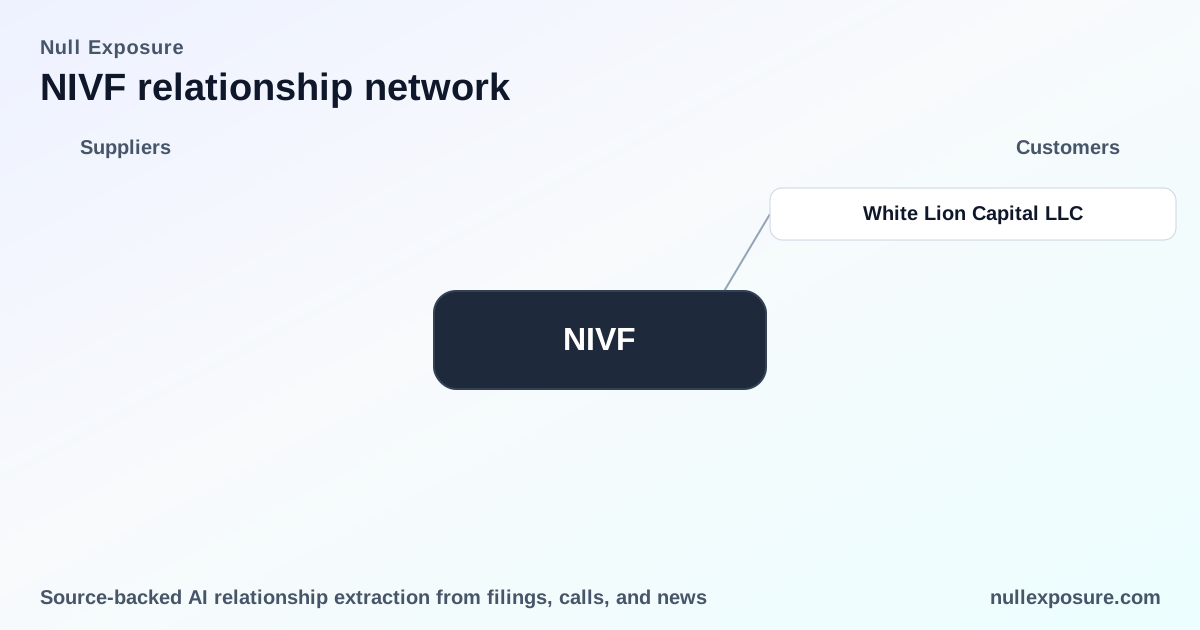
White Lion Capital LLC — equity option tied to Solana tokens
NewGen entered a term sheet that gives White Lion Capital the option — over an initial 24-month window — to receive NewGen common stock up to the value equivalent of 600,000 Solana tokens, with the company holding the option to sell those shares. According to a QuiverQuant news item published March 2026, the arrangement is structured to convert digital-asset value into equity issuance capacity and potential cash proceeds. (QuiverQuant, March 2026)
SAXA, Inc. — $100 million gold-tokenization engagement and reverse-merger pathway
NewGenDigital has agreed to tokenize $100 million in gold-backed assets for SAXA, Inc., described as the first phase of a two-part transaction that includes a proposed reverse merger. This deal positions NewGen as a supplier of tokenization services and a participant in larger corporate restructuring mechanics that could generate both service revenue and strategic equity outcomes. (Investing.com, May 2026)
World Chinese Museum — art-tokenization pilot with upside to $200 million
NewGenIVF agreed to tokenize an art collection initially valued at $2 million, with documented potential expansion to $200 million under the terms reported. This transaction demonstrates NewGenDigital’s broader tokenization pipeline beyond financial metals and suggests a capability to package physical collectibles into tradable tokens at scale. (Investing.com, May 2026)
Constraints and company-level operating signals
The available dataset includes no explicit contractual constraints, termination clauses, or cap table-related limitations disclosed alongside these relationship reports. Presenting this absence as a company-level signal: NIVF public disclosures do not include standardized constraint summaries for these customer relationships, which affects how investors should model contract durability and counterparty risk.
From an operating-model perspective this implies:
- Contracting posture: The firm is using option-style and tokenization term sheets rather than long-term service contracts; this defines a flexible, transaction-oriented posture rather than fixed recurring revenue contracts.
- Concentration: Tokenization projects are currently a small set of high-dollar engagements; revenue concentration risk increases if these projects become a material share of total revenues without broad client diversification.
- Criticality: These relationships are strategically important for NewGen’s non-clinic revenue ambition, but clinic operations remain the core clinical cash engine; tokenization deals are critical for strategic repositioning rather than everyday service delivery.
- Maturity: The initiatives are early-stage commercial implementations of tokenization and structured equity arrangements; operational and regulatory execution risk is elevated relative to mature clinical services.
Strategic interpretation for investors
- Diversification with execution risk. NewGen is diversifying beyond healthcare services into tokenization and structured equity arrangements. These moves can materially boost near-term revenue recognition or capital access if executed, but they introduce execution and regulatory complexities uncommon in medical-care facility businesses.
- Capital strategy via equity-for-token mechanics. The White Lion arrangement signals a willingness to use equity issuance tied to digital-asset valuations as a financing tool, which can be dilutive but also provides bespoke liquidity pathways when traditional capital markets are constrained.
- Revenue recognition and headline volatility. Tokenization deals (SAXA, World Chinese Museum) create headline revenue potential (hundreds of millions if fully realized) but will produce lumpy, event-driven economics; model these as contingent until transaction milestones are publicly confirmed.
For more analysis of how such customer arrangements alter risk profiles and valuation frameworks, see Null Exposure’s strategic coverage: https://nullexposure.com/
Key investment takeaways — what moves the needle
- Positive: If NewGenDigital successfully monetizes tokenization engagements at announced scales, the company scales non-clinical revenue rapidly and diversifies funding sources.
- Negative: These deals increase governance, regulatory, and execution risk; failure to operationalize tokenization or to close reverse-merger mechanics would leave the firm exposed to dilution without offsetting cash.
- Watch points: Counterparty strength, documented milestones for each tokenization phase, the mechanics and timing of any equity issuances tied to digital-asset values, and regulatory notices in key jurisdictions.
Bottom line
NewGenIvf is operating a dual play: established clinical revenue generation plus opportunistic, high-leverage tokenization and equity-structuring transactions. Investors should value the clinical business as the stable base and treat tokenization income as contingent upside that requires active monitoring of milestones and counterparties. The three customer relationships reviewed—White Lion Capital, SAXA, Inc., and World Chinese Museum—collectively illustrate the company’s strategic pivot into digital-asset monetization and alternative capital solutions; they are transformational if executed, destabilizing if not.
For investors and operators needing deeper tracking of counterparty commitments and milestone-driven valuation adjustments, Null Exposure maintains continuous coverage and transaction timelines at https://nullexposure.com/.