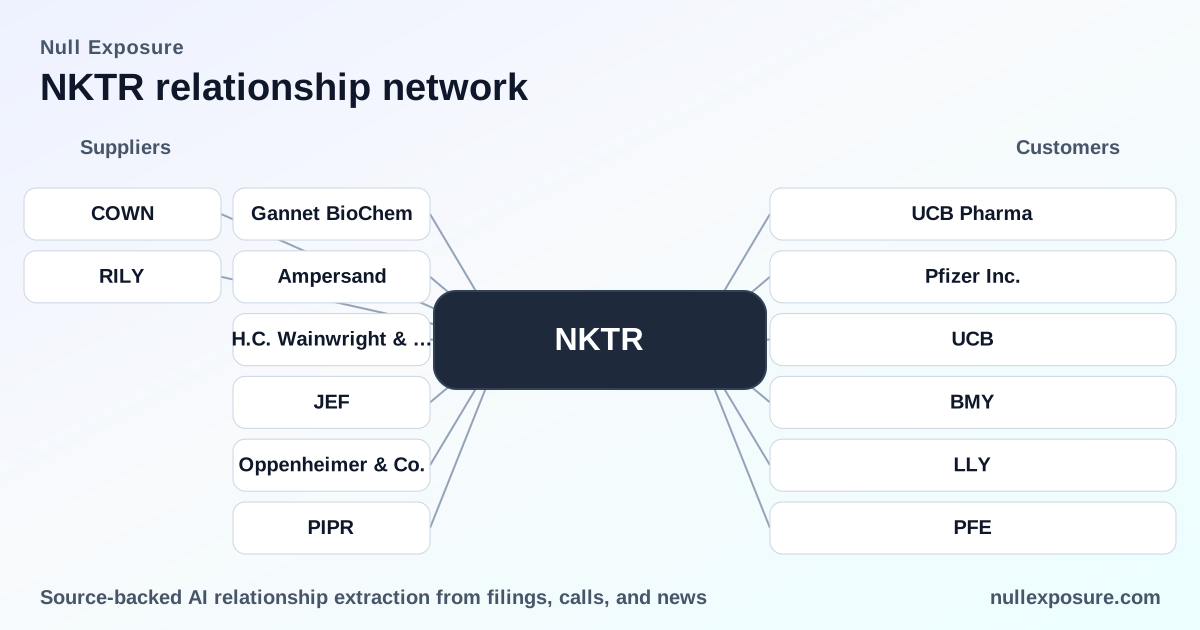
Nektar Therapeutics: partnership-driven revenues, concentrated supply economics
Nektar Therapeutics operates as a biopharmaceutical developer that monetizes through two complementary channels: product sales tied to its PEGylation reagents and platform technologies, and biopharma collaborations that generate upfront payments and milestone potential. Investors should value Nektar as a company whose near-term cash flow profile mixes recurring reagent sales to a small set of large customers with episodic, high-impact licensing and collaboration receipts.
For an interactive breakdown of counterparties and document-level sourcing, see Nullexposure’s coverage at https://nullexposure.com/.
How the business actually makes money — a concise operating thesis
Nektar sells reagents and performs services associated with PEGylation chemistry that historically generated a large share of product revenue, while simultaneously pursuing drug development through collaborations and licensing that produce upfront cash and contingent milestone payments. The 2024 Form 10‑K highlights that UCB and Pfizer historically accounted for the substantial majority of PEGylation reagent sales, which creates clear customer concentration. Collaboration agreements have produced seven‑figure to eight‑figure upfronts (for example, Lilly’s $150 million upfront), but the company recognizes related product sales in cost of goods sold when sold to partners, reflecting Nektar’s role as an active seller as well as developer.
If you want a compact vendor-counterparty view for due diligence, visit https://nullexposure.com/ for the source-level detail.
Company-level operating constraints and what they signal to investors
-
Long‑term contracting posture: Nektar discloses entering into a long‑term “take or pay” supply agreement and internally characterized that agreement as long‑term in its 10‑K analysis. This shows Nektar accepts contractual supply commitments that lock in minimum demand and revenue streams over multi‑year horizons, improving predictability but increasing execution and fulfillment risk.
-
Seller role and cost recognition: Nektar explicitly includes costs for product sales to collaboration partners in cost of goods sold, while other partner-related work is generally expensed to R&D. This is a company‑level signal that Nektar operates both as a developer and an industrial supplier, with gross‑margin dynamics for reagent sales distinct from R&D expense patterns.
Together these constraints describe a hybrid operating model: concentrated, long‑duration supply relationships that provide predictable baseline revenue, plus high‑variance collaboration cash inflows dependent on development outcomes.
Counterparty roll call — what every mention in the record means for investors
Pfizer Inc. (10‑K, FY2024) — Somavert pegvisomant referenced
Nektar’s 2024 Form 10‑K lists Somavert (pegvisomant) under products associated with Pfizer, indicating historical use of PEGylation chemistry in approved Pfizer therapies. According to the FY2024 Form 10‑K filing, Pfizer is a named partner in product listings tied to PEGylation technologies.
UCB Pharma (10‑K, FY2024) — CIMZIA referenced
The 10‑K cites CIMZIA (certolizumab pegol) with UCB, showing that UCB’s commercial biologic used pegylation tied to Nektar’s technology in approved indications, per the FY2024 filing.
UCB (inferred symbol UCB) (10‑K, FY2024) — revenue concentration call‑out
Nektar’s FY2024 10‑K states that, before the sale of a facility, the company derived the substantial majority of its PEGylation reagent product sales from UCB and Pfizer, a direct disclosure of customer concentration risk in reagent revenue.
Bristol Myers Squibb / BMY (news, FierceBiotech, March 2026) — bempeg phase‑3 failure referenced
A FierceBiotech report (March 2026) recounts that the IL‑2 prodrug bempeg, which underpinned a large collaboration with Bristol Myers, failed a phase‑3 trial after Bristol Myers had invested heavily—an outcome that removes a material potential milestone stream tied to that program.
Bristol Myers Squibb (duplicate news entry, FierceBiotech, March 2026)
The same FierceBiotech item is captured twice in the results; both references reiterate that the bempeg phase‑3 data eliminated the clinical path that justified Bristol Myers’s earlier investment and contingency payments.
Eli Lilly (LLY) — upfronts and unrealized milestones (StreetwiseReports, 2024 coverage)
StreetwiseReports and related coverage note that Lilly paid Nektar an initial $150 million under a collaboration launched in 2017, with up to $250 million in additional development/regulatory milestones that have not been realized, per the news coverage captured in early 2026 referencing the earlier 2017 deal.
Eli Lilly and Company (GenEngNews, stock commentary, 2026)
Genetic Engineering & Biotechnology News (March 2026 coverage) reiterates that the 2017 Lilly collaboration included a $150 million upfront and up to $250 million in milestones tied to rezpeg (NKTR‑358), summarizing the ended collaboration’s headline economics.
Eli Lilly (repeat entry, GenEngNews / news sentiment capture)
A second duplicate capture from the same GenEngNews piece repeats the $150 million upfront / $250 million milestone framing, reinforcing that Lilly’s capital injection was material but milestone‑contingent.
Eli Lilly and Co. (duplicate StreetwiseReports capture)
A duplicate StreetwiseReports capture again notes the initial $150 million payment from Lilly and the subsequent nonpayment of $250 million in milestones, consistent across popular coverage.
National Grid (NGG) — NKT cable contract (news, TS2.Tech, March 2026)
Two news captures from March 2026 describe National Grid’s Eastern Green Link 3 (EGL3) contracts and name NKT (an energy cable company) as the cable supplier. These references mention “NKT” and do not concern Nektar Therapeutics’ business, but they appear in the matched results and should be understood as third‑party noise from document parsing.
National Grid (duplicate TS2.Tech entry, March 2026)
A second TS2.Tech article capture repeats the same National Grid / NKT cable contract language; again, this concerns NKT (the cable manufacturer) rather than Nektar Therapeutics.
Investment implications and risk highlights
-
Concentration risk is material. The FY2024 10‑K explicitly states that UCB and Pfizer supplied the substantial majority of PEGylation reagent product sales, making reagent revenue sensitive to a small number of counterparties.
-
Contractual stability is a positive structural signal. The long‑term “take or pay” supply posture creates baseline visibility into minimum revenue but requires reliable fulfillment and counterparty credit.
-
Collaboration economics are binary and high‑impact. Deals such as Lilly’s $150 million upfront and Bristol Myers’s multi‑hundred‑million arrangement show the upside of partnerships; failed trials or missed milestones, as with bempeg, erase that upside quickly.
-
Mixed margin profile. Nektar’s role as a seller of product to collaboration partners (COGS treatment) means reagent sales carry industrial margin dynamics that differ from pure R&D expense recognition.
Bottom line for investors
Nektar combines recurring supplier economics concentrated among a few large pharma customers with sporadic, high‑value collaboration cash flows that materially influence valuation but are heavily outcome‑dependent. The firm’s contracted take‑or‑pay posture and seller role improve baseline revenue predictability while leaving upside exposed to clinical success or failure across partner programs. For document‑level sourcing and further counterparty traces, consult Nullexposure’s repository at https://nullexposure.com/.