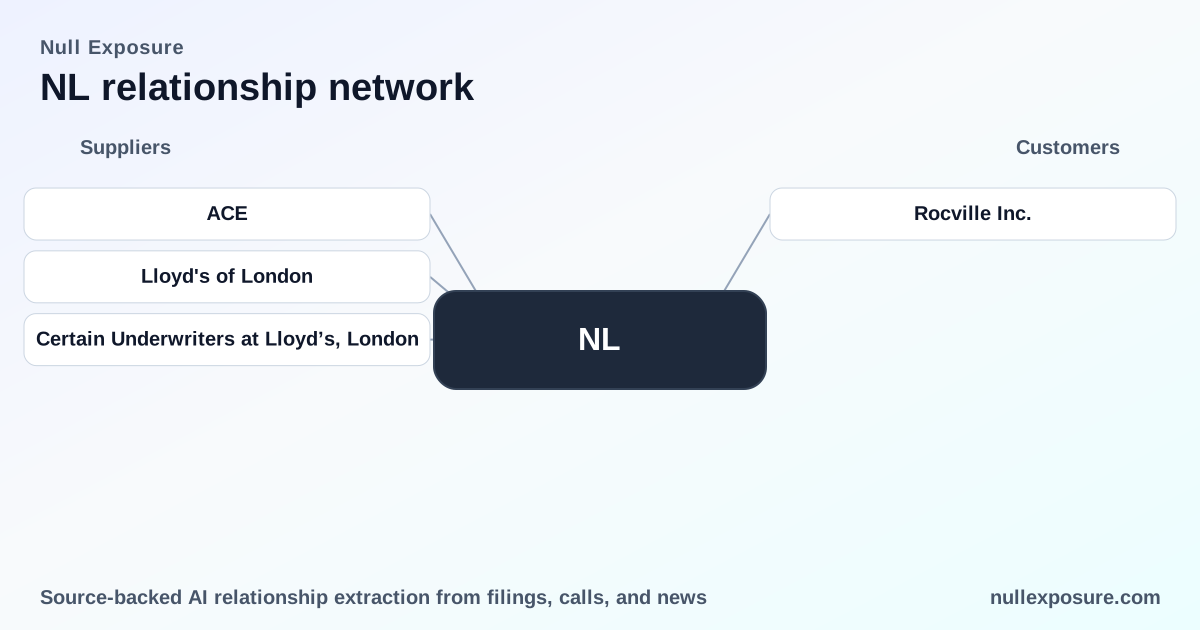
NL Industries: Customer Relationships, Concentration and Contracting Posture
NL Industries operates through its CompX subsidiary to design, manufacture and sell mechanical security components and specialty marine products, monetizing primarily through product sales to OEMs, distributors and select government contracts. With roughly $158 million in trailing revenue and a market capitalization near $288 million (latest reported quarter ending 2025-12-31), the company’s economics are driven by high-margin components sold into concentrated OEM accounts and distributor channels. For investors evaluating counterparty and customer exposure, the key questions are concentration, revenue lability from pilot projects, and the mix between direct OEM sales and distributor throughput. Learn more about our coverage and signals at https://nullexposure.com/.
Executive thesis: concentrated OEM sales plus distributor reach
NL monetizes via CompX’s product sales to industrial and security end markets, where product design win cycles and factory-based sales relationships determine revenue. The business exhibits meaningful customer concentration (top-ten customers accounted for ~47% of Component Products sales in 2024) and reliance on a handful of large OEM and government accounts, which creates both pricing leverage on successful designs and downside risk from single-account demand swings. Company financials show positive operating margins and modest EBITDA, but negative reported EPS driven by non-operating items; invest decisions should weight account concentration and contract structure over headline margins.
How CompX sells and contracts — posture and maturity
Company disclosures describe a forceful, factory-based selling posture: direct sales to large OEMs supported by engineers and field sales personnel, supplemented by independent manufacturer’s representatives and distributors. This creates a hybrid contracting posture with:
- Direct, long-cycle OEM contracts that require engineering collaboration and produce durable revenue when design wins convert to production.
- Distributor channels that broaden market reach but reduce per-unit margin and increase variability in order timing.
- Government and pilot projects that can be lumpy: the company recognized material shipments from a government pilot project in 2023 that did not recur in 2024, illustrating revenue volatility tied to one-off programs.
These dynamics establish a business that is operationally mature in manufacturing and sales execution but commercially exposed to idiosyncratic contract timing and pilot-to-production conversion risk.
Key company-level signals investors need to weight
Company filings and disclosures yield several consistent signals about the customer profile and geographic reach:
- Concentration and criticality: CompX’s largest ten customers represented approximately 47% of Component Products sales in 2024, and the United States Postal Service alone represented 21% of sales in 2024, making a small set of customers materially important to revenue.
- Counterparty type: A majority of sales flow direct to large enterprise OEM customers, supported by engineers and factory-based account teams.
- Geography: While CompX maintains a global footprint, the core revenue base is North America, with U.S. point-of-origin sales dominating recent years (company geographic tables show U.S. sales far larger than Canada and Mexico).
- Channel mix: Security Products sales split between direct OEM relationships and distributor-led sales, introducing a mixed margin profile and varying payment and inventory dynamics.
- Revenue lability: Pilot projects and government programs introduce episodic revenue — the 2023 pilot program substantially affected year-over-year Security Products figures when that work shipped and then ceased.
These signals collectively imply a contracting posture that favors engineered, account-specific agreements with a dependency on a handful of large buyers; operationally mature manufacturing is counterbalanced by commercial concentration and conversion risk.
Relationship-level review: what the record shows
Below I cover every customer-related relationship disclosed in available results; each relationship is summarized in plain language with its source.
Rocville Inc. — litigation tied to a property development dispute
NL Industries and Rocville Inc., the contract purchaser of a development site, jointly sued the Borough of Sayreville, New Jersey, alleging selective enforcement and improper conditions relating to a planned development, according to a local news report in August 2020. The action positions NL as a party to a real-estate dispute rather than as a product customer, signaling some exposure to property and development matters outside core manufacturing operations (MyCentralJersey, August 2020: https://www.mycentraljersey.com/story/news/local/development/2020/08/18/developer-sues-sayreville-nj-over-selective-enforcement-ordinance/5600472002/).
(That relationship entry is the only distinct customer-level result returned in the dataset; other customer signals come from company disclosures summarized above.)
What this means for investors and operators
- Upside levers: Design wins at OEMs and a successful transition of government pilot programs to repeat production provide outsized revenue upside relative to base demand. CompX’s manufacturing footprint and engineering-led sales team support competitive placement in targeted segments.
- Key risks: Customer concentration is the primary risk vector — single accounts account for material shares of revenue (notably USPS at 21% in 2024). Pilot-program revenue creates quarter-to-quarter volatility; distributor channels dilute margin and complicate demand visibility.
- Contracting posture implications: Expect longer sales cycles and contract terms tied to technical performance and quality. Counterparty negotiations will center on qualification, delivery cadence, and acceptance terms rather than purely on price.
Bottom line and investor action points
NL’s revenue model is straightforward: engineered security and component products sold through a mix of direct OEM relationships and distributors, with material revenue concentration among a few large customers and episodic government program exposure. For investors, the trade-off is between durable engineering-driven revenue when design wins stick, and elevated single-account risk that can materially shift results.
If you are evaluating exposure or underwriting counterparty risk at NL, focus due diligence on the top-ten customer list, the status of pilot-to-production transitions, and contract terms that govern acceptance, warranty and pricing adjustments. For a more structured read on NL’s customer risk and to access additional relationship signals, visit https://nullexposure.com/.