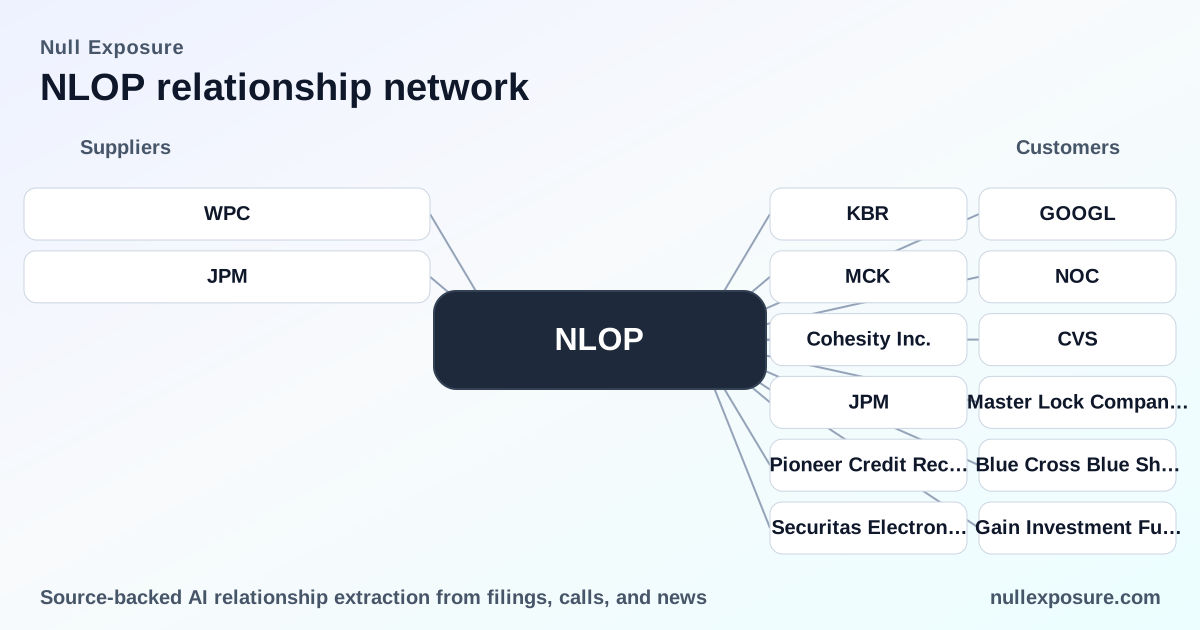
Net Lease Office Properties (NLOP): tenant relationships, recent dispositions and what they mean for investors
Net Lease Office Properties is a single-tenant, net-lease REIT that monetizes long-term contractual cashflows through lease income and active portfolio rotation — selling office assets to crystallize value and fund special distributions. The company concentrates on U.S. office assets leased to creditworthy corporates, collects annualized base rent (ABR) and uses selective dispositions to optimize leverage and shareholder payouts. For drill-downs on filings and deal history, visit https://nullexposure.com/.
How NLOP runs the business today
NLOP operates as a seller/lessor of office real estate on a net-lease basis: tenants generally pay operating expenses while NLOP retains ownership and collects rent. Revenue is concentrated — the top tenant accounted for roughly 22.9% of ABR and the top three ~38% as of year-end 2024 — and the portfolio is overwhelmingly U.S.-centric (with two European assets noted). The company’s contracting posture skews to multi-year leases (weighted-average lease term ~4.3 years at 2024 year-end) and management routinely executes asset sales to repay non‑recourse debt and fund distributions. These actions drive both cash return to shareholders and volatility in reported ABR.
Bold takeaway: NLOP is a concentrated, U.S.-focused net-lease REIT that monetizes cashflow both through rent and opportunistic dispositions.
Recent portfolio moves and the transactional playbook
In early 2026 NLOP completed several material sales that together produced roughly $130.6 million in gross proceeds from three assets and an additional grouping of smaller disposals (~$35.2 million), demonstrating the firm’s active asset-management posture. These sales funded special cash distributions in 2026 and included properties formerly leased to several large corporates; proceeds were used in part to repay non‑recourse mortgages. (See company announcements reported via PR Newswire, Investing.com and MarketScreener, FY2025–FY2026.)
If you want a searchable library of filings and press coverage, see https://nullexposure.com/.
Who NLOP leased to — and what happened (one-line summaries)
Below are concise, plain-English summaries for every relationship in the available coverage, each paired with the primary source reported in the news items.
KBR / KBR, Inc. (FY2026)
NLOP sold a 1,064,788‑square‑foot office building in Houston leased to KBR for $66 million; that asset had ABR reported at $21.288 million at time of sale. Source: company sale notices aggregated in PR Newswire, Yahoo Finance and TipRanks reporting on FY2026 dispositions (Jan–Mar 2026).
Northrop Grumman Systems Corporation / Northrop Grumman (NOC) (FY2026)
NLOP sold an asset leased to Northrop Grumman for approximately $25 million and used about $24.8 million of proceeds to repay a non‑recourse mortgage tied to that property. Source: press releases and investing news coverage summarizing FY2026 sales and mortgage repayments.
Google, LLC (GOOGL) (FY2026)
A Venice, CA property leased to Google generated approximately $39.6 million in gross sale proceeds (ABR reported around $3.018 million at time of sale). Source: PR Newswire and related FY2026 press material on portfolio dispositions.
CVS Health / CVS (FY2024–FY2026)
NLOP sold a large Scottsdale medical office/data center campus that served as a mission‑critical operations center leased to CVS; sale proceeds reported in news coverage totaled ~$71.5 million for the 380,100‑sq‑ft asset (reported earlier in 2024 coverage and reflected in 2026 aggregate reports). Source: The Real Deal and REBusinessOnline reporting (Aug 2024 and follow‑ups cited in FY2026 summaries).
Thermo Fisher Scientific (TMO) (FY2026)
A Morrisville, NC property leased to Thermo Fisher sold for about $33 million in gross proceeds; the property had generated roughly $4.06 million in annual base rent before sale. Source: Investing.com and company sale disclosures summarized in FY2026 reporting.
Cohesity Inc. (FY2025)
NLOP sold a Roseville, MN building leased to Cohesity — this asset was included in a bundle of FY2025 dispositions that funded a special distribution. Source: PR Newswire release and FY2025 special distribution announcement.
JPMorgan Chase Bank / JPMorgan Chase Bank, N.A. / JPM (FY2025)
NLOP disposed of two properties formerly leased to JPMorgan Chase in Tampa, FL and Fort Worth, TX as part of multi‑state sales included in the FY2025 distribution program. Source: Investing.com and PR Newswire summaries of FY2025 asset sales.
Pioneer Credit Recovery / Pioneer Credit Recovery, Inc. (FY2025)
A Moorestown, NJ property leased to Pioneer Credit Recovery was sold in the FY2025 transaction package that supported a special cash distribution. Source: PR Newswire FY2025 distribution filing.
Securitas Electronic Security / Securitas Electronic, Security, Inc. (FY2025)
A Plymouth, MN facility leased to Securitas Electronic Security was sold as part of the FY2025 disposals reported by the company. Source: PR Newswire / Investing.com coverage of FY2025 dispositions.
Bankers Financial (FY2026)
A vacant building formerly occupied by Bankers Financial in St. Petersburg, FL was sold for $22.5 million and listed among FY2026 gross proceeds used to fund a $3.30 per-share special distribution. Source: PR Newswire and Barchart reporting in FY2026.
North American Lighting (FY2026)
NLOP sold an asset leased to North American Lighting in Farmington Hills, MI for approximately $12.7 million of the FY2026 sale pool. Source: PR Newswire and Barchart FY2026 disclosure.
Master Lock Company / Master Lock Company, LLC (FY2025)
A vacant property in Oak Creek, WI formerly occupied by Master Lock was included in FY2025 sale listings; the property was reported as vacant at sale. Source: Investing.com and MarketScreener FY2025 summaries.
McKesson / MCK (FY2025)
An office building previously occupied by McKesson was sold — coverage notes a purchase by Howard Hughes for the building that had been owned by NLOP. Source: realtynewsreport and FY2025 reporting.
Blue Cross Blue Shield (FY2025)
NLOP’s portfolio disclosure noted three remaining properties leased to Blue Cross Blue Shield among the company’s roughly 44 U.S. properties; Blue Cross Blue Shield represents a continuing tenant exposure in the portfolio. Source: MarketScreener portfolio disclosure summarized in FY2025 press.
Gain Investment Fund LLC (FY2025)
Gain Investment Fund LLC acquired a Class A office building (176,150 sq ft) in Tampa from NLOP for an estimated $25.2 million as part of the FY2025 disposition activity. Source: MarketScreener notice of the transaction in FY2025.
What the relationship map signals about NLOP’s business model
- Contracting posture and maturity: Lease terms are multi‑year with a WALT around 4.3 years (company disclosures through 2024), so cashflows are predictable in the near term but require active rollover management. This is a company‑level signal from NLOP’s filings rather than tied to any single tenant.
- Geography and concentration: The portfolio is overwhelmingly U.S. (two European holdings noted), and ABR concentration is material — the top tenant singlehandedly represented ~22.9% of ABR at year‑end 2024. These facts heighten sensitivity to large‑tenant dispositions and tenant credit events.
- Role and cash management: NLOP acts as owner/seller — it retains ownership to collect rents but regularly sells assets to optimize leverage and fund distributions; several FY2025–FY2026 sales repaid non‑recourse mortgages and funded special cash distributions.
- Criticality: Some assets were described as mission‑critical to tenants (e.g., CVS data/operations campus), indicating that NLOP’s tenants can be strategically important to their operations, which supports lease stability while also producing attractive sale markets.
Investment implications and risk checklist
- Positive: Active asset rotation boosts liquidity and funds payouts; long leases with credit tenants provide steady ABR while management crystallizes gains via sales.
- Negative: High tenant concentration and U.S. geographic concentration create idiosyncratic risk — the departure or sale of a single large tenant asset materially changes ABR and portfolio cashflow.
- Operational: Dispositions can mask operating performance volatility; investors should reconcile rental yield trends with one‑time sale gains and mortgage paydowns reported in filings.
For deeper sourcing and a consolidated feed of the filings and press coverage cited above, visit https://nullexposure.com/.
Bold final thought: NLOP is a focused, active net‑lease operator that converts concentrated tenant exposure into shareholder cash through disciplined disposals — a strategy that delivers distributions but raises concentration and rollover risk investors must price.