Annaly Capital Management (NLY): How customer relationships are reshaping a mortgage REIT’s economics
Annaly Capital Management operates as a diversified capital manager that earns through asset finance and servicing—primarily by investing in mortgage-backed securities, financing commercial real estate positions, and collecting mortgage servicing fees where it owns MSRs (mortgage servicing rights). The company monetizes via net interest spread on financed assets, fee income from servicing contracts, and opportunistic asset sales; recent activity shows a deliberate pullback from direct commercial real estate ownership in favor of platform disposals and capital redeployment. For a focused map of customers and counterparties that matter to NLY’s operating profile, visit Null Exposure for deeper relationship analytics: https://nullexposure.com/.
What the recent deal flow tells investors about Annaly’s customer posture
Annaly’s sale of its commercial real estate platform and selective financing transactions reveal a dual strategy: de-risk asset ownership while preserving fee and financing channels. Dispositions to institutional managers and REITs translate into immediate liquidity and reduced balance-sheet concentration, while financing relationships like those with large alternative managers preserve recurring interest income and distribution opportunities.
Recent customer and counterpart summaries — each recorded relationship
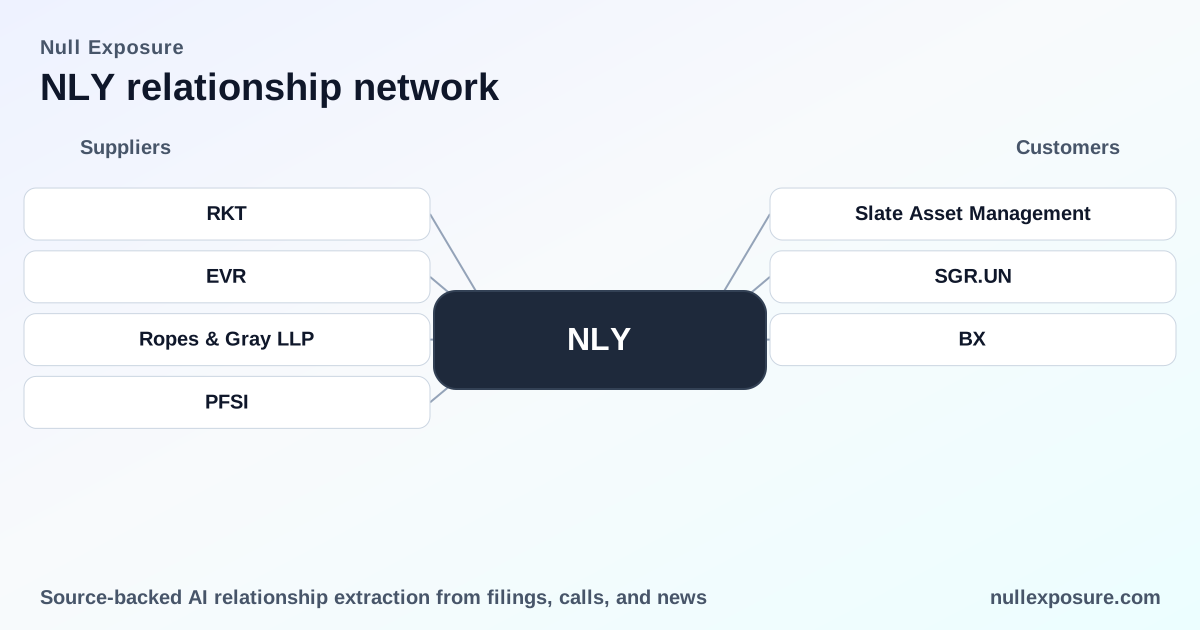
Slate Asset Management — buyer of Annaly’s CRE platform (PR Newswire, Mar 10, 2026)
Slate Asset Management acquired Annaly’s Commercial Real Estate Business (ACREG) for US$2.33 billion, a transaction that transfers active CRE asset management and related operating functions to Slate while converting Annaly’s owned positions into cash and structured consideration. According to a PR Newswire release announcing the deal on March 10, 2026, the sale is a strategic exit of Annaly’s CRE operating vertical.
SGR.UN (Slate Grocery REIT) — purchaser of grocery-anchored properties (PR Newswire, Mar 10, 2026)
A portion of the Annaly disposal — roughly US$0.4 billion — was earmarked for purchase by Slate Grocery REIT (TSX: SGR.UN), representing a carve-out of grocery-anchored retail assets into a pure-play platform focused on defensive retail real estate. The PR Newswire release from March 10, 2026, details this allocation as part of the larger US$2.33 billion transaction.
Slate Grocery REIT — the same slate-branded retail buyer (PR Newswire, Mar 10, 2026)
Slate Grocery REIT is explicitly identified in the company announcement as the counterparty for the grocery-anchored portfolio, underscoring Annaly’s use of targeted buyers to maximize price and liquidity on specialized asset classes. The March 2026 PR Newswire filing lists the SGR.UN transaction as the purchaser for the $0.4 billion grocery portfolio.
Blackstone (BX) — large-scale financing counterparty (REIT.com, Mar–Apr 2016)
Annaly has a history of arranging sizeable financing with private capital managers; in September (reported in REIT Magazine, March–April 2016), Annaly provided Blackstone with $592 million of financing secured by a multifamily portfolio, illustrating Annaly’s role as a lender to institutional real estate owners. The 2016 REIT.com article records the $592 million financing as an example of Annaly’s portfolio-finance business.
BX (duplicate record of Blackstone) — financing relationship (REIT.com, Mar–Apr 2016)
The dataset includes a second entry identifying BX with the same financing reference; the duplication reinforces that Annaly’s counterparty network includes repeat interactions with major alternative managers for portfolio-level financing. REIT Magazine’s March–April 2016 coverage documents the $592 million transaction.
What the constraint signal reveals about Annaly’s operating model
Annaly’s internal classification includes a services segment centered on mortgage servicing rights (MSRs); corporate materials identify an “Annaly Mortgage Servicing Rights Group” that invests in MSRs and collects a portion of interest payments as servicing compensation. This is a company-level signal indicating that contracting posture is fee-oriented and long-duration: MSR income generates recurring fees tied to servicing contracts rather than one-time sales proceeds.
- Contracting posture: Service contracts for MSRs are contractual and fee-based, providing recurring cash flows that are sensitive to prepayment and delinquency dynamics rather than mark-to-market swings in asset values.
- Concentration: The presence of a distinct MSR group signals segmentation of earnings—interest spread and asset sales dominate investment returns, while the services segment provides diversification and non-interest fee income.
- Criticality: MSRs act as a stabilizer for revenue volatility because servicing fees continue through loan life; however, that income is interest-rate and credit-cycle sensitive, making it a strategic but cyclically exposed complement to core financing operations.
- Maturity: The MSR business is mature and standardized within mortgage finance, implying predictable contract terms and an established playbook for valuation and hedging.
Investment implications and risk vectors
- Capital redeployment through disposals is earnings-accretive in the near term. Converting CRE ownership into cash (as in the Slate sale) reduces balance-sheet risk and funds higher-yielding financing or securities positions. This improves liquidity and reduces concentration risk on direct property ownership.
- Counterparty mix matters. Maintaining lending and financing relationships with large managers like Blackstone provides scale and predictable deal flow, but it also concentrates credit exposure to sophisticated counterparties. Annaly’s institutional customer base both stabilizes origination and increases reputational dependence on a handful of large partners.
- MSR revenues smooth but do not eliminate cycle sensitivity. Servicing fees reduce reliance on spread income but are exposed to prepayment and delinquency regimes; investors should treat MSR earnings as complementary but correlated to the broader mortgage cycle.
- Execution risk on platform exits. Selling a CRE platform for $2.33 billion delivers immediate capital but transfers operational upside to buyers; Annaly trades future fee and asset-capture potential for current balance-sheet strength.
For readers seeking a structured view of NLY’s counterparty map and the transactional linkages that shape its capital allocation, Null Exposure offers deeper customer relationship intelligence: https://nullexposure.com/.
Bottom line for investors
Annaly is crystallizing a strategy to convert illiquid CRE ownership into deployable capital while retaining fee-bearing and financing relationships with sophisticated counterparties. The company’s revenue profile now blends interest spread, recurring MSR fees, and selective monetizations, a mix that enhances liquidity and reduces direct property concentration while leaving the firm exposed to mortgage-cycle dynamics and counterparty credit concentration. Investors should watch counterparty rollovers and MSR performance metrics as the primary signals of durable cash generation.