NLY-P-F: How Annaly’s Preferred Holders Should Read the Slate Asset Sale
Annaly Capital Management operates as a large mortgage REIT that earns returns through a mix of mortgage-backed securities, real-estate investments and balance-sheet financing; it monetizes by capturing spread income on assets and selectively realizing value through asset dispositions. The Series F preferred (NLY-P-F) sits ahead of common equity in the capital stack and benefits from Annaly’s ability to generate steady cash distributions and to manage balance-sheet risk via strategic sales. For investors evaluating counterparty exposure and customer relationships tied to that activity, the recent Slate transaction is the most material customer-facing development. Learn more about how we track these relationships at https://nullexposure.com/.
Overview of the announced transaction
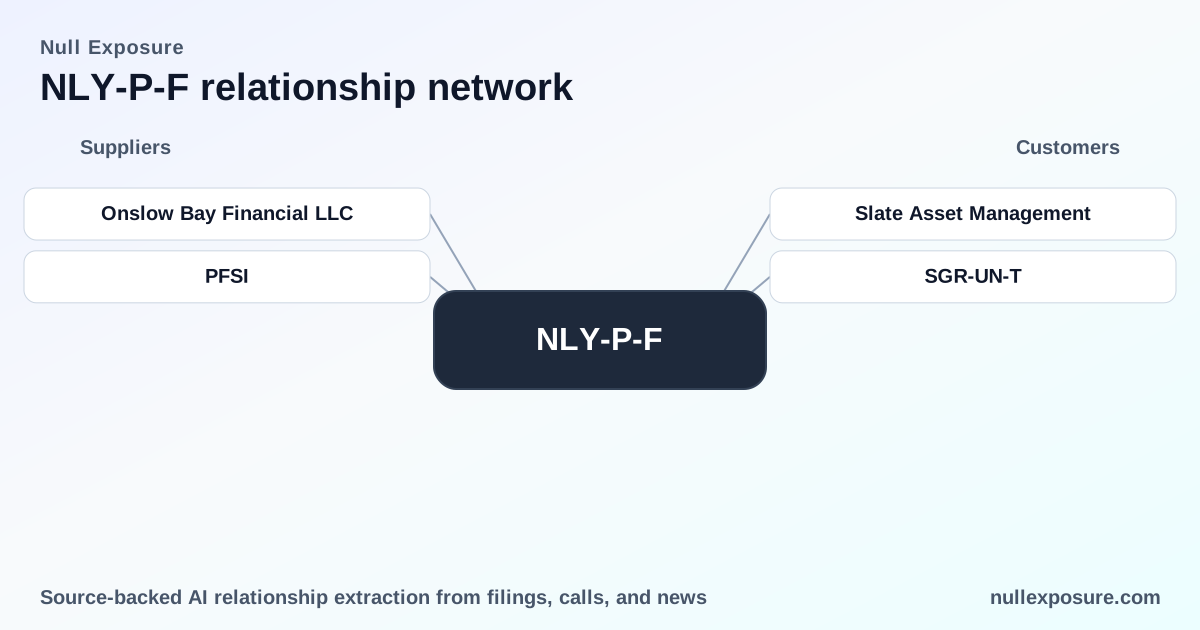
- Slate Asset Management agreed to purchase Annaly’s U.S. real estate assets for $2.93 billion, and Slate’s Grocery REIT unit (SGR-UN-T) will buy a $490 million grocery-anchored portfolio as part of the package. This deal signals Annaly’s explicit use of large institutional buyers to execute sizeable dispositions and reallocate capital. According to a Renx report dated March 10, 2026, Slate Asset Management committed to the $2.93 billion purchase as an “opportune time in the market cycle.” (Renx, 2026-03-10: https://renx.ca/slate-to-acquire-2-93b-u-s-portfolio-from-annaly-capital)
What each named relationship represents
-
Slate Asset Management — Slate is the strategic buyer that agreed to take the lion’s share of Annaly’s U.S. real estate assets in a $2.93 billion transaction. This is a direct institutional buyer relationship that crystallizes value from Annaly’s property holdings and reduces on-balance-sheet real-estate exposure. (Renx, 2026-03-10: https://renx.ca/slate-to-acquire-2-93b-u-s-portfolio-from-annaly-capital)
-
Slate Grocery REIT — The transaction allocates a $490 million grocery-anchored portfolio to Slate Grocery REIT, Slate’s U.S. grocery-anchored investment arm, indicating a carve-out executed directly into a specialized vehicle that matches asset type with buyer expertise. (Renx, 2026-03-10: https://renx.ca/slate-to-acquire-2-93b-u-s-portfolio-from-annaly-capital)
-
SGR-UN-T — The ticker SGR-UN-T corresponds to Slate Grocery REIT, the purchaser of the grocery-anchored tranche; this identifies the market-facing counterparty through which the grocery-anchored assets will be held and managed. (Renx, 2026-03-10: https://renx.ca/slate-to-acquire-2-93b-u-s-portfolio-from-annaly-capital)
Operating model signals and what they imply for preferred holders No explicit contractual constraints were returned in the customer-relationship data set, which itself is a company-level signal: there are no flagged forced-sale covenants, counterparty restrictions or special servicing arrangements disclosed in this feed. Interpreting Annaly’s operating model from the transaction activity produces several actionable characteristics:
-
Contracting posture — opportunistic and transactional. Annaly demonstrates a willingness to source large institutional buyers for whole-portfolio or tranche sales rather than hold every asset to maturity. That posture reduces duration and market-price exposure but increases reliance on large buyers to absorb inventory.
-
Concentration profile — institutionally concentrated. The $2.93 billion disposition to a single manager (Slate) and the carve-out to a single REIT ticker (SGR-UN-T) create counterparty concentration that can compress liquidity if the party’s financing or capital appetite shifts.
-
Criticality to capital structure — material and direct. Large asset sales change the composition of Annaly’s balance sheet, influence liquidity available to support preferred dividends, and affect leverage metrics that underwrite the Series F coupon prioritization.
-
Maturity and market positioning — established and asset-centric. Annaly operates with the scale and market relationships to execute multi-billion-dollar dispositions, demonstrating maturity in sourcing specialized buyers for specific asset niches (e.g., grocery-anchored retail).
Why the Slate deal matters to holders of NLY-P-F
-
Immediate cash and balance-sheet effect: A $2.93 billion sale materially alters asset composition and generates cash that management can use to de-lever, fund preferred distributions, or repurchase liabilities. That cash effect directly supports the preferred’s reliability when executed cleanly.
-
Counterparty concentration risk: Routing a substantial chunk of assets through a single buyer raises exposure to that buyer’s financing and execution capability. If Slate’s financing conditions tighten, the timing or pricing of disposition proceeds could move.
-
Strategic shift toward specialty buyers: Carving grocery-anchored assets into a vehicle like SGR-UN-T shows discipline in matching asset type to buyer expertise; this improves pricing outcomes for the seller and reduces ongoing asset-management burden, a net positive for preferred security holders who prefer stable cash flows over direct real-estate operations.
Constraints and company-level signals
- The relationship data returned no explicit contractual or third-party constraints in the feed; treat that as a signal that no specific customer-side covenants or limits were captured here. Investors should nevertheless review Annaly’s filings for any sale-and-leaseback clauses, change-of-control triggers, or preferred-protection covenants that would not surface in press coverage alone.
Near-term monitoring checklist for investors and operators
- Confirm how sale proceeds are allocated: dividend coverage, debt paydown, or retained liquidity. Allocation decisions drive preferred coverage and credit metrics.
- Watch for financing or regulatory disclosures from Slate and SGR-UN-T that could affect close timing or per-asset pricing. Buyer execution risk is the primary near-term read-across.
- Review Annaly’s next SEC filings and earnings commentary for pro forma leverage and book-value adjustments tied to the transaction.
Bottom line — what this means for NLY-P-F holders This transaction exemplifies Annaly’s playbook: use institutional relationships to monetize real-estate holdings and reallocate capital efficiently. For holders of NLY-P-F, the sale is a positive operational signal when proceeds strengthen balance-sheet liquidity and reduce risky exposures; it is a cautionary signal if concentration of buyers or execution timing creates volatility in cash available for preferred distributions. For a deeper view of counterparty mapping and ongoing monitoring, visit https://nullexposure.com/.
If you want a tailored briefing or continuous tracking of Annaly’s counterparty movements and how they affect preferred securities, NullExposure provides focused coverage and alerts tied to material customer events.