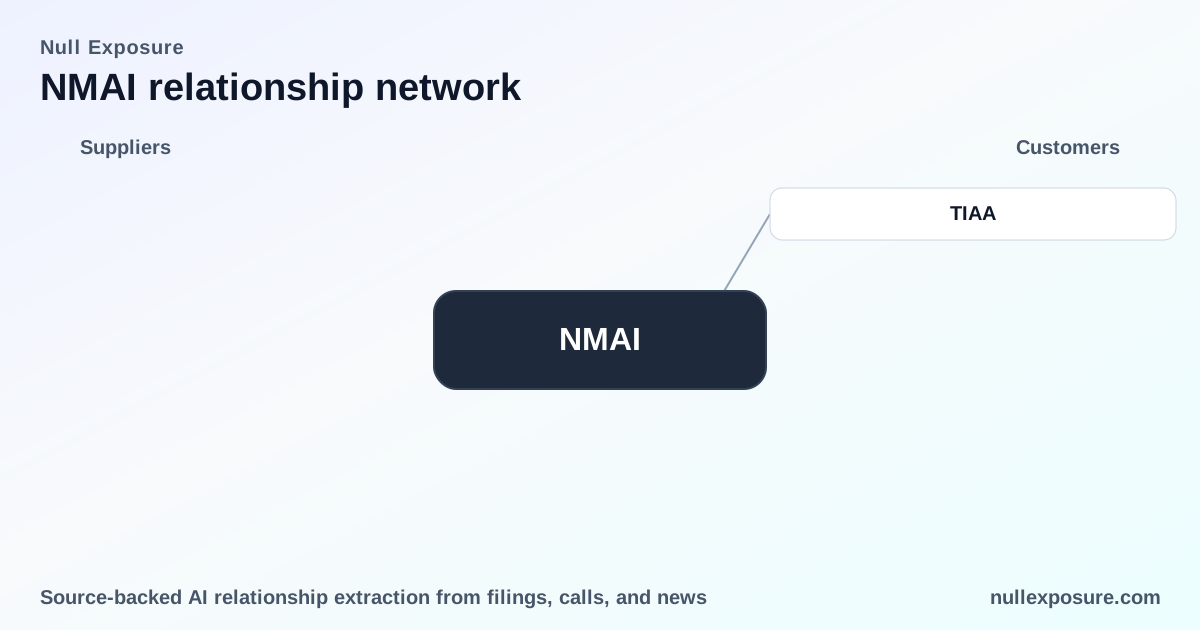
NMAI and the Nuveen–TIAA Axis: a customer-relationship briefing for investors
Nuveen Multi-Asset Income Fund (NMAI) is a diversified income vehicle that delivers shareholder returns through yield and total-return allocation across equities, fixed income and alternatives, with day-to-day portfolio decisions and monetization functions executed by Nuveen as the fund’s investment manager. For investors, the relevant commercial exposure is not to the fund’s holdings alone but to the manager-client relationship and strategic moves by Nuveen/TIAA, which shape fee capture, distribution stability and operational risk. For detailed relationship intelligence on NMAI and its service counterparties, visit https://nullexposure.com/.
Why the manager-client dynamic drives NMAI performance
NMAI is a manager-dependent vehicle: Nuveen provides investment management, and its corporate ties to TIAA establish a governance and capital backdrop that affects strategy, risk appetite and resource allocation. Management continuity, M&A activity within the Nuveen group, and executive leadership changes are primary drivers of operational risk and strategic direction for NMAI investors. Those factors change the economics of fee capture, the sourcing of alternative investments, and the robustness of distribution channels to institutional buyers.
What the recent coverage documents about NMAI’s customer relationships
Below are the three reported relationships in the collection, each reflecting Nuveen’s role as an investment manager within the broader TIAA group and the corporate actions that can influence NMAI.
TIAA — Nuveen names a new CEO (William Huffman), FY2024
Nuveen, the investment manager of TIAA, named William Huffman as chief executive officer, signalling a leadership transition at the firm that manages NMAI’s portfolio decisions and client servicing. According to FundSelectorAsia (reported March 10, 2026), this executive change is material to investors because the CEO sets investment culture, product priorities and integration posture with TIAA institutional distribution.
Source: FundSelectorAsia, March 10, 2026 — “William Huffman has been named as chief executive officer of Nuveen, the investment manager of TIAA.”
TIAA — Nuveen agreement to acquire Arcmont Asset Management, FY2022 (WealthBriefing)
Nuveen — described in reporting as the investment manager of TIAA — entered an agreement to acquire a controlling interest in Arcmont Asset Management, a European private-debt manager with sizeable committed capital, underscoring Nuveen’s strategic expansion in private-credit capabilities that feed into multi-asset income strategies like NMAI. WealthBriefing covered the transaction as part of Nuveen’s FY2022 strategic M&A activity that strengthens alternative-income sourcing for funds managed under the Nuveen/TIAA umbrella.
Source: WealthBriefing, FY2022 — coverage of Nuveen entering an agreement to acquire Arcmont Asset Management.
TIAA — Nuveen to acquire Arcmont (PR Newswire), FY2022
Nuveen publicly announced a definitive agreement to acquire a controlling interest in Arcmont Asset Management, which Nuveen positioned as a move to enhance European private-debt capabilities; this corporate action was issued in a PR Newswire release in May 2026 and reinforces the expansionary strategy that supports higher-yield allocations available to NMAI. The PR Newswire release identifies Nuveen as the investment manager of TIAA and quantifies Arcmont’s committed capital when describing strategic rationale.
Source: PR Newswire, May 3, 2026 — corporate announcement that Nuveen (the investment manager of TIAA) will acquire a controlling interest in Arcmont Asset Management.
Company-level operating model signals (constraints and posture)
The data payload contains no explicit contractual constraints to report, which itself is a signal: there are no recorded limiting covenants or named contractual dependencies surfaced in this customer-focused sweep. Presently, NMAI’s operational profile shows these characteristics:
- Contracting posture: NMAI operates through a delegated management model — Nuveen is the active manager — so the fund’s commercial posture is that of a managed client rather than a vertically integrated operator. This creates an outsourcing dynamic where manager capabilities and stability have first-order impact on outcomes.
- Concentration: There is concentrated operational exposure to Nuveen/TIAA group decisions; manager-level decisions and M&A activity materially influence product strategy and access to alternative assets used in the fund’s income generation.
- Criticality: The manager relationship is critical — changes in leadership, strategic focus, or resource allocation at Nuveen affect NMAI’s sourcing of private credit and alternatives and therefore its yield profile.
- Maturity and scale: Nuveen’s affiliation with TIAA and engagement in strategic acquisitions indicate a mature manager executing scale-oriented growth initiatives to broaden product capabilities that feed into funds such as NMAI.
These signals should be read as company-level characteristics rather than as relationship-specific constraints, because the source material did not include constraint excerpts tied to individual counterparties.
Investment implications and risk checklist
- Leadership risk is real and immediate: The appointment of a new CEO at Nuveen alters stewardship of NMAI’s manager and can change talent allocation, product priorities and risk tolerance. Investors should watch governance communications and portfolio turnover following leadership transitions.
- M&A reshapes asset access: The Arcmont acquisition enhances Nuveen’s European private-debt footprint, which is a supply-side improvement for a multi-asset income product — but it also concentrates integration risk and capital deployment choices that could influence fee structures and performance attribution.
- Manager concentration equals single-point operational risk: NMAI’s performance and distribution profile are tied to Nuveen’s capabilities; monitor key-person dependencies, process continuity, and the stability of the Nuveen–TIAA relationship.
- Disclosure cadence: Because the public record in this tranche is news-driven (press release and industry coverage), investors should demand regular, fund-level disclosure on how manager-level M&A and executive changes affect strategy, fees and realized portfolio exposures.
Bottom line for investors
NMAI is a manager-dependent income vehicle whose prospects are shaped as much by Nuveen/TIAA corporate moves as by security selection. Recent reporting — executive change at Nuveen and its acquisition of Arcmont — signals both a potential uplift in alternative-income sourcing and elevated integration risk during a phase of managerial transition. Active monitoring of Nuveen’s post-deal integration steps, leadership communications and any fund-level disclosures on portfolio shifts is essential for assessing future yield stability and net returns.
For continued coverage of NMAI’s counterparty relationships and to access deeper relationship analytics, visit https://nullexposure.com/.