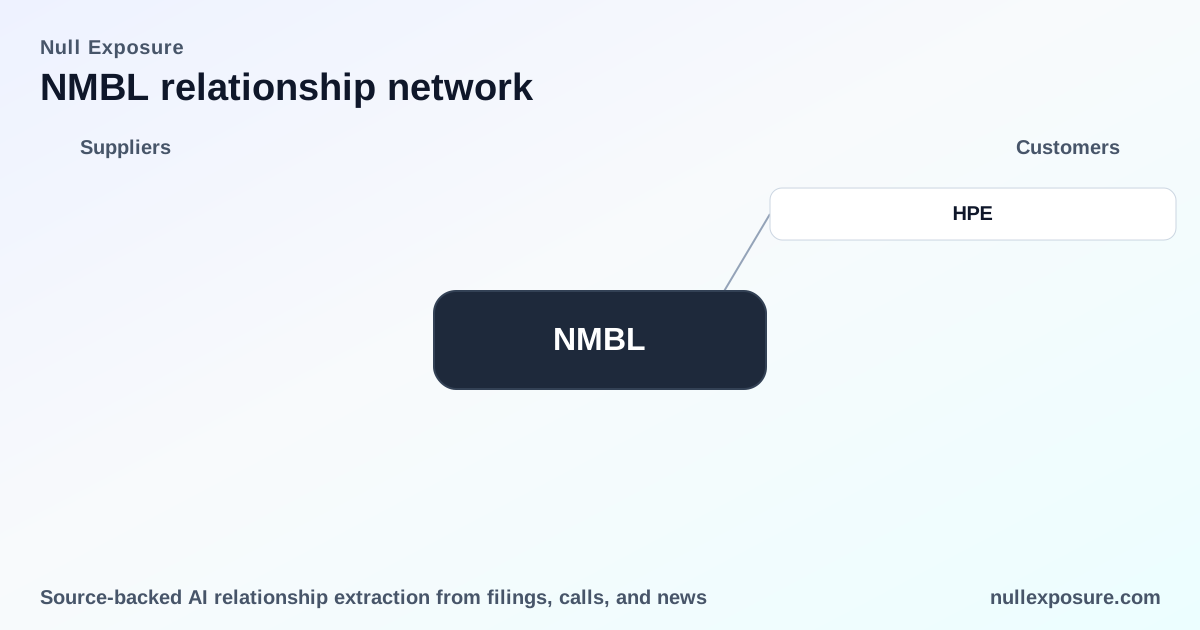
NMBL Customer Relationships: What the HPE Acquisition and Channel Partners Tell Investors
NMBL (Nimble Storage) historically built and monetized predictive all‑flash and hybrid‑flash storage systems plus the InfoSight analytics stack, selling hardware through direct and channel partners and licensing value from its predictive analytics as a differentiator. The business transformed into a strategic technology asset when Hewlett Packard Enterprise acquired Nimble in FY2017 for approximately $1 billion, folding InfoSight and Nimble architecture into HPE’s broader storage product line to capture enterprise flash growth and AI‑driven operations.
Explore primary relationship signals and implications for investors and operators at https://nullexposure.com/.
Why the HPE deal defined NMBL’s commercial value
HPE’s acquisition is the definitive commercial event for Nimble: it converted a fast‑growing storage vendor into a platform capability inside a global systems vendor, validating Nimble’s product maturity and the strategic value of InfoSight. That transaction also converted Nimble’s commercial footprints—customer logos, channel agreements, and R&D—into an integrated HPE offering, reshaping go‑to‑market dynamics and concentration of future revenue capture.
How each major partner and suitor contributed to value and distribution
Hewlett Packard Enterprise (HPE)
HPE purchased Nimble Storage in FY2017 for roughly $1 billion and immediately integrated Nimble’s InfoSight predictive analytics into HPE’s data center portfolio, using the technology to bolster 3PAR and later Alletra products. According to SDxCentral and LightReading coverage from FY2017, HPE explicitly incorporated InfoSight to make its storage systems more autonomous and competitive (see SDxCentral FY2017 and LightReading FY2017).
Source: SDxCentral (FY2017) — https://www.sdxcentral.com/news/hewlett-packard-enterprise-to-buy-nimble-storage-for-1b/; LightReading (FY2017) — https://www.lightreading.com/ai-machine-learning/hpe-adding-ai-to-data-centers-courtesy-of-nimble-storage-acquisition
Lenovo
Lenovo established a channel and technology partnership to create the ThinkAgile converged offering that combined Lenovo servers and networking with Nimble storage, extending Nimble’s distribution through OEM and converged infrastructure channels. CRN’s FY2017 coverage documented the ThinkAgile integration as a strategic extension of Nimble’s channel reach into Lenovo’s enterprise customers.
Source: CRN (FY2017) — https://www.crn.com/slide-shows/storage/300084091/9-things-partners-need-to-know-about-hpes-1b-acquisition-of-nimble-storage
Cisco (Cisco Systems)
Nimble ran a meet‑in‑the‑channel relationship with Cisco starting in 2014 to produce SmartStack converged infrastructure—pairing Cisco UCS compute with Nimble storage—demonstrating a policy of go‑to‑market co‑engineering with major infrastructure vendors. CRN covered the Cisco/Nimble SmartStack collaboration as a practical channel route prior to the HPE sale.
Source: CRN (FY2017) — https://www.crn.com/slide-shows/storage/300084091/9-things-partners-need-to-know-about-hpes-1b-acquisition-of-nimble-storage
NetApp
NetApp appeared in market commentary and trade reporting as one of several potential acquirers and strategic competitors for Nimble during the run‑up to the FY2017 sale, underlining Nimble’s competitive positioning in the all‑flash market and drawing interest from established storage incumbents. CRN compiled the list of possible suitors and competitive dynamics in its FY2017 coverage.
Source: CRN (FY2017) — https://www.crn.com/slide-shows/storage/300084329/6-possible-suitors-in-the-storage-wars-behind-the-scenes-of-hpes-1b-plan-to-acquire-nimble-storage
EMC
EMC also surfaced in contemporaneous industry reporting as a potential suitor back to 2015–2017, reflecting the strategic premium placed on flash‑first architectures and analytics-driven storage intelligence across legacy storage vendors. The CRN slideshow on FY2017 market speculation listed EMC among the interested parties.
Source: CRN (FY2017) — https://www.crn.com/slide-shows/storage/300084329/6-possible-suitors-in-the-storage-wars-behind-the-scenes-of-hpes-1b-plan-to-acquire-nimble-storage
What these relationships collectively reveal about Nimble’s operating model
- Contracting posture: Nimble deployed a hybrid go‑to‑market—direct sales plus OEM and channel partnerships (Lenovo, Cisco)—that positioned the company to scale without bearing the full cost of global sales infrastructure. The HPE acquisition transferred many contracting relationships to a larger vendor framework.
- Concentration: The acquisition by a single strategic buyer (HPE) concentrated long‑term value capture under one large platform owner, reducing Nimble’s independence but increasing the reach of InfoSight through HPE’s installed base.
- Criticality: InfoSight’s adoption into HPE’s 3PAR and later Alletra lines demonstrates product criticality: HPE used Nimble technology as a differentiator to defend and expand its flash storage market share. See TechTarget’s FY2022 review linking Alletra development to Nimble technology.
Source: TechTarget (FY2022) — https://www.techtarget.com/searchstorage/news/252525397/HPE-expands-Alletra-with-lower-prices-and-more-options - Maturity: Multiple trade reports and the acquisition itself are conclusive signals that Nimble achieved both product maturity and market validation by FY2017; subsequent HPE product development levered that maturity into broader enterprise offerings.
These operating model observations are company‑level signals derived from public coverage; they do not assign constraint excerpts to individual partners except where the reporting specifically does so.
Risk and value implications for investors and operators
- Strategic premium realized: The ~$1 billion acquisition price in FY2017 confirms that market acquirers paid a premium for analytics and flash architecture, a positive precedent for assets with similar capabilities.
- Channel leverage is material: Partnerships with Lenovo and Cisco demonstrate that OEM/channel strategies significantly expanded Nimble’s route to enterprise customers; future acquirers will value similar distribution access.
- Integration risk converts to scale: HPE’s absorption of Nimble removed vendor independence but accelerated scale and product integration—good for persistent technology value capture but limiting standalone upside for the original company.
- Competitive interest underscores defensibility: Publicized interest from NetApp and EMC during FY2015–FY2017 highlights defensible IP and go‑to‑market positioning that attracted incumbents.
Practical takeaways for diligence and operations
- For investors assessing storage or analytics plays, InfoSight’s post‑acquisition integration into HPE is evidence that analytics-first storage technology commands strategic value; prioritize assets with demonstrable integrations and OEM partnerships.
- For operators and buyers, products derived from Nimble (now under HPE) carry enterprise continuity and broader support, but procurement negotiations should account for HPE’s contracting posture and potential legacy channel transitions.
Learn more about vendor relationship signals and tailored exposure analysis at https://nullexposure.com/.
Conclusion
Nimble’s set of relationships—channel partnerships with Lenovo and Cisco, market attention from NetApp and EMC, and final acquisition by HPE—map a clear commercial arc: from a differentiated storage vendor with strong predictive analytics to a strategic capability embedded inside a global systems vendor. For investors, the HPE outcome is the primary valuation event; for operators, the enduring value is InfoSight and the operational integration into HPE’s enterprise storage portfolio.