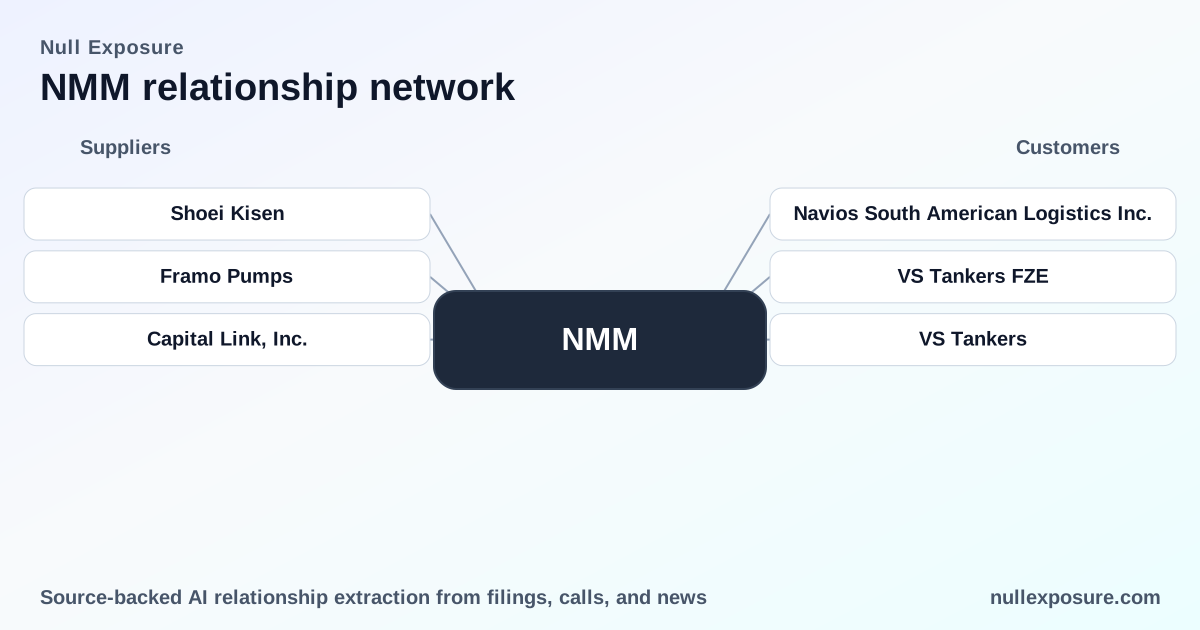
Navios Maritime Partners (NMM): Customer Relationships and Commercial Signals
Navios Maritime Partners operates and monetizes a fleet of dry-bulk and tanker vessels through a mix of ownership, time-charters and bareboat charters, and opportunistic vessel sales. The business converts vessel capacity into recurring charter revenue and one‑off cash from asset disposals, while related-party transactions and charter counterparty arrangements shape short‑term cash flow and asset utilization. Investors should read these customer links as indicators of commercial counterparty mix, asset redeployment strategy, and the company’s exposure to charter counterparties rather than as an exhaustive sales ledger.
For a concise view of our coverage and tools, visit the Null Exposure homepage: https://nullexposure.com/
Investment thesis in one paragraph
Navios Partners generates cash from charter contracts and periodic vessel sales, balancing steady charter yields with asset-liquidity events to manage leverage and return capital. The firm’s monetization levers are: charter-hire revenue, strategic disposals of older tonnage, and structured bareboat agreements that transfer operating risk while preserving asset ownership economics. Public disclosures in FY2025 demonstrate active use of these levers: a material vessel sale to a related Navios entity and charter arrangements with external tanker operators.
What the customer map reveals about commercial posture
Navios’ public customer mentions in FY2025 cluster around a handful of counterparties and affiliated entities. That concentration of visible counterparties is a signal about disclosure practices rather than a complete indicator of counterparty concentration across the fleet. Key commercial characteristics for investors:
- Contracting posture: The company uses a mix of ownership and charter structures, including bareboat and time charters, to shift operating risk and stabilize revenue streams.
- Concentration signal: Publicly reported transactions in FY2025 involve a narrow set of counterparties, including related-party purchasers and a named tanker operator; absence of broader customer roll-forward in the press release suggests selective public disclosure.
- Criticality: Charter counterparties such as VS Tankers are operationally critical—charters determine vessel employment and revenue realization—while related-party purchases are strategic liquidity and fleet‑management levers.
- Maturity of relationships: The mix of long‑term bareboat arrangements (noted for VLCCs from 2020–2021) and single-transaction asset sales indicates a blend of enduring counterparty contracts and opportunistic, discrete transactions.
Detailed relationship notes (FY2025 public mentions)
Below are concise, plain-English summaries of every customer-related relationship that surfaced in the FY2025 filings and press coverage.
Navios South American Logistics Inc.
Navios Partners sold a 2009-built transhipper of 57,573 dwt to Navios South American Logistics Inc. for a gross sale price of $30.0 million in July 2025, indicating the group’s use of intra‑group transactions to recycle capital and manage the age profile of the fleet. According to Navios’ August 21, 2025 financial results release on GlobeNewswire, the sale was disclosed as part of FY2025 activity. (GlobeNewswire, August 21, 2025)
VS Tankers FZE
Navios reported that two very large crude carriers (VLCCs), built in 2020 and 2021, were placed on bareboat charter to VS Tankers FZE, reflecting a strategy to monetize newer assets through long‑term charter structures that offload operational running costs while retaining asset ownership. This arrangement was disclosed in the company’s FY2025 results announcement. (GlobeNewswire, August 21, 2025)
VS Tankers (operational counterparty and sub-charter activity)
A separate market report described chain-charter activity involving the tanker Erbil: the vessel is owned by Shoei Kisen, bareboat‑chartered to Navios Maritime Partners, sub‑bareboat‑chartered to VS Tankers, and then time‑chartered to Unipec—illustrating multi‑tier chartering that distributes operational and commercial risk across counterparties. This structure underlines the complexity of tanker employment and the role of Navios as an intermediate asset manager. (Tradewinds report, accessed March 2026)
How these relationships affect revenue dynamics and risk
The FY2025 disclosures and market reporting combine to produce several actionable commercial signals for investors:
- Revenue composition: Time‑charters and bareboat agreements create predictable revenue blocks; the presence of multi‑tier charters (owner → bareboat → sub‑charter → time charterer) demonstrates how Navios can capture asset cashflow while delegating operations.
- Balance sheet and liquidity strategy: The $30.0 million related-party sale is an example of disciplined asset recycling to unlock value and improve cash position or pay down debt when necessary.
- Counterparty operational risk: Charter counterparties such as VS Tankers are material to vessel employment; disruptions to these charter relationships can materially affect utilization and cash generation.
- Disclosure focus: Public filings highlight selective transactions rather than exhaustive customer lists, which requires investors to triangulate revenue concentration from charter schedules and fleet employment tables in regular filings.
Constraints and company-level commercial signals
The customer-scope feed returned no explicit contract constraints or flagged limitations for NMM in FY2025. This absence is itself a company-level signal: no contract-specific encumbrances or supplier constraints were disclosed in the customer-focused public items reviewed. Investors should interpret this as an information gap rather than an affirmative statement about counterparty security; detailed contract terms remain available only through periodic SEC filings and charter schedules.
Key takeaways for operators and investors
- Navios monetizes through a disciplined mix of charters and sales; the FY2025 record shows both long-term bareboat placements for newer VLCCs and selective fleet disposals to affiliated entities.
- Counterparty complexity is high in tanker employment; multi-tier charter chains create operational buffers but also opaque counterparty exposures.
- Public disclosures are selective; the customer mentions in FY2025 cover a small set of counterparties, signaling the need for deeper primary-file review for full exposure analysis.
For a practical next step, review Navios’ full FY2025 filings and the detailed charter schedules to quantify counterparty concentration and contract maturities; our platform aggregates these items for rapid investor due diligence at https://nullexposure.com/
Investors and operators should treat these relationship signals as directional inputs to a broader diligence process that includes fleet employment schedules, charter duration roll‑forwards, and the company’s public covenant and leverage disclosures.