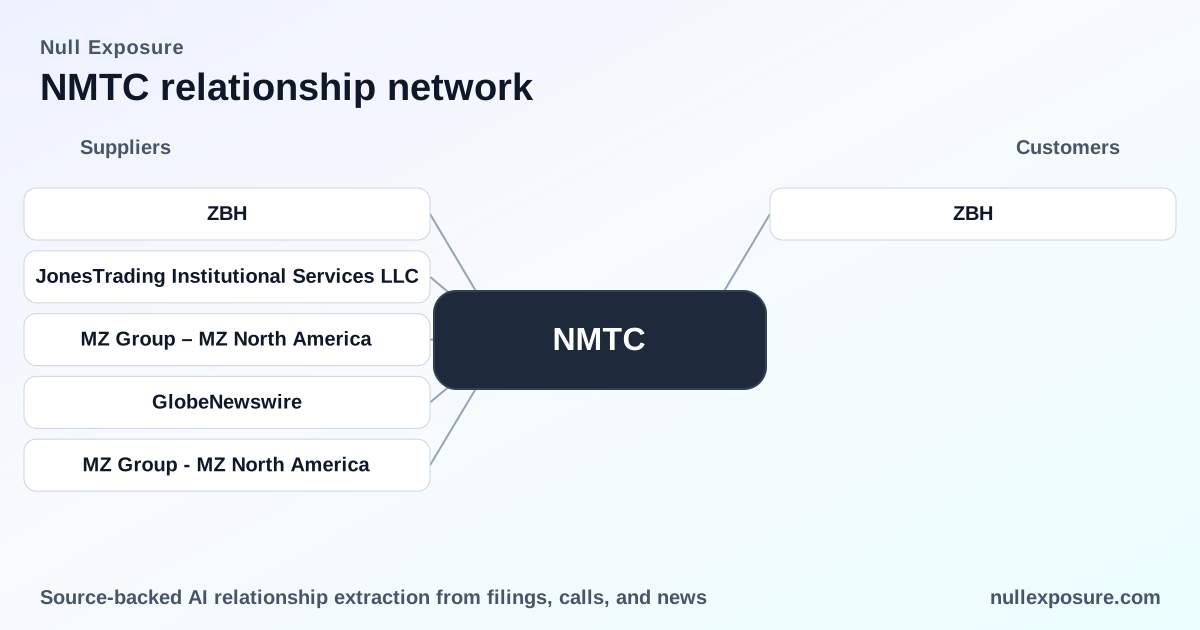
NeuroOne (NMTC) — Customer relationships and what they mean for commercialization
NeuroOne Medical Technologies develops neuromodulation devices (Evo cortical and sEEG electrodes, OneRF ablation system) and monetizes through product sales, licensing and exclusive distribution agreements — most materially a multi-year exclusive distribution arrangement with Zimmer Biomet that transfers commercialization and marketing responsibility and has produced upfront license revenue. The company is at an early-commercial stage with limited direct clinical rollout and concentrated commercial exposure to its strategic distributor; investors should evaluate revenue cadence tied to partner milestones, the ongoing limited launch, and the operational leverage Zimmer Biomet provides. For a broader signal library and relationship tracking, visit https://nullexposure.com/.
The Zimmer Biomet relationship is the commercial center of gravity
NeuroOne’s go-to-market model is built around a strategic distribution pact with Zimmer Biomet. That agreement gives Zimmer exclusive rights to distribute NeuroOne’s Evo and OneRF products and places commercialization and marketing responsibility squarely on Zimmer, which accelerates scale while concentrating revenue risk into one large partner. NeuroOne recognized an upfront license payment of $3.0 million tied to that expanded distribution arrangement; that one-time recognition drove reported license revenue in FY2025/FY2026 and materially affected near-term P&L. Source signals across filings and earnings calls indicate the partner handles global distribution and that the relationship has been in place since a 2020 agreement and expanded in late 2024.
A second look at commercial and clinical execution: NeuroOne has initiated a limited direct commercial launch with early clinical procedures reported at University Hospitals Cleveland, showing initial customer-level adoption while overall market access and scale are levered to Zimmer’s network.
If you want a consolidated view of how these relationships translate to risk and opportunity models, explore full coverage at https://nullexposure.com/.
All reported customer-related items (documented excerpts and sources)
-
Zimmer — FY2026: NeuroOne reported $3.0 million of license revenue related to a distribution license granted to Zimmer for the OneRF product in October 2024, recorded in net income for the first quarter of fiscal 2025. Source: earnings call transcript reporting (May 3, 2026) via Investing.com.
-
Zimmer Biomet — FY2026: Company commentary states Zimmer Biomet bears full responsibility for product commercialization and marketing under the 2020 distribution agreement. Source: press release / earnings-call transcript (March 10, 2026) via The Globe and Mail.
-
ZBH — FY2026: The same disclosure is reflected under the ticker ZBH, reiterating Zimmer Biomet’s commercialization role in fiscal 2026 reporting. Source: press release / earnings-call transcript (March 10, 2026) via The Globe and Mail.
-
Zimmer Biomet — FY2025: NeuroOne announced an expansion of its exclusive distribution agreement with Zimmer Biomet and reported receiving an upfront payment of $3.0 million in November 2024. Source: financial results summary (March 10, 2026) via TradingView reporting on FY2025.
-
ZBH — FY2025: TradingView’s FY2025 coverage repeats the November 2024 upfront $3.0 million payment tied to the expanded exclusive distribution pact. Source: TradingView FY2025 financial-results summary (March 10, 2026).
-
ZBH — 2025Q2: In the 2025Q2 earnings call, management emphasized building awareness through the strategic distribution partner and leveraging Zimmer Biomet’s extensive distribution network and scale to increase patient access. Source: NeuroOne 2025 Q2 earnings call transcript (March 7, 2026).
-
Zimmer Biomet — 2025Q2: The same Q2 remarks were reiterated referencing Zimmer Biomet’s market presence and role in scaling adoption within the epilepsy market. Source: NeuroOne 2025 Q2 earnings call transcript (March 7, 2026).
-
Zimmer Biomet — FY2021: A July 2020 distribution and development agreement with Zimmer Biomet provided exclusive rights to distribute Evo cortical electrodes and sEEG product line once FDA clearance is secured, documented in a corporate press release discussing executive appointments. Source: PR Newswire release (July 2020; company announcement reprinted in 2026 PR archive).
-
Zimmer — FY2026: FY2026 disclosures again reference the prior year’s net income including the $3.0 million license revenue from the expanded exclusive distribution agreement with Zimmer. Source: TradingView note on FY2026 earnings (May 3, 2026).
-
ZBH — FY2025: The company’s SEC 10-K and related summaries list the distribution agreement with Zimmer, Inc. for Evo Cortical, Evo sEEG, and OneRF Brain Ablation System as a principal commercial arrangement. Source: SEC 10-K / TradingView synopsis (FY2025).
-
Zimmer, Inc. — FY2025: Consistent with the 10-K, filings identify Zimmer, Inc. as the distribution counterparty maintaining commercialization and distribution rights for NeuroOne’s product lines. Source: SEC 10-K / TradingView synopsis (FY2025).
-
University Hospitals Cleveland — FY2026: NeuroOne initiated a limited commercial launch and reported that the first two patients were treated at University Hospitals Cleveland in the first quarter of fiscal 2026, with both patients reporting pain relief following the procedure. Source: earnings call transcript and press reporting (May 3, 2026).
What these relationships imply about NeuroOne’s operating model
- Contracting posture: NeuroOne contracts out commercialization to a single large strategic distributor, which reduces direct sales and marketing expense but creates dependency on partner execution and milestone timing.
- Concentration: The commercial model is concentrated; Zimmer Biomet is the primary distribution channel for the company’s key product lines, implying a single-counterparty revenue concentration risk.
- Criticality: Zimmer’s role is critical to broad market access and revenue scale—upfront payments can boost short-term revenue but recurring product sales depend on the partner’s commercialization success.
- Maturity: The company is in an early commercial stage: limited internal launch activity (two patients at a single hospital) complements the partner-driven rollout, indicating early clinical validation but nascent commercial traction.
These are company-level signaling points derived from filings and public remarks, not attributed to any single relationship excerpt unless explicitly named.
Investment implications — crisp takeaways
- Positive: The Zimmer Biomet partnership materially de-risks in-house commercialization cost and provides access to an established global distribution network that can accelerate adoption at scale.
- Risk: High counterparty concentration and revenue timing volatility — a single upfront payment (the $3.0 million recognized across FY2025/FY2026) demonstrates lumpiness in reported revenue and sensitivity to milestone structures.
- Early evidence of clinical utility: The limited launch and two treated patients at University Hospitals Cleveland provide initial clinical validation, but broader commercial traction is still dependent on partner rollout and reimbursement pathways.
- Financial backdrop: NeuroOne is an early-revenue, loss-making medical device company (negative EBITDA, limited revenue base) and investors should model potential lumpiness from license payments separately from recurring device sales.
For a consolidated relationship map and ongoing signal monitoring, see the NeuroOne coverage at https://nullexposure.com/.
Appendix — reporting segment constraint
NeuroOne reports one reportable segment focused on neuromodulation products (cEEG and sEEG recording, monitoring, ablation, and stimulation solutions). This company-level disclosure reinforces a focused product portfolio and limited business-line diversification, which is consistent with the concentrated distribution strategy described above. Source: company filings (reported segmentation language).