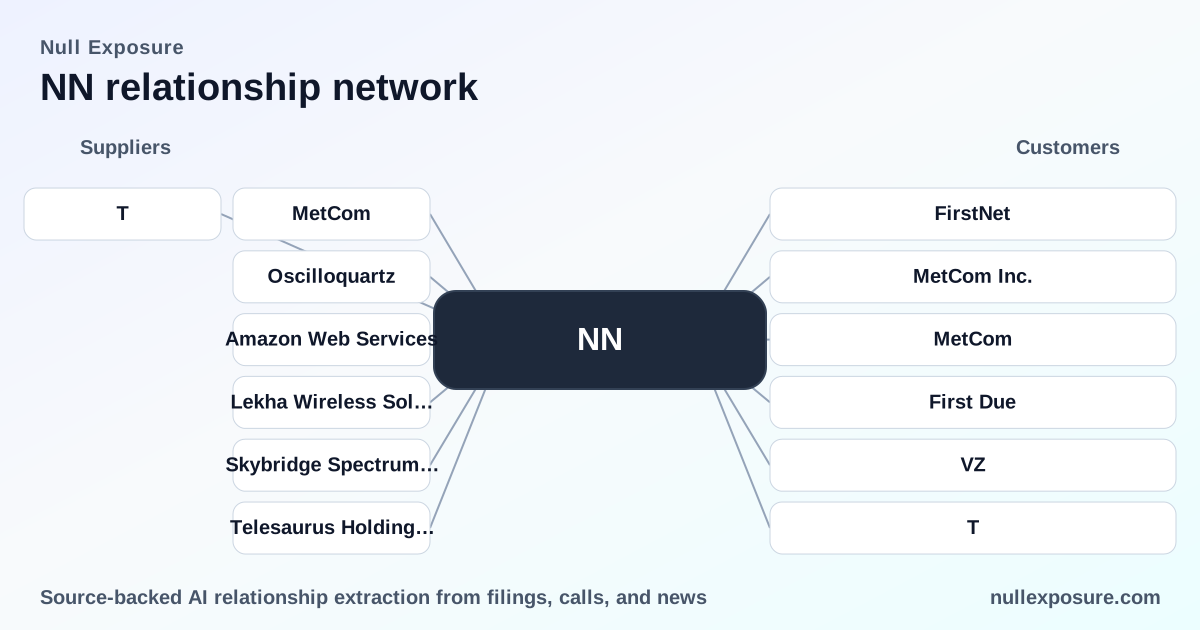
NextNav (NN): Customer Map and Commercial Signals
NextNav operates and monetizes as a technology infrastructure and licensing company built around advanced positioning, navigation and timing (PNT) products — notably the Pinnacle altimeter and a 5G-based 3D PNT waveform — selling services, equipment and intellectual property to wireless carriers, public-safety networks and enterprise partners. Revenue is generated via multi-year carrier operations agreements, licensing deals for 5G PNT technology, equipment sales and government/service contracts, positioning NextNav as a supplier of mission-critical positioning services rather than a simple consumer app vendor. Learn more about our coverage at https://nullexposure.com/.
Investment thesis up front
NextNav’s commercial traction is concentrated but strategic: a small set of large partners and carrier relationships drive the majority of near-term revenue, while licensing agreements (notably the Japan MetCom deal) demonstrate a route to international scale and recurring royalties. For investors, the trade-off is clear — high customer concentration and government/civil-critical use cases create both revenue visibility and single-counterparty risk; the company’s ability to convert spectrum/regulatory work into global licensing revenue is the key growth vector.
What the customer map actually implies for operators and investors
NextNav’s customer set has three important characteristics: concentration, carrier integration, and growing international licensing. The company discloses that three customers accounted for 57%, 18% and 11% of 2024 revenue, signaling material dependence on a handful of counterparties (company filing disclosures, FY2024). Substantially all historical revenue has been U.S.-derived, but recent deals show a deliberate move to export its 5G PNT technology internationally (investor presentation and press reports, Dec 2025–May 2026). Contracts span commercial carriers, public-safety networks and government support work — a seller posture that mixes recurring operations fees with one-off licensing and equipment receipts.
Relationship briefings — who pays and why it matters
Below are the relationships identified in public reporting and company commentary. Each entry is a concise, plain-English take with the source noted.
FirstNet
FirstNet consumes NextNav’s public-safety applications and receives enhanced 911 services delivered across national cellular networks, with FirstNet traffic supported primarily via NextNav’s partnership-enabled network operations with AT&T. This positioning underscores NextNav’s role in public-safety critical services (NN 2025 Q3 earnings call).
AT&T (T)
NextNav extended its agreement with AT&T for Pinnacle network operations through October 2028, keeping a direct operations relationship with one of the nation’s largest carriers and anchoring recurring operations revenue for the Pinnacle system (NN 2025 Q3 earnings call; investor presentation, Q4 2025).
Verizon (VZ)
Verizon is a commercial user of NextNav’s Z-axis altitude service — the same capability used in public-safety E911 — and Verizon networks already incorporate NextNav’s altitude solution outside public-safety applications, indicating broader carrier-level adoption (NN 2025 Q3 earnings call; investor presentation/Q4 2025 summary).
MetCom / MetCom, Inc.
NextNav expanded its partnership with Tokyo-based MetCom in December 2025, licensing its 5G-based 3D PNT waveform and receiver technologies to deliver terrestrial timing and positioning services in Japan’s major metropolitan areas; the deal is NextNav’s first international 5G PNT licensing arrangement and signals a scalable licensing model (Markets FinancialContent, Dec 16, 2025; Marketscreener investor presentation, Dec 2025).
First Due
First Due has integrated NextNav’s vertical location and 3D visualization into its Incident Command platform, representing an enterprise/SaaS integration use case where NextNav’s altitude data improves first-responder situational awareness (EMS1 coverage, FY2025).
T-Mobile (TMUS)
T-Mobile shows up in analyst commentary as a logical strategic acquirer in the wireless consolidation discussion surrounding NextNav; while this is a market commentary point rather than a reported customer contract, it reflects industry interest in integrating NextNav’s spectrum and PNT capabilities into major carrier footprints (Investing.com analyst coverage, May 2026).
SpaceX
SpaceX is cited in analyst and market write-ups as a credible strategic buyer given its satellite and timing ambitions; this is external strategic speculation rather than a disclosed commercial contract, but it shows the perceived value of NextNav’s timing and positioning intellectual property to non-traditional telecom acquirers (TipRanks / The Fly, May 2026).
How these relationships shape the operating model and commercial constraints
- Customer concentration and counterparty leverage. The company-reported top-three customer split (57% / 18% / 11% in 2024) establishes material revenue concentration, which creates two dynamics: clearer short-term revenue visibility tied to a few contracts, and elevated counterparty risk if any large partner alters scope or pricing (company filings, FY2024).
- Seller posture with diversified monetization paths. NextNav sells operations services, equipment and licenses. The corporate disclosures emphasize revenue from services contracts with wireless carriers, application developers and government support work — a hybrid monetization model that blends recurring operations fees and licensing royalties (company disclosures).
- Geographic base with a rising international footprint. Historically, substantially all revenue was U.S.-based, but the MetCom Japan licensing arrangement is a clear signal of an export strategy for 5G PNT technology; the company is shifting from U.S.-centric commercialization toward selective international licensing (FY2024 filings; Dec 2025 MetCom announcements).
- Government and public-safety criticality. Contracts include government and public-safety work — this confers higher revenue stickiness for some lines but also subjects the company to procurement cycles, regulatory oversight and programmatic funding constraints (company revenue description).
- Commercial maturity and scaling pathway. NextNav’s model is transitioning from network operations and domestic carrier deployments to licensing its waveform/receiver stack globally; successful replication of the MetCom license across other markets is the primary operational scaling lever.
Investment implications: risks and upside to weigh
- Upside: Licensing deals like MetCom unlock high-margin, scalable revenue beyond U.S. operations and validate NextNav’s technology as infrastructure-level PNT. Carrier renewals with AT&T and deployment within Verizon’s network validate product-market fit for altitude services.
- Risk: High customer concentration and a seller posture mean negotiating leverage resides with a few large counterparties; regulatory changes in international markets or shifts in carrier strategies could materially affect revenue. Government/public-safety contracts increase stability for certain revenue lines but also lengthen sales cycles.
Bottom line and next steps for analysts
NextNav’s commercial foundation is strong but concentrated. Carrier operations agreements and the MetCom licensing milestone create a credible path to recurring and international revenue; conversely, the top-customer concentration and government exposure are non-trivial risk factors that will determine valuation multiple expansion or compression. For deeper due diligence, focus on contract economics with AT&T and Verizon, the revenue share/timing profile of the MetCom license, and backlog or renewal visibility for public-safety contracts.
If you want continued, structured coverage of these customer relationships and how they affect valuation scenarios, visit https://nullexposure.com/ for our research updates and relationship dashboards.