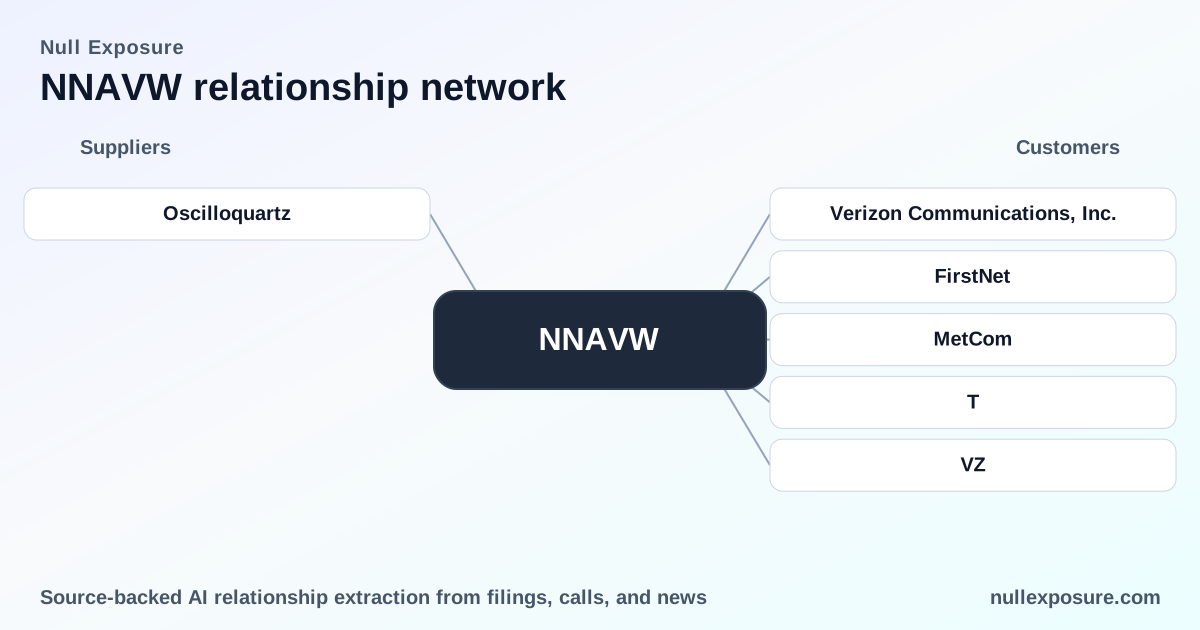
NextNav (NNAVW) — who pays for Pinnacle and why it matters
NextNav operates a nationwide 3D positioning service (Pinnacle) and monetizes through a mix of service contracts with wireless carriers, public-safety network agreements, government support work, equipment sales, and IP licensing to device/chipset partners. For investors evaluating NNAVW exposure, the commercial backbone is concentrated around a handful of large partners that both buy services and host NextNav’s Z-axis positioning in their networks; this concentration drives both upside in scale and elevated counterparty risk. Explore the company coverage and relationship detail at https://nullexposure.com/.
What investors need to know in one paragraph
NextNav sells location infrastructure and related services rather than a pure consumer product — it is a service provider and licensor that depends on large carriers and government/public-safety contracts for most revenue. Revenue concentration is high and geographically focused in North America, while product criticality is also high because Pinnacle supports enhanced 911 and FirstNet public-safety capabilities. Financially, the business is still maturing with negative operating margins and declining quarterly revenue growth, so long-term value depends on contract renewals and wider device adoption.
The customer roster — each relationship that shows up in filings and calls
Verizon Communications, Inc. (10‑K, FY2024)
NextNav reports that its Pinnacle system is primarily used for public-safety applications including enhanced 911 for Verizon, indicating Verizon is a primary commercial customer for E911 services. This is recorded in the company’s 2024 Form 10‑K as part of Pinnacle’s public-safety footprint. According to NextNav’s 2024 Form 10‑K (FY2024), Verizon is a key public-safety partner.
FirstNet (earnings call, 2025 Q3)
Management stated during the Q3 2025 earnings call that the network operating in partnership with AT&T provides enhanced 911 and public-safety applications across major cellular networks and to FirstNet, linking NextNav’s service into the dedicated public-safety broadband ecosystem. During the Q3 2025 earnings call, NextNav referenced FirstNet as a beneficiary of its network capabilities.
MetCom (earnings call, 2025 Q3)
On the Q3 2025 call, NextNav confirmed an ongoing partnership with MetCom and noted that MetCom has achieved significant milestones in their deployment journey, signaling a regional partner or systems integrator relationship that advances Pinnacle rollout. Management discussed MetCom’s progress on the Q3 2025 earnings call.
VZ (earnings call, 2025 Q3)
Management explicitly noted that the Z‑axis solution is already being used in the Verizon network beyond public-safety applications, implying commercial use-cases for vertical location inside Verizon’s footprint. This statement appears on the Q3 2025 earnings call.
AT&T (earnings call, 2025 Q3)
NextNav announced a two‑year extension of its agreement with AT&T for Pinnacle network operations through October 2028, which preserves a multi-year carrier contract and provides short- to medium-term revenue visibility for those services. This extension was disclosed on the Q3 2025 earnings call.
T (earnings call, 2025 Q3)
The earnings call entry labeled “T” repeats the AT&T extension: the AT&T agreement was extended to October 2028, reinforcing contract continuity with a major carrier. This appears in the Q3 2025 earnings call.
Verizon (earnings call, 2025 Q3)
The earnings call also referenced Verizon directly: Verizon’s network is already using NextNav’s Z‑axis outside of public-safety, confirming the carrier-level deployment cited elsewhere in filings and remarks. See the Q3 2025 earnings call.
VZ (10‑K, FY2024)
NextNav’s 2024 Form 10‑K reiterates that Pinnacle is used for enhanced 911 for Verizon, underlining the carrier’s role as a high‑visibility customer for public-safety positioning. This is documented in the 2024 10‑K (FY2024).
Verizon Communications (10‑K, FY2024)
A duplicate reference in the 2024 Form 10‑K restates that Verizon is a prominent public-safety customer using Pinnacle for E911, consistent with other filings. See NextNav’s 2024 Form 10‑K (FY2024).
How these relationships shape the operating model and investment thesis
- Concentration and counterparty scale: NextNav relies on a small group of very large customers (major carriers and public-safety networks). The company disclosed that for 2024, three customers accounted for 57%, 18% and 11% of revenue, signaling high revenue concentration centered in the United States. This concentration creates binary outcomes: contract renewals and expanded carrier integrations materially affect cash flow.
- Contracting posture: The company operates primarily as a service provider domestically, delivering network operations and support to carriers, while also acting as a licensor of receiver technology to device and chipset partners with typically no per-device royalty. These dual roles produce both recurring services revenue and strategic distribution leverage via partners.
- Criticality of service: Supporting enhanced 911 and FirstNet is inherently high-cost-of-failure work; that elevates NextNav’s commercial value but also creates high expectations around uptime, compliance, and contractual SLAs.
- Geography and market focus: Substantially all revenue is U.S.-based, and filings flag international regulatory and security risks, so the business is primarily North America‑centric with global expansion exposed to regulatory friction.
- Maturity and financial posture: Financials show an early-stage company dynamic — negative EBITDA, negative gross profit in the latest TTM, and a reliance on a few large contracts while device penetration remains limited. Revenue growth has been uneven, underscoring the need for scaled carrier and device adoption.
Key risks and upside points for investors
- Key risk — customer concentration: Three customers delivered most revenue in 2024; the loss or deterioration of any one major contract would materially affect cash flow. This is a structural counterparty risk given the carrier-focused model.
- Key risk — operating scale vs. margin: Current negative operating margins and negative gross profit indicate the company has not yet reached cost scale for consistent profitability.
- Upside — embedded public-safety value and contract extensions: The AT&T agreement extension to October 2028 and Verizon’s in‑network use of Z‑axis beyond E911 provide near-term commercial stability and avenues to expand beyond pure public-safety billing.
- Upside — licensing leverage: Licensing receiver elements to chipset and device vendors gives NextNav distribution optionality without direct per‑device royalties, which can scale adoption without linear cost increases.
For a deeper look at how these relationship dynamics map to commercial runway and contract timelines, visit https://nullexposure.com/ for the full coverage and tracking insights.
Bottom line
NextNav’s value proposition to investors is clear but binary: the company delivers critical public‑safety and commercial vertical position solutions and monetizes through large carrier and government contracts plus selective licensing. That structure produces high strategic value and high concentration risk. Investors should prioritize tracking carrier contract renewals (AT&T to 2028), ongoing Verizon deployments, and progress with device/chipset partners as the primary drivers of scale and margin improvement.