Nelnet (NNI): Customer Footprint and Contract Risk Profile for Investors
Nelnet operates as a diversified education finance and services company that earns recurring revenue from loan servicing, technology subscriptions, and payment-processing partnerships. The core monetization comes from servicing contracts (notably with the U.S. Department of Education), licensing and hosting of servicing software to third-party servicers, and subscription sales of school information systems and payment products; these streams produce a mix of large, long-duration government cash flow and smaller, higher-margin technology subscriptions. For detailed signal aggregation and relationship monitoring, visit https://nullexposure.com/.
Why customers drive valuation: concentrated, contract-driven cash flows
Nelnet’s LSS (Loan Servicing and Systems) operations are contract-centric: a handful of long-term servicing agreements generate the bulk of revenue while technology and payment services supply diversification and higher margin upside. The Department of Education alone accounted for 26% of company revenue in 2024 and represents a multi-year, long-term contract with extension options, making it simultaneously a cash-flow anchor and a concentration risk.
- Contracting posture: The company’s major relationships are structured as multi-year, often five-year base contracts with extension options, which creates predictable revenue recognition and high switching costs for counterparties.
- Concentration and criticality: Government servicing is material — a single counterparty generates triple-digit millions annually — making contract renewal events and performance risks material to near-term cash flow.
- Business maturity: Nelnet’s model blends mature, low-margin servicing scale with more growth-oriented, subscription and software offerings sold to schools and third-party servicers, providing optionality but also execution complexity.
- Geographic footprint: Revenue and long-lived assets are predominantly U.S.-centric, but Nelnet maintains an international services arm focused on Australia/New Zealand and broader APAC opportunities.
Bold takeaways: long-term, high-dollar government contracts underpin cash flow; subscription and licensing provide margin diversification; cyber and performance risks are value-relevant.
Constraints that shape partner and investment risk
Nelnet’s operating model reflects several company-level constraints that investors must price into valuation and credit risk assessments:
- Long-term contracting is a defining feature — the company discloses five-year base periods with multi-year extension options on major government contracts, which increases revenue visibility but also concentrates renewal risk.
- Licensing and hosted-software revenue is an emerging stream tied to third-party servicer relationships; this shifts some revenue from pure servicing to software-as-a-service style recurring fees.
- The customer base includes both government and individual borrowers; the former is financially material while the latter exposes the company to consumer complaint and regulatory risk.
- Geographic concentration in North America for material revenue, with international pockets in APAC that carry different growth and operational dynamics.
- Spend concentration is meaningful: department-level servicing revenue has been in the $380–$423 million range annually, placing Nelnet in a high-spend band for government contracting.
For active monitoring and signal-driven client intelligence, see https://nullexposure.com/ — the platform compiles relationship-level signals and public filings into actionable investor intelligence.
Customer relationships: what every cited source in our set reveals
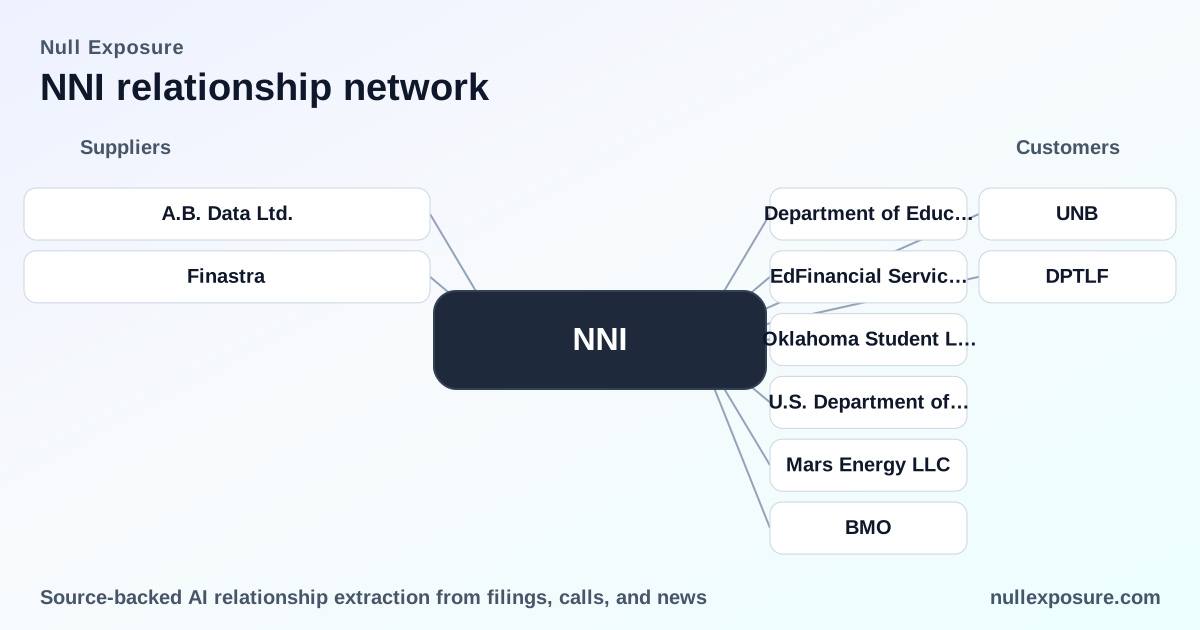
Below are concise, plain-English reads of each relationship entry pulled from public reports and news sources in the supplied results.
-
University of Louisiana System — Nelnet won a contract to provide payment services across the University of Louisiana System, underscoring the company’s role in campus payment infrastructure and revenue capture from public higher-education customers (MarketScreener, March 11, 2026: https://www.marketscreener.com/news/evan-claudeanos-named-managing-director-of-product-and-engineering-at-nelnet-campus-commerce-ce7e5cd2d081f624).
-
OSLA (Oklahoma Student Loan Authority) — Reporting indicates Nelnet supplies online technology services to other student loan servicers including OSLA, signaling Nelnet’s role as a third-party technology provider beyond its core servicing book (Yahoo News, FY2026: https://www.yahoo.com/news/articles/deadline-claim-part-nelnets-10m-202322516.html).
-
EdFinancial Services LLC — A 2022 breach disclosed that records belonging to EdFinancial were exposed in a Nelnet-related incident; this historical security event links Nelnet operational risk to third-party servicer data exposures (SiliconANGLE, Aug 2022; cited FY2022: https://siliconangle.com/2022/08/30/data-breach-nelnet-exposes-2-5-million-student-loan-records/).
-
Oklahoma Student Loan Authority (OSLA) — Nelnet Serving notified OSLA and EdFinancial about a vulnerability that led to a data event in 2022, illustrating the operational interdependence and reputational risk that accompanies servicing relationships (SiliconANGLE, Aug 2022: https://siliconangle.com/2022/08/30/data-breach-nelnet-exposes-2-5-million-student-loan-records/).
-
U.S. Department of Education — The Department contracts multiple servicers, including Nelnet, to manage the federal student loan portfolio; that contracting backdrop places Nelnet in the role of a major government contractor for federal loan servicing (CNBC, Sept 15, 2025: https://www.cnbc.com/2025/09/15/student-loan-servicer-transfer-can-come-without-notice-what-to-know.html).
-
Edfinancial (news) — Multiple reports note Nelnet provides online technology services to Edfinancial, reflecting Nelnet’s licensing/hosting role for peers and the diversification of its customer base into other servicers (CTInsider and Yahoo News, FY2026: https://www.ctinsider.com/news/article/nelnet-settlement-file-claim-ct-data-breach-21954761.php and https://www.yahoo.com/news/articles/deadline-claim-part-nelnets-10m-202322516.html).
-
OSLA (CTInsider) — Local coverage reiterates Nelnet’s technology service relationship with OSLA, reinforcing the company’s multi-channel exposure to state authorities and other servicers (CTInsider, FY2026: https://www.ctinsider.com/news/article/nelnet-settlement-file-claim-ct-data-breach-21954761.php).
-
Nelnet Servicing / Department payment — A government payment data point recorded a $27 million payment to Nelnet Servicing LLC from the Department of Education, demonstrating sizable, discrete cash flows under servicing contracts (QuiverQuant government contract update, FY2025: https://www.quiverquant.com/news/Government+Contract+Update%3A+%2427M+payment+to+NELNET+SERVICING+LLC).
-
BMO Harris Bank (BMO) — Nelnet’s U-fi partnership with BMO Harris provides private student loan and refinancing channels through a bank partner, highlighting distribution partnerships that expand Nelnet’s financing products (PR Newswire, FY2020: https://www.prnewswire.com/news-releases/bmo-harris-bank-and-nelnet-partner-to-create-private-student-loan-financing-options-301153246.html).
-
Mars Energy LLC — Mars Energy acquired Nelnet Renewable Energy, indicating Nelnet has divested non-core solar construction assets to focus on core services (MarketScreener, FY2026: https://www.marketscreener.com/news/earnings-flash-nni-nelnet-inc-posts-q4-adjusted-eps-1-56-per-share-vs-factset-est-of-1-63-ce7e5cd9d18cf320).
-
BMO (duplicate entry) — The same PR Newswire release again documents the BMO partnership, reinforcing that the partnership is a previously disclosed strategic distribution arrangement (PR Newswire, FY2020: https://www.prnewswire.com/news-releases/bmo-harris-bank-and-nelnet-partner-to-create-private-student-loan-financing-options-301153246.html).
-
Union Bank (UNB) — Nelnet serviced FFELP and private education loans for Union Bank, with portfolio balances noted in the company 2024 10‑K, indicating legacy private loan servicing relationships with regional banks (Nelnet 2024 10‑K, FY2024: nni-2024-12-31).
-
UNB (duplicate entry) — The 10‑K repeats the Union Bank servicing figures, documenting continued servicing volumes across 2022–2024 and underscoring recurring contractual servicing work (Nelnet 2024 10‑K, FY2024: nni-2024-12-31).
-
DPTLF / Department servicing — Nelnet’s 2024 10‑K explicitly states the company earns loan servicing revenue from a servicing contract with the Department, highlighting the formal contractual basis for material government revenue (Nelnet 2024 10‑K, FY2024: nni-2024-12-31).
-
Department (duplicate) — The 10‑K’s multiple references to the Department servicing contract confirm the Department of Education is a major, active customer driving a material share of LSS revenue (Nelnet 2024 10‑K, FY2024: nni-2024-12-31).
Investment implications and risk checklist
- Upside: Predictable, high-dollar government cash flows and subscription/licensing optionality support stable EBITDA conversion and multiple expansion if growth in software-hosting continues.
- Downside: Customer concentration with the Department and historic cyber incidents elevate contract renewal, regulatory, and reputational risk; investors should monitor contract milestones and security remediation timelines.
- Monitoring priorities: Department contract performance, renewal/extension notices, licensing uptake by third-party servicers, and any new material disclosures related to data security or consumer disputes.
For a consolidated feed of relationship signals and ongoing monitoring that ties these public disclosures into investment-grade alerts, explore our platform at https://nullexposure.com/.
Bold conclusion: Nelnet’s valuation is driven by a dual dynamic — government-servicing scale that secures large, multi-year cash flows, and software/licensing channels that create growth optionality; investor returns will depend on contract retention and operational resilience.