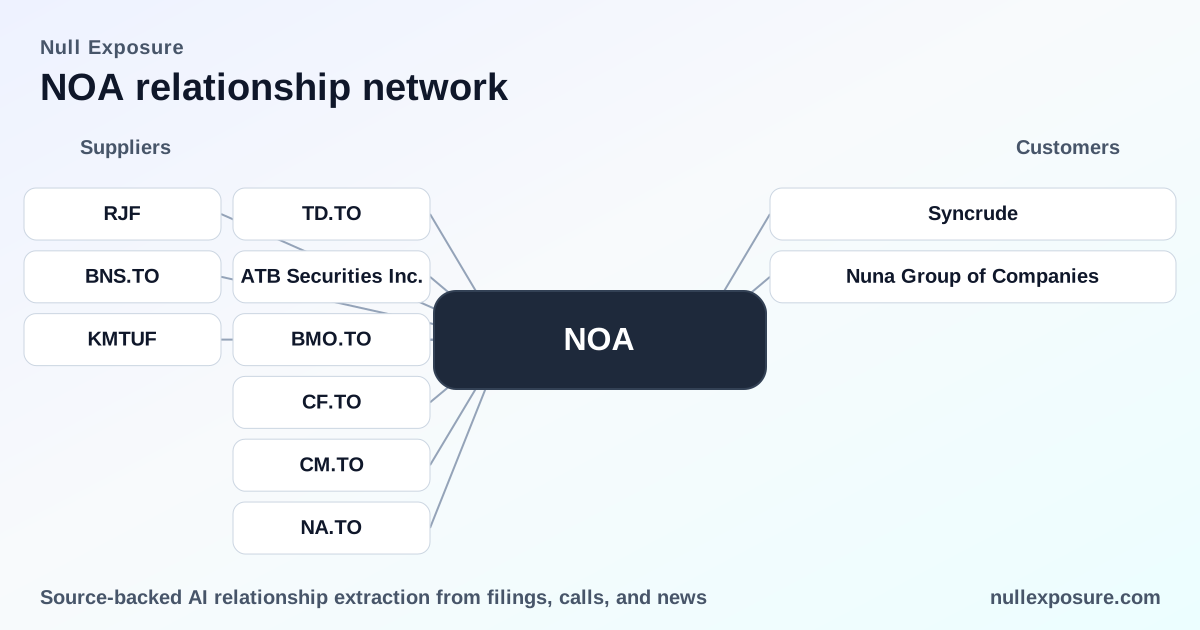
North American Construction Group (NOA) — customer map and what it means for investors
North American Construction Group operates as an end-to-end mining and heavy-construction services provider, monetizing through fixed-price and cost-plus contracts, equipment fleet utilization, and joint-venture participation on large resource and infrastructure projects. Revenue drivers are project cadence, equipment deployment, and joint-venture throughput; earnings sensitivity tracks contract scopes and weather-driven site availability. For a concise company overview and model context, see https://nullexposure.com/.
Why customers matter more than headlines
NOA’s earnings profile is driven at the site level: a handful of large mining contracts and affiliated joint-ventures produce outsized swings in reported Heavy Equipment and joint-venture revenue. Recent filings show two structural forces at work: scope contraction at legacy oil-sands clients and volatile JV/affiliate contributions. The combination produces episodic revenue shocks rather than steady linear growth.
- Contracting posture: NOA runs project- and alliance-style contracts that allocate risk and reward by site; alliance arrangements increase operational interdependence with counterparties and amplify weather/operational exposure.
- Concentration: Oil-sands and large mine customers dominate Heavy Equipment revenue, creating single-client sensitivity when scopes are reduced.
- Criticality and maturity: Services are operationally critical to mine and construction clients, but revenue maturity depends on discrete project phases (pre-stripping, reclamation, stream diversions) rather than recurring contracted hours.
For more situational intelligence on customer-level trends and how they connect to corporate P&L, visit https://nullexposure.com/.
Customer readout — line-by-line takeaways
Below are the customer and affiliate mentions drawn from the company’s recent releases; each entry is a concise investor-focused snapshot with source context.
Kearl mines (FY2026)
Kearl underwrote a stream-diversion ramp-up that partially offset otherwise lower Heavy Equipment revenue in Canada; the company specifically cites Kearl as a positive contributor in FY2026. According to NOA’s FY2026 results press release on GlobeNewswire (March 11, 2026), the stream-diversion project at Kearl helped mitigate declines in other areas (https://www.globenewswire.com/news-release/2026/03/11/3254197/0/en/North-American-Construction-Group-Ltd-Announces-Results-for-the-Fourth-Quarter-and-Year-Ended-December-31-2025.html).
Syncrude (FY2025)
Reduced scopes at Syncrude materially weighed on Heavy Equipment — NOA reports a decline in Canada equipment revenue tied directly to smaller Syncrude scopes and lower overburden/reclamation activity. This observation comes from the company’s third-quarter FY2025 results release (GlobeNewswire, November 12, 2025) documenting a year-over-year decline in that segment (https://www.globenewswire.com/news-release/2025/11/12/3186874/0/en/North-American-Construction-Group-Ltd-Announces-Results-for-the-Third-Quarter-Ended-September-30-2025.html).
Carmichael mine (FY2026)
Carmichael’s output was pronouncedly affected by above-average wet weather late in the quarter, with the impact amplified by the alliance-type contract in place at the site. NOA flagged the weather-driven disruption in its FY2026 press release (GlobeNewswire, March 11, 2026), noting operational effects specific to the Carmichael alliance (https://www.globenewswire.com/news-release/2026/03/11/3254197/0/en/North-American-Construction-Group-Ltd-Announces-Results-for-the-Fourth-Quarter-and-Year-Ended-December-31-2025.html).
Syncrude mines (FY2026)
NOA reported a 10% decline in Heavy Equipment — Canada revenue, attributing the fall to reduced scopes at the Syncrude mines and the divestiture of an ultra-class 797 fleet, partially offset by Kearl activity. The FY2026 company statement on GlobeNewswire explicitly connects the Syncrude scope reductions and fleet sale to the drop in equipment revenue (GlobeNewswire, March 11, 2026).
Mikisew North American Limited Partnership (FY2026)
Reduced activity from Mikisew was a meaningful contributor to a 43% decline in revenue generated by joint ventures and affiliates (net of eliminations) in FY2026, as NOA documents updated project forecasts and lower affiliate throughput in its FY2026 release (GlobeNewswire, March 11, 2026).
Nuna Group of companies (FY2026)
The Nuna Group’s lower revenue contribution factored into the same 43% drop in JV and affiliate revenue noted for FY2026, with NOA calling out weaker Nuna volumes in its FY2026 press release (GlobeNewswire, March 11, 2026).
Nuna Group of Companies (FY2025)
NOA had already reported decreased volumes from the Nuna Group in FY2025, linking an 8% reduction in JV and affiliate revenue to lower Nuna activity in the third-quarter FY2025 results statement (GlobeNewswire, November 12, 2025).
What the relationship map implies for financials and risk
The customer list and the narrative in NOA’s releases reveal clear investment signals:
- Revenue volatility is structural. Joint-venture revenue swung from $67.1M to $38.4M year-over-year (per FY2026 commentary), demonstrating the scale of affiliate-driven volatility that investors must model explicitly.
- Client concentration compresses predictability. Repeated references to Syncrude, Kearl and Nuna show that a small number of sites drive meaningful share of equipment and JV revenue; any scope reductions at these clients drive corporate-level revenue declines.
- Operational risk is idiosyncratic and seasonal. Weather disruptions (Carmichael) and scope cadence at oil-sands clients create episodic earnings pressure; these are execution and timing risks, not structural demand failures.
- Asset strategy matters to margin. The divestiture of the ultra-class 797 fleet is a capital allocation decision that reduced equipment-related revenue but can improve return on capital and reduce maintenance / ownership risk.
From a valuation lens, the company trades at a trailing P/E around 17.7 with a forward P/E near 7.7, and institutional ownership around 72.6%, indicating professional investor interest despite cyclical client exposures (company data, latest available periods).
Bottom line — what investors should watch next
- Syncrude scope updates and contract renewals will drive near-term equipment revenue direction.
- JV activity (Mikisew, Nuna) is the single largest swing factor for reported affiliate revenue; forecast accuracy for these projects is critical to earnings guidance.
- Site-level weather and alliance arrangements (as at Carmichael) introduce outsized operational risk that investors must factor into quarterly timing.
- Asset disposition strategy (fleet sales) will shift revenue composition away from equipment rentals and toward service and project revenue, improving capital intensity if executed cleanly.
Key takeaway: NOA’s revenue profile is concentrated and project-driven; valuation upside depends on tighter predictability of JV throughput and stabilization of scopes at core oil-sands customers. For deeper tracking of customer-level developments and to integrate these relationship signals into model scenarios, visit https://nullexposure.com/.